Wands · Ace of Wands
Ace of Wands — A Living Branch Held by a Hand from the Clouds
What is the hand holding a sparking branch offering you? Follow the gaze of the picture and consider the nature of the beginning this card describes.
『Ace of Wands』 — what this card actually draws
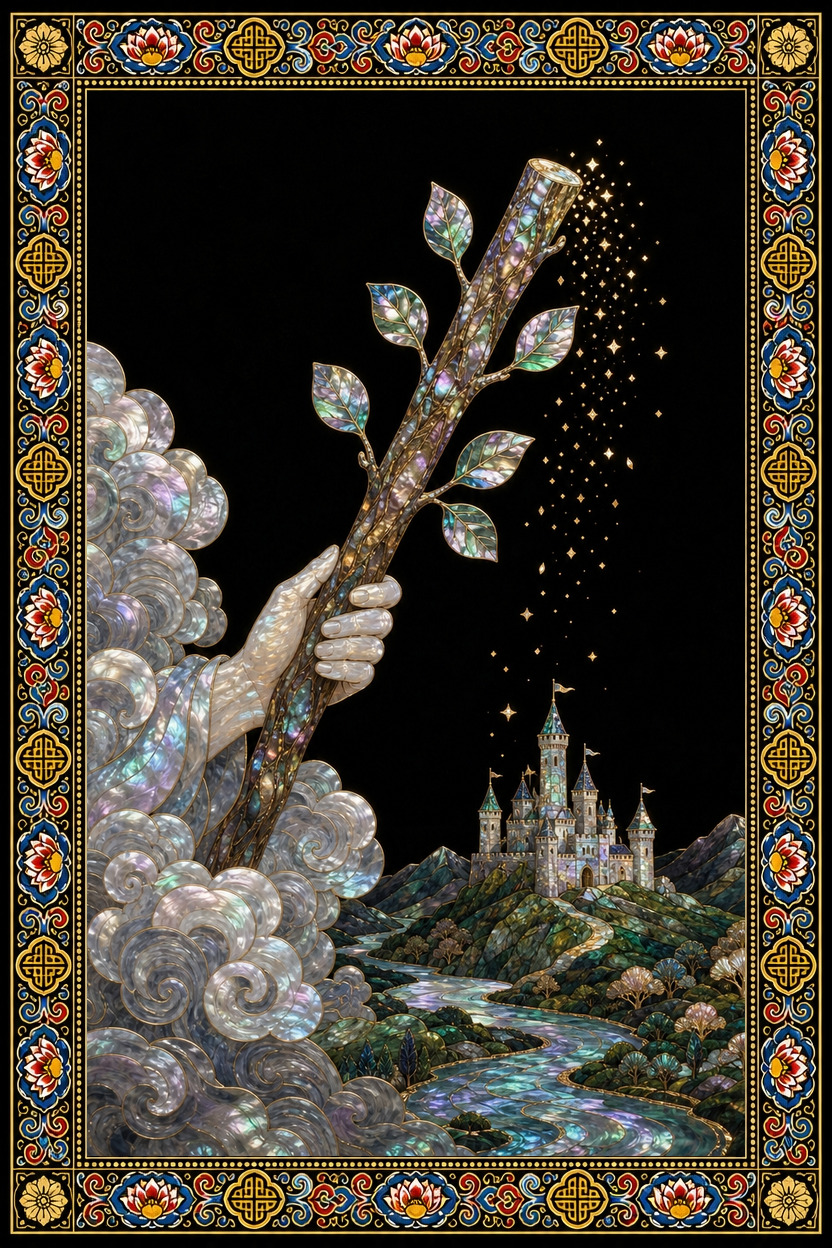
At the top of the image a billowing pearl-coloured cloud swells, and from within it a single hand emerges. The hand does not grip a smooth wand but a thick branch bearing leaves and flower buds. From the tip of the branch, small sparks stream out as if scattering.
Lower your gaze and gentle green hills and a river unfold, and across the river stands a castle with several pointed spires rising from it. The hand and branch dominate the image while the castle recedes small, making it clear what the protagonist of this scene is.
The leaves and buds on the branch look alive even though the branch has already been cut. So the picture reads less like a finished tool than like the moment a force that has only just begun to grow is taken in hand.
Symbols and meaning
The hand from the cloud signifies a stimulus handed over from somewhere that is not a person's own domain. To grip the branch means that stimulus has been seized and made yours, and the sparks flying from its tip show energy spreading out without yet having chosen a direction. So upright, this card reads as a signal to turn the impulse now in your hand into movement rather than waiting for a plan to ripen.
That the branch carries leaves and buds also matters. It is not a finished result but a material holding the room to bloom later. The castle and river below tell you that this beginning is not floating in empty air but touches a real place.
Reversed, the same branch becomes one slipping from the hand. It points to a state in which the will is there but no object has been chosen to grasp, or, conversely, in which the start is rushed forward without the strength to carry on being prepared. Cases where energy is scattered as the sparks scatter in all directions belong here too.
When this card appears
At work, there is a start you have long put off. It reads as meaning you are better off taking the first step with the materials now in hand than with a perfect plan. In relationships, it becomes a signal to be the one who speaks first or expresses their feelings.
With money, it means a source of income or a first investment — capital that corresponds to a seed — is before your eyes. But just as the branch is not yet fruit, at this stage it is better to attend to the beginning itself than to the harvest. In a place of choice, it appears as a request to take hold of one among several possibilities and set a direction.
When your mind branches out in many directions the way sparks scatter from the tip of the branch, this card tells you to choose one of them and grasp it. It might be put into words like this: "Even if what you hold now looks small, first decide where you will plant that branch."
History and culture: card printing — woodblock, stencil, lithograph
The lines that make up this card's branch and leaves are bound up with the circumstances of woodblock printing. In fifteenth-century European cards, the outline was printed from an engraved block and colour was then laid on with stencils, which required thick, simple outlines so the colour would not bleed. The leaves and buds on the branch being drawn as clear masses are shapes well suited to this process.
In eighteenth-century France, mass production was achieved by printing several plates over one another, with colour engraved separately for each plate. From then on the same image passed through far more hands. Delicate textures like the ripples of the cloud are elements that survive only with skill in overprinting plates.
Nineteenth-century lithography and chromolithography allowed colour to be handled far more freely. It is thanks to this technology that the hand and branch, the cloud and the hills could be separated into distinct colour planes and printed. Yet this card's imagery also shows traces of the simple outlines of the earlier woodblock period, long preserved.
Common misreadings
This card is often taken as a universal signal to set off. But the branch in the picture is buds, not fruit, and the castle is still across the river. You should see together that the beginning is open but the distance to fruition remains.
It is also hasty to settle on the reversed card as failure or frustration. Dropping the branch is closer to meaning that the direction has not yet been decided. Read as a process of choosing again what to grasp, it becomes far more useful.
Another point: some see the sparks as an ominous sign. The sparks in the picture are closer to a small light reaching out from the hand. See them not as a frightening signal but as energy not yet given form, scattering.
Draw a card yourself
The picture you have just read can be placed against your own question. The same card answers differently when the question changes.
- A deck drawn in-house — 78 cards in the colours of nacre and dancheong
- Readings that read the picture, not a keyword list
- Keep asking — draw one more card for your next question
- A record you can return to and compare
- Let a friend draw for you with a single link
- Seventeen languages, one deck, one reading
More from this suit

