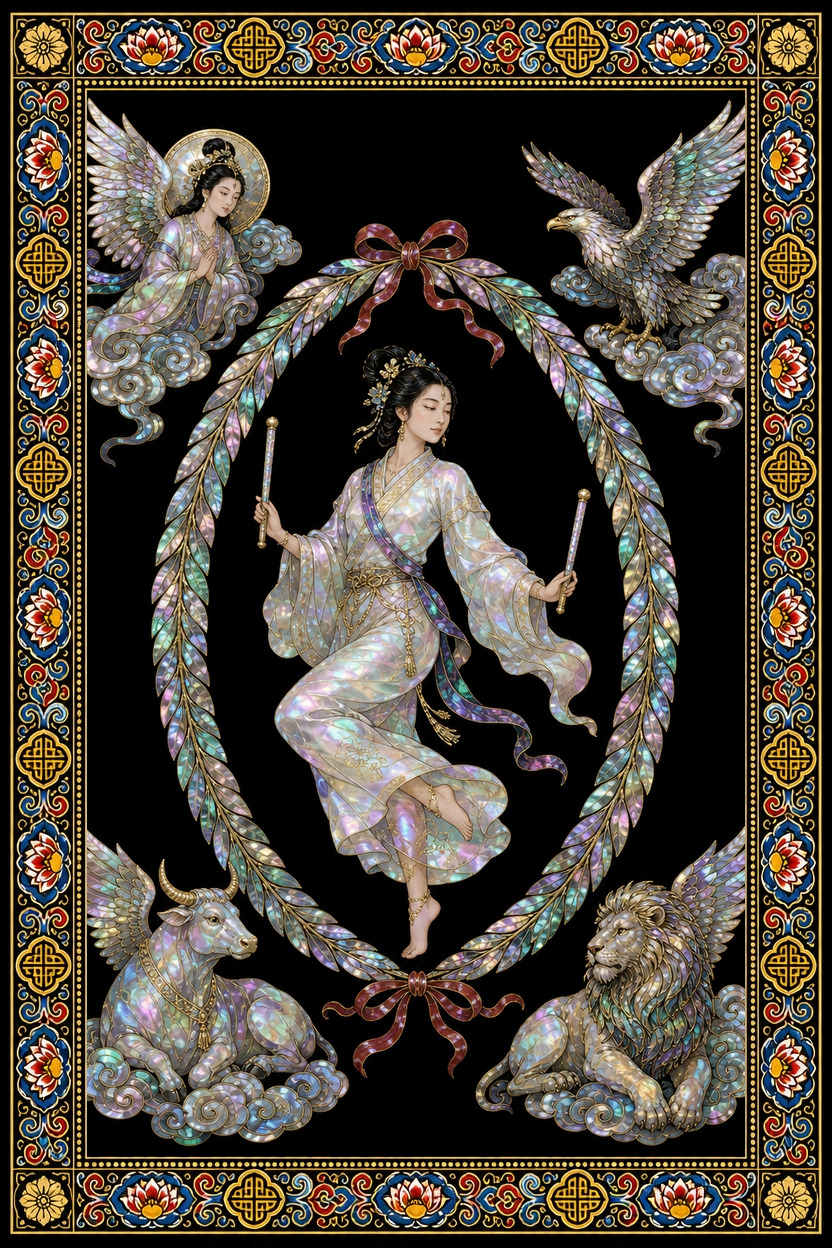
Major Arcana · The World
The World — A Dance with Two Wands Inside a Ring of Flowers and Ribbons
Does the word completion always mean an ending? The ring in The World shows a place that is closed and yet leads on again.
『The World』 — what this card actually draws
At the centre of the image lies a large oval ring. The ring is woven of flowers and ribbons, and inside it stands a woman in a white long robe (traditional dress). She holds one wand in each hand, and her body tilts slightly as if she is dancing.
Moving your gaze outward, four beings take their places at the four corners of the ring. An angel, an eagle, a bull and a lion each hold one side. They form an arrangement that surrounds the figure inside from beyond the ring, and the whole picture is completed in a composition held within a single frame.
Inside and outside the ring are clearly divided, yet they face each other, and that is the impression this image leaves. The figure moves within the ring, and the four beings seem to watch over that movement from outside.
Symbols and meaning
The ring woven of flowers and ribbons is a closed shape, a single cycle. Being closed does not mean there is nothing left to fill; it reads as meaning that the process already passed through has come together into one form. The dancing posture, wands in hand, shows that the person who has reached the end is not standing still but is still moving.
The angel, eagle, bull and lion at the four corners face the same centre from different directions. Here arises the reading that integration happens when disparate things keep their own places within a single frame. So the completion of this card is less a state gained by adding something than a state in which the elements already present have found their places.
Placed reversed, the same image reads in a different way. If you imagine the ring failing to close, one side gaping open, the remaining knots and unfinished tasks come into view. The card then arrives not as a signal to hurry the ending but as a question: check which knot is still left.
When this card appears
At work, it reads as a phase in which a task you have held for a long time takes shape. Still, you should distinguish for yourself whether that shape is the final version or the end of one cycle. In relationships, it is a point to examine whether two different people are forming a single frame while each keeps their own place.
In money, you can picture a flow in which resources scattered across several branches are gathered into one picture. Before a choice, check what knots remain rather than whether every condition is in place. The closer you are to completion, the more the final check decides the outcome.
Picture the figure inside the ring still dancing, and a sentence like this comes up: "I've come all the way to the end, so why do I still feel something is missing?" This is not because achievement is lacking; it is an invitation to look together at where the unclosed place is.
History and culture: French fortune-telling and the occult rearrangement
This card is number 21, the last position. If we take as a premise that the 78-card system began as a card game, the weight of this number is interesting. When the numbers used in playing cards were carried over into a fortune-telling system, the position of "last" itself acquired meaning.
In card use around the time of Mademoiselle Lenormand, numbers were closer to markers indicating the order of an arrangement. Later, as strands such as those of Éliphas Lévi and the Golden Dawn added layers of Kabbalah and astrology onto the cards, the number 21 and the four corner beings came to be read again as symbols pointing to cosmic order.
There is something to separate here. The ring and flowers, the two wands, the four beings are a layer that was in the picture from the start. The metaphysical interpretation given to the number, by contrast, is a layer added later. Overlay the two layers, but keep the attitude of not mixing what is actually drawn in the picture with later interpretation and stating it as settled fact.
Common misreadings
Many read The World as meaning everything is over. But the figure in the image is still dancing, and the ring sits in a place from which it can lead on to the next cycle. Completion is not a standstill but the closing of one round.
There is also the misreading that takes this card as a guarantee of success. What the image shows is not a guarantee of results but a state in which form has been achieved. What has been achieved and what remains is for the reader to judge in their own situation.
When it appears reversed, some conclude that they have failed. Having knots left means there is still room to work on them, not that it cannot be undone.
Draw a card yourself
The picture you have just read can be placed against your own question. The same card answers differently when the question changes.
- A deck drawn in-house — 78 cards in the colours of nacre and dancheong
- Readings that read the picture, not a keyword list
- Keep asking — draw one more card for your next question
- A record you can return to and compare
- Let a friend draw for you with a single link
- Seventeen languages, one deck, one reading
More from this suit

