Major Arcana · Judgement
Judgement — The Trumpet, the Open Coffins, the Raised Arms
What does the trumpet wake, and what are the people rising from the open coffins lifting their arms toward? This piece follows the gaze built into the picture and reads Judgement as a tool for reflection.
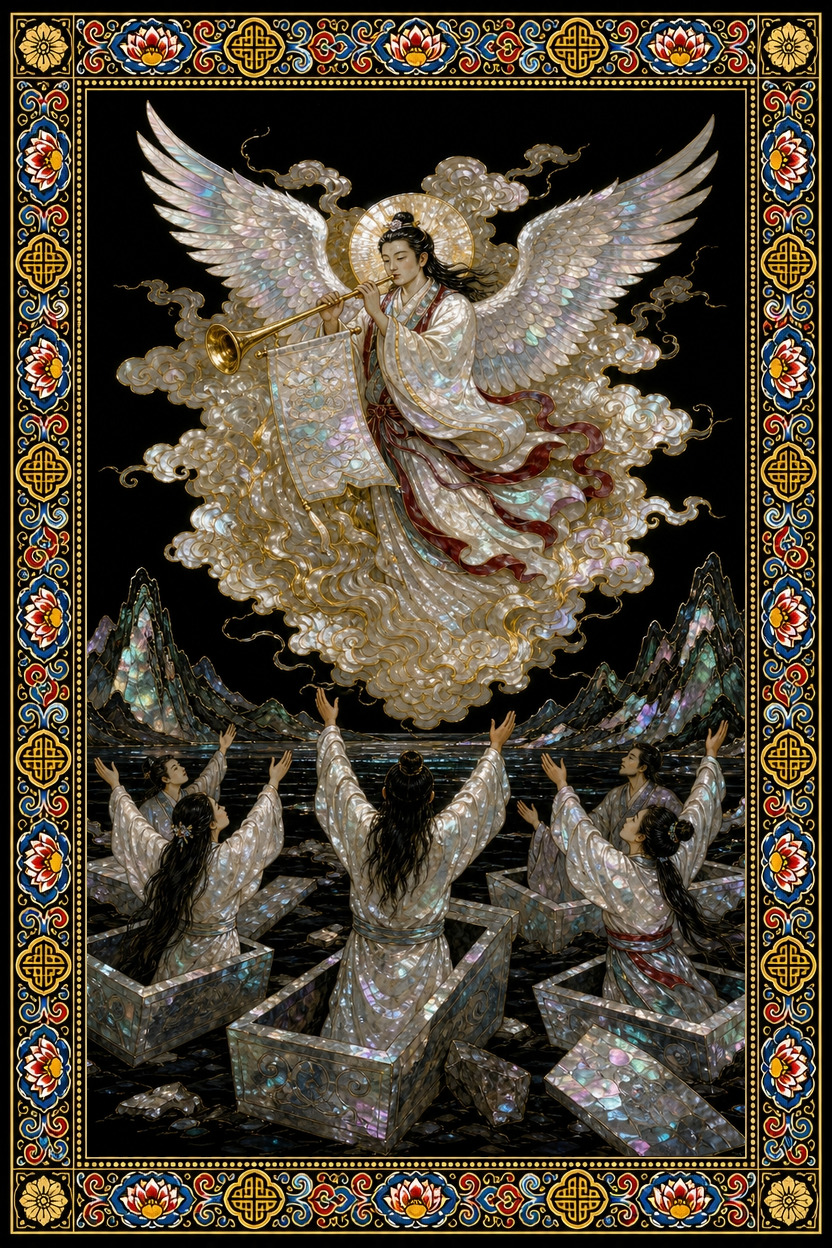
『Judgement』 — what this card actually draws
Across the top of the image a bank of cloud is spread, and above that cloud stands an angel with wings outspread. The angel holds a trumpet to its lips and blows downward, and a banner hangs from the end of the trumpet. The eye follows the trumpet down almost on its own.
Below, coffins with their lids thrown open lie scattered about, and people are rising out of them. Each figure has lifted an arm, leaning out beyond the coffin. The coffins are drawn open, not buried in the ground.
Behind the people rise mountains with a nacre-like sheen. The mountains are set larger than the figures and give the background its weight, while the coffins and people in front sit beneath them. The composition is arranged so the eye travels from top to bottom and then back to the mountains behind.
Symbols and meaning
The trumpet reads as a sound ringing from outside and, at the same time, as a signal waking something within. What matters is that the coffins do not open by themselves: they open in response to a sound blown from above. The awakening in this card is therefore less a sudden event than a matter of noticing what was already in the mind.
The posture of the people rising from the coffins is not passive. Lifting the arms is a gesture of receiving and a gesture of answering at once. When reflection goes too far and hardens into self-evaluation, this gesture disappears, and only a verdict passed on oneself is left.
Reversed, the same picture works differently. It can be seen as a state in which the trumpet is heard but the head is not turned, or one in which, standing before an open coffin, you try to shut the lid of the past again. When self-criticism runs too deep, avoidance is easily chosen in place of renewal.
When this card appears
At work, a long-postponed clearing up may come to the fore. This is a moment for deciding whether to keep repeating what you have been doing or to assess your way of working so far and correct it. If the word calling sounds too grand, start by naming the thing that weighs on your mind most right now.
In relationships, the wish to pass judgment on the other person and the wish to look back at yourself pull in different directions. Rather than dredging up the past to settle who was right, it is better to ask what you learned from it. In money matters, this reads as a time to review income and spending thoroughly, all at once.
Faced with a choice, you may feel the pressure of not being able to turn back. What is needed then is not to rush the conclusion but to admit the answer you already knew.
"Have you already settled the answer inside and are only pretending you haven't decided yet?"
History and culture: figures East and West — immortals, emblems, diagrams
What stands out in this card is that all the figures lift their arms upward and face the same direction. European emblem books and astrological diagrams often arranged several figures repeating a single gesture, so that the whole picture pointed toward one proposition.
In East Asian paintings of immortals or Buddhist iconography, by contrast, each figure has its own gaze and attributes, and individual narratives stay alive. Illustrations in Confucian ritual texts do the opposite, laying out posture and position in orderly rows according to norms. The Judgement card sits between these: it binds the figures into a standardized gesture while marking each one's place with the coffin as an attribute.
The posture of the angel blowing the trumpet also follows the grammar of the diagram tradition. A composition that sets the direction of the whole image through the single act of making sound is closer to drawing relationships and calls than to drawing a figure's inner life. The power of this card comes not from faces but from the direction of bodies.
Common misreadings
Judgement is often read only as a final verdict or a judgment seat. But what the picture shows is not a posture waiting for punishment but one answering with lifted arms. This card puts its weight on awakening and renewal rather than condemnation.
It is also hard to assert that this card always means a time requiring a great decision. The coffins in the picture are already open, and the people are already standing. In other words, the card reads more naturally as a signal to notice a change already under way than as a prediction of a new event.
It is a shame, too, to see the reversed position only as a bad omen. Reversed is closer to a mirror showing a state in which self-criticism has grown excessive. Precisely at such times, check whether the standard by which you judge yourself has become too harsh.
Draw a card yourself
The picture you have just read can be placed against your own question. The same card answers differently when the question changes.
- A deck drawn in-house — 78 cards in the colours of nacre and dancheong
- Readings that read the picture, not a keyword list
- Keep asking — draw one more card for your next question
- A record you can return to and compare
- Let a friend draw for you with a single link
- Seventeen languages, one deck, one reading
More from this suit
