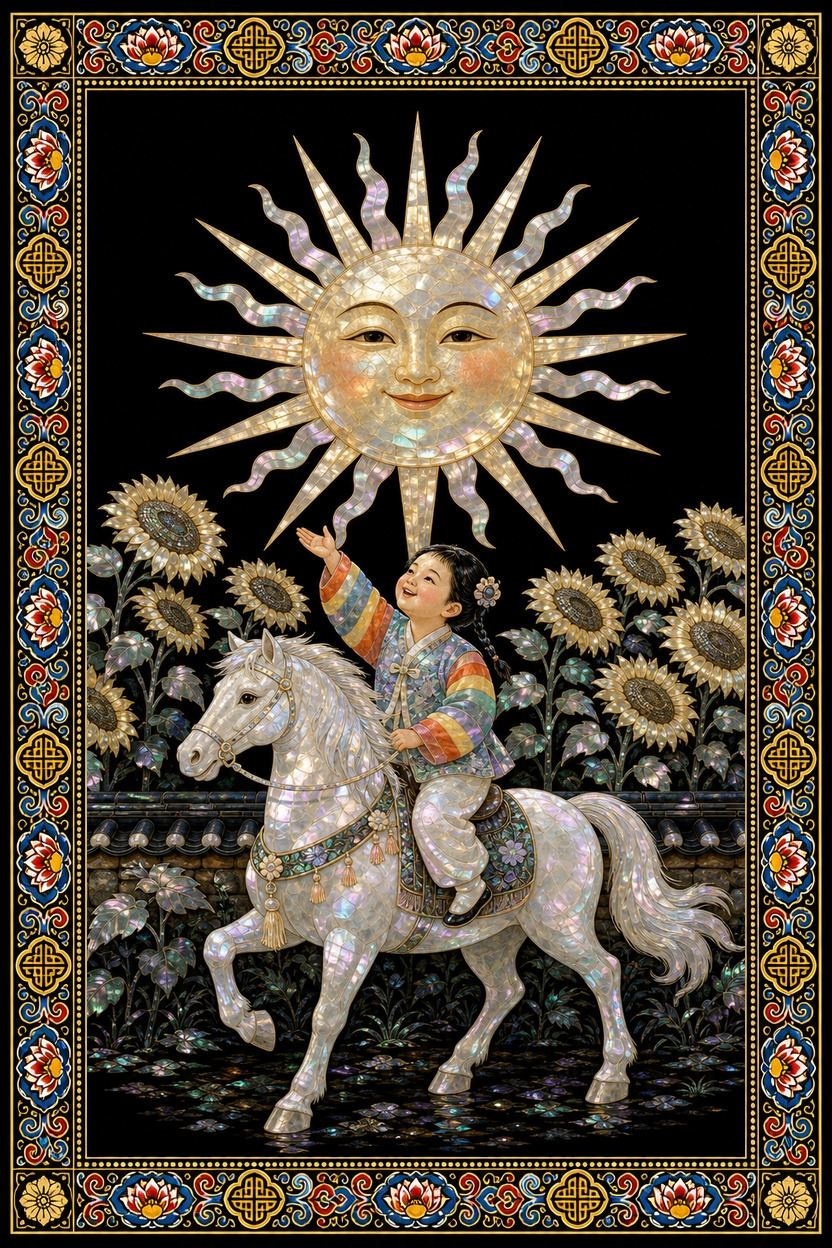
Major Arcana · The Sun
The Sun — a child on a white horse beneath wavy rays
Why is the sun's face smiling? Following the child's raised hand and the wavy rays, let us look at what this card illuminates, and also sort out the story of its origins.
『The Sun』 — what this card actually draws
At the top of the image sits a sun with a smiling face. Wavy rays stretch out in every direction from the sun's face, and that light reaches down to touch the figures below.
Lowering your gaze, you find a child dressed in a brightly coloured short jacket (the short jacket of long robe) riding a white horse. The child faces forward with one hand raised, and the horse stands with reins attached.
Behind the child stretches a field of sunflowers, and beyond it a tiled wall runs across. The composition layers the sun, the child, the horse, the flowers, and the wall onto a single picture plane.
Symbols and meaning
The central point of this card is that the sun's face is smiling. The way the light spreads in all directions is a pictorial rendering of the act of illuminating and revealing something, so upright it reads as a current in which things become distinct and confidence takes hold.
The child's posture on the horse, hand raised, touches on an attitude of fearless exposure. The bright clothing of the short jacket adds the same tone, showing a state in which joy and vitality are not hidden inside but brought out.
Conversely, one can imagine when this picture dims. Joy is hard to see, as though the sun were covered, and the child who raised a hand lowers an arm for a while — that season is the flavour of the reversed card. Delayed success or exhaustion is best understood not as light that has vanished but as light that has been obscured.
When this card appears
In work, it reads as a place where results come into view as much as the sun shines. It is a current in which something long prepared is recognized, or a blocked problem becomes clear. Yet just as the light is strong, a burden about being exposed comes with it.
In relationships, the attitude of not hiding feelings becomes the topic. The one who steps forward brightly, like the child in the short jacket, has the advantage, but keep in mind that excessive optimism can miss the other person's pace.
In money and choices, judgment tends toward clarity rather than blurring. When reversed, however, you should first look at a state where results are delayed or motivation has sagged. This card is often summed up in the sentence: "The sun is smiling, so do not hide now — bring it out into the open."
History and culture: the Egyptian origin myth and its refutation
In the eighteenth and nineteenth centuries, the claim spread that tarot originated from Egyptian mysteries, and Court de Gébelin pressed this in his writings. However, once the deck's origins in play were confirmed, that claim was refuted in the literature.
What to note in this card's iconography is the sun's face and the wavy rays. Such personified suns were a common expression in European prints and popular imagery, so they differ in character from a rendering of the Egyptian sun god.
The child, the horse, the sunflower field, and the tiled wall are likewise familiar materials in the European print tradition. The Egyptian origin story cannot serve as grounds for explaining this card's picture, and the iconography is more accurately read within European print culture.
Common misreadings
Some conclude that when The Sun appears, everything will work out. But this card speaks only of being illuminated and revealed; it does not guarantee outcomes. An exposed position carries a responsibility that goes with it.
Seeing the reversed card only as an ominous sign is also a misreading. Since it is closer to the sun in the picture being obscured rather than gone, it is enough to read it as a period when joy dims for a while and motivation drops.
Some interpret the child only as pure immaturity. But this child faces forward confidently on the horse with a hand raised, so in this card the weight falls on the side of the courage to be revealed.
Draw a card yourself
The picture you have just read can be placed against your own question. The same card answers differently when the question changes.
- A deck drawn in-house — 78 cards in the colours of nacre and dancheong
- Readings that read the picture, not a keyword list
- Keep asking — draw one more card for your next question
- A record you can return to and compare
- Let a friend draw for you with a single link
- Seventeen languages, one deck, one reading
More from this suit
