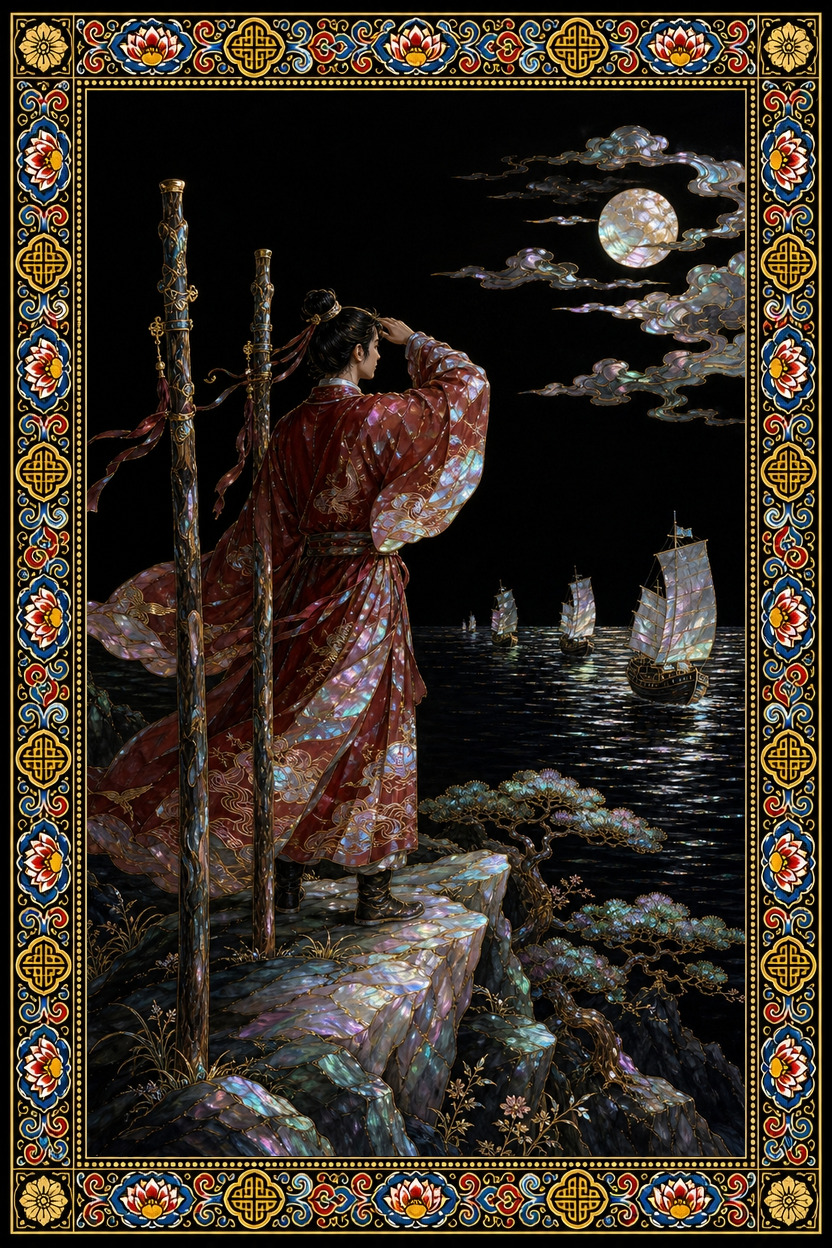
Wands · Three of Wands
Three of Wands — The Figure on the Cliff Watching the Ships
Why does the figure on the cliff, with three staffs planted in the ground, keep watching the ships far out at sea? This essay reads that gaze as the place in the mind that moves between steps already taken and arrivals not yet come.
『Three of Wands』 — what this card actually draws
At the centre of the image stands a figure on a cliff. Wrapped in a red robe, turned toward the sea, with three staffs planted in the ground behind them. The eye of the picture runs from the figure past the staffs to the horizon.
Ships ride on the horizon, and a moon hangs in the sky. The figure does not reach for the ships or try to grasp them, but stays in the posture of simply looking. The three staffs are already set; what belongs to this figure now is to stand on that ground and check the distance.
In this scene observation comes before any clear action. The position on the cliff shows a point past the first step but not yet across. So the card remains a picture of the gaze between departure and arrival.
Symbols and meaning
The three staffs stand for the number of things already set in place. That it has become three rather than stopping at one or two reads as a sign that the beginning has repeated and settled. The act of the figure beside them watching the ships is the process of checking where those things are headed.
The ships and the moon point to results not yet in hand. Visible but far off, moving but not steered by you. Upright, the image leads to the strength to endure waiting without impatience — momentum that rides the current.
Reversed, the same gaze narrows. The ships are visible but feel as though they will not come closer, and the three staffs turn into something that trips you up. Delay and setback are not absent from the picture; they can be read as the feelings that arise when this time of watching cannot be borne.
When this card appears
At work it turns your attention to the current in which what you prepared leads to a result. It means this is the moment to check where the next stage's ship has got to, rather than the gain in front of you. In relationships it reads as time to measure the distance from the other person, and to look back on what has built up rather than rush.
With money it points to the season when work already begun is recovered, while also saying that the timing cannot be hurried. In matters of choice it asks whether you are missing other possibilities while waiting for a result that has not yet come.
Read this card with the mind of the person on the cliff counting ships. The sentence "Three are already set, so now is the time to see what is coming" sits well in this card's place.
History and culture: America, Britain and the modern tarot
What stands out in this card's image is the simple outline made by the figure's robe and the arrangement of the staffs. In the period when the Waite-Smith deck spread widely in America, cards printed in small runs differed from edition to edition in subtle shades of colour and the thickness of lines. Those differences did not change the meaning of the picture; if anything, they made the same scene repeat before the eye in several editions.
When New Age currents met popular psychology in the 1970s, readers began rereading this scene as a psychology of waiting. The gaze from the cliff was interpreted not as fixation on a goal but as the attitude of checking your present position, which connects with the practice of using tarot as a tool for self-reflection.
What matters when you see this card today is not foretelling when the ships will arrive. It is closer to acknowledging that the three staffs are already planted, and asking yourself what you are watching from that ground.
Common misreadings
People often settle this card as a card of guaranteed success. But what is in the picture is not a ship that has arrived but ships on the horizon. It points to the possibility of expansion; it does not promise the result.
Conversely, the reversed card is sometimes read as meaning plans collapse entirely. The figure and the staffs remain as they are, so it is closer to the picture to see the reversal as a narrowed field of vision rather than a state in which what was set has vanished.
Another is taking this card as a signal to do nothing but wait. The person who planted the three staffs has already moved, and this card can be read as asking you to confirm direction from on top of that movement.
Draw a card yourself
The picture you have just read can be placed against your own question. The same card answers differently when the question changes.
- A deck drawn in-house — 78 cards in the colours of nacre and dancheong
- Readings that read the picture, not a keyword list
- Keep asking — draw one more card for your next question
- A record you can return to and compare
- Let a friend draw for you with a single link
- Seventeen languages, one deck, one reading
More from this suit
