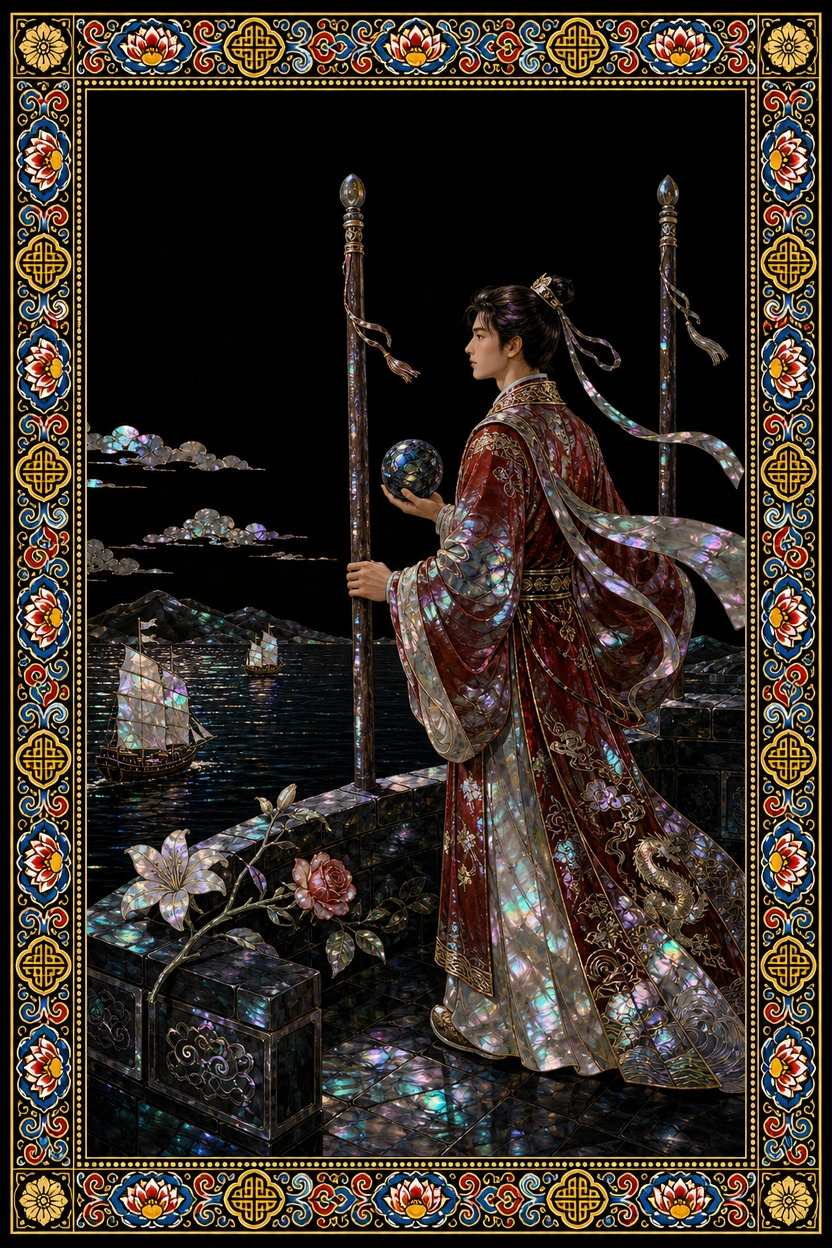
Wands · Two of Wands
Two of Wands — The One on the Wall Who Holds the World
Why hasn't the person standing on the wall boarded the boat yet? We look at the world in the hand and the staff at the feet, and at the moment of decision they describe.
『Two of Wands』 — what this card actually draws
First the eye lands on the figure standing on the wall. Dressed in red, this person stands at something like a parapet, body turned slightly, a small globe in one hand and a staff in the other. Roses and a box lie at the feet, showing that the place where they stand is anything but barren.
Then the eye travels behind the figure. Beyond the wall the sea opens out with boats riding on it, and beside the figure another staff stands planted in the ground. That the held staff and the planted staff sit side by side is the centre of this scene.
Finally the eye returns to the globe in the hand. To hold the world and yet not have crossed the wall — that is the moment this image holds onto.
Symbols and meaning
The globe in the hand is a possibility already measured out. What matters is that it is drawn small enough to fit in a hand, not at some exaggerated size that would mean gripping the whole world. So this card points not to a vague dream but to a plan with defined limits.
The planted staff is strength not yet used. It is commonly read that the held staff stands for present will and the planted staff for the next stage. The wall is the safe starting point, and the boats behind suggest that this starting point is already connected to another world.
Read reversed, the same elements turn into a standstill. The picture is read again as a state of having the globe in hand yet being unable to cross the wall — fear of the unknown and indecision. When the planning is thin, the planted staff also comes to nothing.
When this card appears
At work it points to the time for setting the next step. Take stock of what you have achieved where you are, and ask yourself whether you are ready to move onto a wider field. Better to settle the scope in your hand first than to rush the expansion.
In relationships it reads as the process of getting clear about what you want with the other person. The choice remains between staying safely at close range and taking one step further. In money it looks like a time for building the next plan on resources you have already secured.
Faced with a choice, the heart of the matter is deciding which of the two staffs to take up and carry forward. Like the person on the wall turning the globe over, the time spent putting off the decision cannot itself be an answer. "Confirm what is in your hand first, and then choose the boat."
History and culture: the old grammar of number and figure
What stands out in this card's figure are two vertical lines and one round form. In ancient Greek number theory, two was treated as the first number to divide — the number of opposition and choice. The idea that the moment one thing splits into two is the place of decision carried on into medieval European number symbolism.
What is interesting is that this image sets the two side by side. One is in the hand and one on the ground, arranged so that they form a pair rather than an opposition. This overlaps with the way East Asian yin-and-yang thinking reads two as complementing each other.
The vertical arrangement of wall and sea is no accident either. By placing a closed space and an open space in one frame, it makes visible the boundary nature that the number two carries. This iconography stands on that old grammar.
Common misreadings
When this card appears, many conclude that you must leave right away. But the figure in the picture stays standing on the wall, and the roses and the box remain at the feet. Reading it as a signal that preparation and review come before departure is truer to the image.
There is also the opposite misreading, that planning alone is enough. The planted staff only means something when it pairs with the staff in the hand. With conception alone and no gesture of action, this picture stays frozen.
Taking the reversed card as a forecast of failure is also too much. Here it is enough to accept the fear or hesitation and to check the plan once more.
Draw a card yourself
The picture you have just read can be placed against your own question. The same card answers differently when the question changes.
- A deck drawn in-house — 78 cards in the colours of nacre and dancheong
- Readings that read the picture, not a keyword list
- Keep asking — draw one more card for your next question
- A record you can return to and compare
- Let a friend draw for you with a single link
- Seventeen languages, one deck, one reading
More from this suit
