Wands · Four of Wands
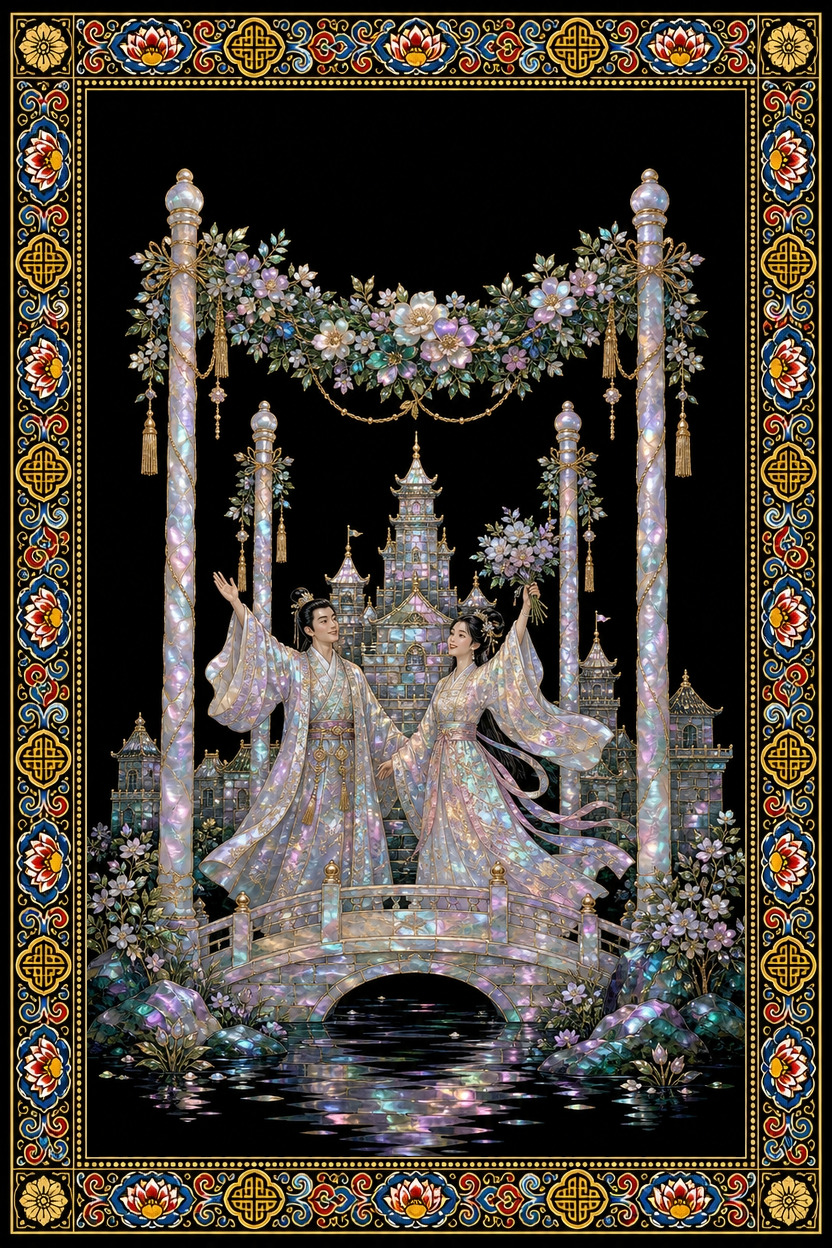
Four of Wands — Two Figures Crossing a Bridge Beneath a Flower Garland
Beneath a garland of flowers held up by four staffs, two figures are walking somewhere. This piece reads that scene on the bridge against the fingertips of the najeon craft.
『Four of Wands』 — what this card actually draws
Across the upper part of the image hangs a garland woven of flowers and fruit, and four tall staffs hold it up. The staffs stand planted in the ground at even intervals, forming a structure in which each one braces the others. The garland does not sag but stretches taut, showing that the staffs really are dividing the weight among them.
Lower your eyes and there is a bridge, and two figures in long robe (traditional dress) walking side by side. They are not shown holding anything in their hands or looking up at the garland. All that remains is the fact that they walk abreast in the same direction.
Behind them, tier upon tier of palace roofs rise. The roofs are far higher and farther off than the people, and there is a distance between the bridge and the roofs. The picture moves your gaze from the near structure to the distant roofs, and then back to the walking figures.
Symbols and meaning
The shape of four staffs holding up a garland resembles a structure no one raised alone. Take one staff away and the garland would droop, so the stability in this picture comes not from individual strength but from an arrangement in which each part holds up the others. This is why the card, upright, speaks of celebration and community.
The flowers and fruit point to results already borne. They are not buds in the middle of opening but grown enough to be woven into a garland, so this card draws not a beginning but the moment a milestone is reached. That the two figures walk beneath it means they are passing through that result together.
Reversed, the same structure shakes. As though one staff had drawn back and let the garland sag, instability at home or in your foundations comes to the surface, along with postponed celebration and a lack of support. But the bridge and the roofs in the picture remain as they were, so this shaking should be read not as collapse but as a rearrangement during a transition.
When this card appears
At work, it suggests that the results of joint effort have reached a point you can see. Yet so that you do not mistake those results for something you raised alone, it has you count the people who held them up with you. In relationships, it has you look at whether the two of you are walking in the same direction, or each looking at a different roof.
With money, the topic becomes maintaining the foundation you have already laid. Rather than a large expansion, it is the side of checking the spacing of the staffs so that the present structure does not fall. Faced with a choice, it advises you not to put off the celebration. A celebration postponed does not come back later at the same weight.
Thinking of the two figures walking on the bridge, you might offer a sentence like this: "Ask yourself who is walking beside you right now, and whether you are heading toward the same roof."
History and culture: najeon chilgi — inlaying crushed shell into lacquer
The garland on this card is an ornament made by weaving flowers and fruit into a single band. In the najeon craft, the same work is done by hand. Nacre (mother-of-pearl) is hammered and spread thin, cut along the pattern, and set onto a bamboo or lacquered surface, and each piece must keep its own size for the whole garland not to break. The garland on this card is painted, not nacre; what it borrows is that division of labour.
Tongyeong and Wonju are regions often mentioned in the lineage of this technique. From Goryeo through Joseon, the patterns of najeon boxes ran to garlands and flowers, birds and fish, and the story goes that the method of cutting and attaching pieces and the method of crushing shell into powder and scattering it diverged from era to era.
Just as four staffs divide the garland's weight among them, a single piece of nacre cannot complete a pattern alone. Only when the cut pieces fill each other's empty places on the lacquered surface does the light gather into grain and flow. Set the steadiness of this card beside that division of labour at the fingertips.
Common misreadings
There are cases where people conclude that a party or feast will soon be held as soon as this card appears. The celebration in the picture is closer to a state than an event. That the garland is hung means something has already been borne, not that a stage is ready for tonight.
It is also common to link the reversed card straight to a ruinous turn in a relationship. The bridge and roofs in the picture still stand, and the two figures are still walking. What shakes is the arrangement of the staffs, so it is better to look first at the structure you can repair.
Another is to read this card as the end of arrival. The two figures have not already gone in under the roofs; they are on the bridge. The celebration is something being passed through, and see along with it the fact that the next step remains.
Draw a card yourself
The picture you have just read can be placed against your own question. The same card answers differently when the question changes.
- A deck drawn in-house — 78 cards in the colours of nacre and dancheong
- Readings that read the picture, not a keyword list
- Keep asking — draw one more card for your next question
- A record you can return to and compare
- Let a friend draw for you with a single link
- Seventeen languages, one deck, one reading
More from this suit
