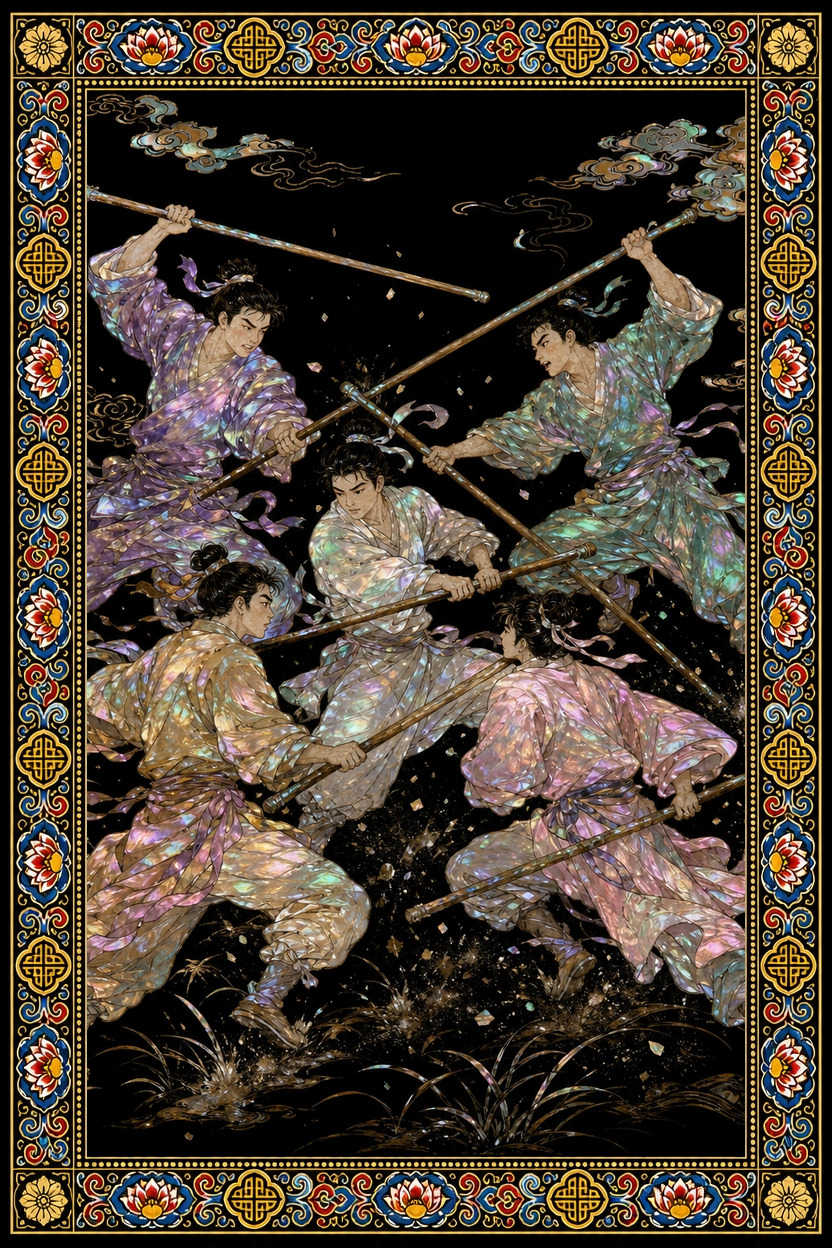
Wands · Five of Wands
Five of Wands — A Melee With No Clear Winner
In this tangle of five staffs, can you tell who is winning? The Five of Wands asks less about conflict itself than about the direction it is heading.
『Five of Wands』 — what this card actually draws
Dust rises in the lower part of the image and sparks scatter through the air. Above it, five people each lift a long staff at an angle, striking against one another's staffs. The tips of the staffs reach toward the top of the frame, so your eye is drawn naturally to the points where the tangled staffs cross.
The five figures wear long robe (traditional dress), and it is not clear who leads and who gives way. One staff cuts across another, another stands aside, and the force does not gather in a single direction. The figures' faces and bodies turn toward each other, but the points where their gazes meet are scattered.
Nothing in the picture signals victory or defeat. No one has fallen, and no staff lies on the ground. The scene seems to hold not an ending but the friction itself, still in progress.
Symbols and meaning
Staffs striking one another show the friction that arises when forces pointed the same way meet head-on. The fire element of the wands means a driving momentum, but when five of them thrust out at once, that momentum cannot gather into one and scatters instead. Upright, the conflict this card speaks of is closer to a clash of pride than to malice.
Turn the image over, and the tips of the staffs point downward, the forces that were colliding settling into the ground. So the reversed card reads less as conflict having vanished than as a state in which the friction has stopped and things are being put back in order. As the tension eases, inner conflict you had put off may come to the surface.
Either way, the card does not rule on whether there is a fight. What remains is the fact that the five staffs each have their own direction, and the question of where to gather those directions.
When this card appears
At work, meetings where opinions collide or disputes over roles may be piling up. No one's way is wrong, but when directions differ, the same task gets done five times over. The task of this moment is deciding whose staff gets planted first.
In relationships, a small turn of phrase easily escalates into a matter of pride. Change the conversation from one meant to win into one meant to be understood, and the temperature of the friction shifts. With money, look at whether spending and income are pulling in opposite directions.
When you face a choice, the key point is that you do not have to answer every fight. Laying down a staff is also a choice, and sometimes it protects more. As the dust settles, a sentence surfaces: "The problem isn't the person I'm fighting right now — it's where I'm putting my strength."
History and culture: Marseille tarot and the fifteenth-century card game
The number 5 places this card in the early part of the minor suits. If we start from the premise that the 78-card system was born as a card game rather than as divination, the numbers were not a ranking that decided wins and losses but the place a card held in play. The Five of Wands takes the early position that stages a contest of strength.
In the system that began in the Tarot region and became standard in Marseille, France, the suit cards were divided into four suits. The staff corresponds to today's wands, and the image of five tangled together survives as lines carved into a printed woodblock. Cards pulled from the same block still come down to us with their own colours and wear.
While the twenty-one trumps and the Fool hardened into today's majors, the suit cards remained cards that competed in combinations within the rules of the game. The melee in this card is less an image the rules produced than a moment of colliding force cut into the plate.
Common misreadings
Some conclude that a fight will break out the moment the Five of Wands appears. But no one has fallen in the picture, and there is no decisive blow. The card only signals the possibility of conflict; it does not fix the outcome.
Reading the reversed card only as "the conflict has been fully resolved" is also hasty. Staffs pointing down mean the tension has subsided, not that its cause has disappeared. A postponed problem may still be there.
Finally, it is worth examining the habit of seeing this card only as a bad card. Where different forces collide, there is also room for adjustment. Gathering the five staffs into one direction is what this card is actually asking.
Draw a card yourself
The picture you have just read can be placed against your own question. The same card answers differently when the question changes.
- A deck drawn in-house — 78 cards in the colours of nacre and dancheong
- Readings that read the picture, not a keyword list
- Keep asking — draw one more card for your next question
- A record you can return to and compare
- Let a friend draw for you with a single link
- Seventeen languages, one deck, one reading
More from this suit
