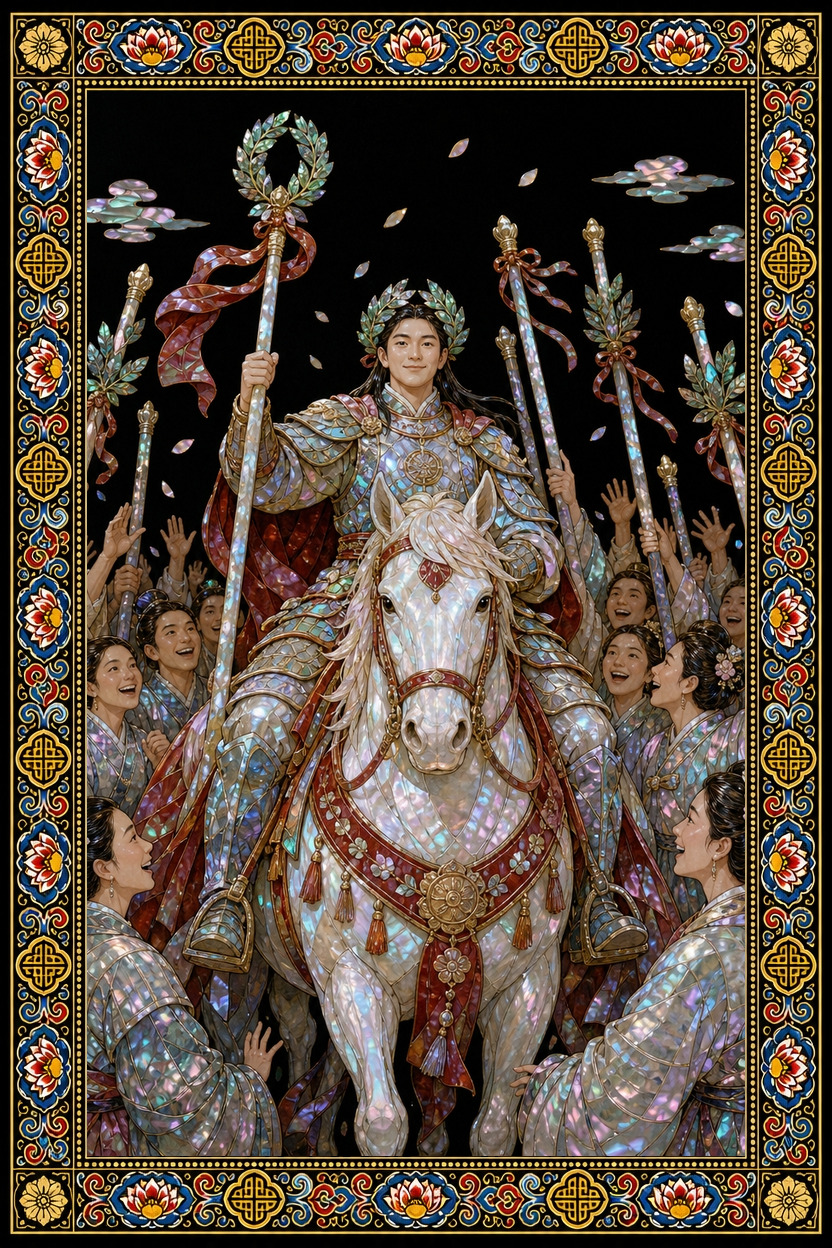
Wands · Six of Wands
Six of Wands — The Rider on the White Horse
What is there on the side where people reach out their hands, that the figure on the horse should raise the staff so high? This essay follows the Six of Wands with the eye, tracing how recognition and self-doubt split apart within a single card.
『Six of Wands』 — what this card actually draws
At the centre of the image is a young person on a white horse. A laurel wreath sits on their head, armour is worn over a long robe (traditional dress), and one staff is lifted high into the sky. The horse seems to move at a slow walk in the middle of a procession.
Lower your gaze and people are gathered around the horse. They reach their hands toward the mounted figure, and petals scatter between them. The image does not record who raised a hand first, or who remains to the last.
On the picture surface only the figure, the horse, the staff, and the petals are distinct. The terrain or buildings of the background are barely revealed, so the eye naturally travels between the tip of the raised staff and the outstretched hands.
Symbols and meaning
The pose with the staff held high turns the power of the Wands suit upward. The driving force of the Fire element is read as having come to fruition in a personal achievement, and as having risen to a place where others can see it too. The laurel wreath is the mark that achievement gives to itself.
That the horse passes among people matters. Recognition cannot be won alone, so this scene draws the process by which an achievement is completed in the gaze of a community. The scattering petals quietly signal that this welcome may be temporary.
Placed reversed, the same image reads at a different temperature. The people reaching out are no longer visible, or the situation shifts to one in which the raised staff must be lowered. Here you look first not at the size of the recognition but at your own attitude toward receiving it.
When this card appears
At work it reads as a period when effort shows on the outside. You may draw strength in settings where results are made public, such as a presentation or an evaluation. Only you can judge whether that praise is the starting point of the next task or a signal to rest a while.
In relationships, how the other person sees you becomes the topic. The wish for recognition and the wish to have it confirmed can overlap. In money, results are confirmed in numbers, but those numbers do not by themselves mean stability.
At a fork in the road, it is worth asking whether you are using other people's applause as your standard. Come down from the horse and check the faces of the people reaching out, at least once. This card often shows up with the sentence: "Is this place a place for me, or a place for showing off?"
History and culture: dancheong — the five colours of timber painting
What stands out in the mounted figure's dress is the field of colour where the long robe (traditional dress) is layered over the armour. In dancheong (traditional polychrome painting on timber), colour was a device for announcing position before it was decoration. Painting the members of a wooden building protects the wood from moisture and insects, and at the same time the colour reveals which rank the building belongs to.
Obangsaek (the five cardinal colours) assigns a role to each direction. Blue in the east, red in the south, white in the west, black in the north, and yellow at the centre each keep their place, repeated in pattern units such as meoricho and hongchang. Drawing a boundary line between one colour and the next so that they do not encroach on each other is the basic grammar of dancheong.
The figure in this card demonstrates that grammar with the body. Just as armour and long robe overlap and the laurel wreath rests on the head, each element keeps its place while forming a single scene. Yet if dancheong is a painting meant to guard a building for a long time, the scattering petals seem to catch the moment before that paint has dried.
Common misreadings
First, there is the case of concluding that great success must arrive whenever this card appears. What the image shows is the scene of an achievement, not its size or how long it lasts. The welcome passes, and the horse keeps walking.
Second, the misreading that takes the reversed card as nothing but a downfall. Reversed points to a phase in which self-doubt grows where recognition has shrunk; it does not make what you have already achieved undo itself. A quiet victory is still a form of victory.
Third, the view that treats this card only as a card of self-display. Do not miss that the people reaching out complete this scene more than the person holding the staff. Recognition is an event that the giver and the receiver make together.
Draw a card yourself
The picture you have just read can be placed against your own question. The same card answers differently when the question changes.
- A deck drawn in-house — 78 cards in the colours of nacre and dancheong
- Readings that read the picture, not a keyword list
- Keep asking — draw one more card for your next question
- A record you can return to and compare
- Let a friend draw for you with a single link
- Seventeen languages, one deck, one reading
More from this suit
