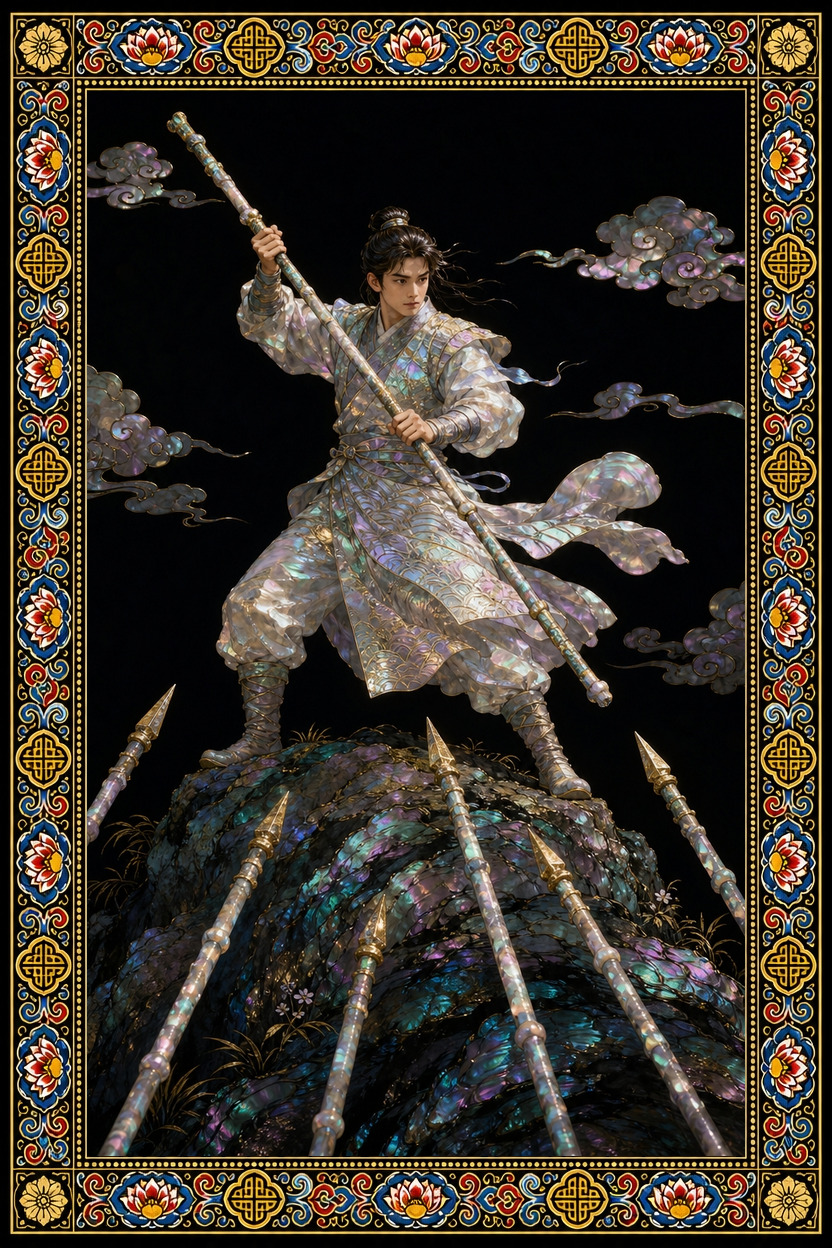
Wands · Seven of Wands
Seven of Wands — The figure holding six staffs at bay on the hill
Why does the person standing so high, staff in hand, keep watching below without resting? This essay reads the gap between defense and exhaustion in the image of the Seven of Wands.
『Seven of Wands』 — what this card actually draws
Your eye first lands at the top of the image, on the person standing on the rocky rise. He grips one staff at an angle in both hands and turns his body toward what lies below. Clouds seem to flow at his feet, hinting that he stands quite high up.
Where his gaze goes, six staffs thrust up from below. Every tip points toward him, and he holds his stance as if determined not to miss a single one. There is only one figure, yet the image is filled by a composition of six against one.
This picture holds neither a scene of victory nor one of defeat. The staffs are not yet broken, and the figure has not yet stepped back. The card captures not the outcome but the middle of an ongoing act of holding firm.
Symbols and meaning
In this card, height reads not simply as an advantage but as a matter of sight. Because he stands where he can look down on what rises from below, he can take in all six movements at a glance. The upright meanings of defense and standing your ground are bound up with the composure that comes from this height.
The clouds at his feet, by contrast, signal that this height is not entirely comfortable. A narrow foothold with something constantly rising from below is a heavy burden to bear for long. The reversed meanings of overwhelm and exhaustion describe what happens when this narrow footing reaches its limit.
It is also worth noticing that he holds only one staff. He is not pushing back all six at once but fixing a direction with one and holding firm, so the patience in this card is closer to selective focus than to indiscriminate force.
When this card appears
At work, a defensive battle may open over the position or role you currently hold. This looks less like a stage for producing results than one for keeping what you have already gained, so it helps to decide what you will protect to the end and what you can let pass.
In relationships, the card pictures demands arriving from several directions at once. Trying to satisfy everyone will make the staff in your hand waver, so it is better to sort out in advance where you will yield and where you will hold. With money, this reads as a time for defensive judgment, holding back spending.
When you face a choice, the wish to step back and the wish to hold firm rise at the same time. What sets the standard here is stamina and time. The sentence of holding firm usually takes a shape like this: "It would be easier to set it down now, but if I let go here, I don't think I'll ever stand in this place again."
History and culture: the Visconti-Sforza deck and the Milanese court
What stands out in the image of the Seven of Wands is the figure's clothing and posture. In the gold-leaf deck commissioned by the ducal family of fifteenth-century Milan, figures like this followed the conventions of court painting. Handcrafted cards of great expense were possessions of the nobility, and the bearing of the figures painted on them was a mirror reflecting the taste of the owner.
The cards of the Visconti-Sforza deck are not consistently organized with numbers and suit marks the way later standard decks are. Cards set on gold-leaf grounds with heraldry and portraits were both playthings and ceremonial objects. Read in that context, the figure on the hill is less a simple fighter than a portrait of a courtier holding his own place.
It is hard to claim, however, that the composition of the Seven of Wands carried over unchanged from that deck. That the seventy-eight-card system took hold in early card play is a premise many cards share, and many details of this image were refined later. When looking at the picture, it helps to keep an eye on what survives and what was added.
Common misreadings
Some read the Seven of Wands as the card of the fight that is always won. But the figure in the image has not yet won, and the six staffs remain six. This card shows not victory but a contest still in progress.
It is also common to read the reversed card flatly as defeat or surrender. Reversed is closer to a signal to look back at what you have been clinging to. Changing what you hold firm to is not the same as giving up on defense.
Finally, some narrow this card to aggression in personal relationships. The staff in his hand is not a weapon aimed at others but is aimed at his own place. Look first at why the defense is needed.
Draw a card yourself
The picture you have just read can be placed against your own question. The same card answers differently when the question changes.
- A deck drawn in-house — 78 cards in the colours of nacre and dancheong
- Readings that read the picture, not a keyword list
- Keep asking — draw one more card for your next question
- A record you can return to and compare
- Let a friend draw for you with a single link
- Seventeen languages, one deck, one reading
More from this suit
