Swords · Ace of Swords
Ace of Swords — A Hand from the Clouds, a Sword, a Crown
What is the sword raised toward, and why does the crown hang on the blade rather than rest in the hand? Taking that arrangement as its clue, this essay reads the Ace of Swords as a card of clarity and judgment.
『Ace of Swords』 — what this card actually draws
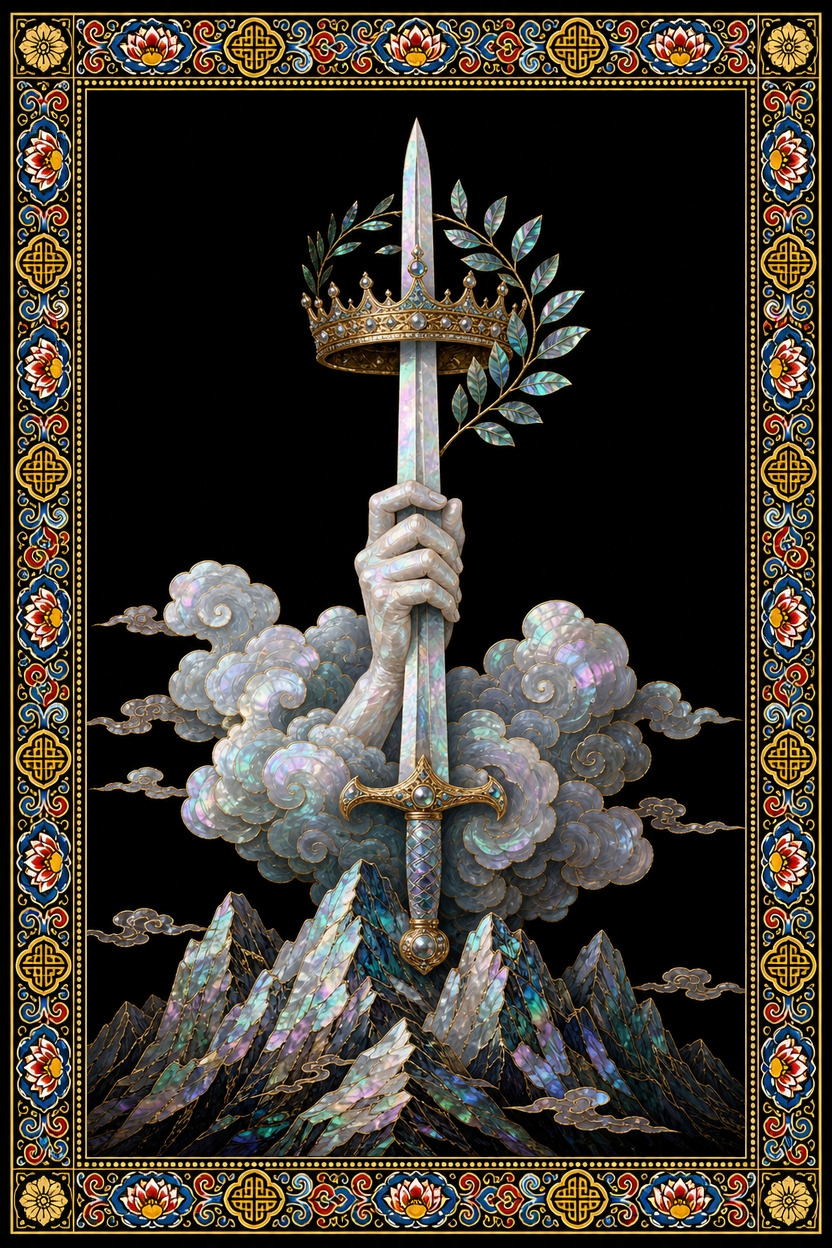
High in the frame, a hand comes out of a cloud with the sheen of nacre and takes hold of an upright sword. The hand wraps around the hilt, but the blade reaches far from the hand, upward toward the top of the frame. Your eye travels naturally from the hand up to the point.
Near the tip, a jewelled crown hangs on the blade, and a laurel branch is suspended beside it. The hand does not hold the crown. It rests on the narrow point of the blade, keeping its balance there.
Below the sword, jagged peaks rise in a row, and the sky has sunk into darkness. The bright cloud and the dark terrain divide the image above and below, so that the sword looks like a single vertical line cutting across the gap.
Symbols and meaning
The sword belongs to the suit of Air. Air is invisible, yet it shows itself in the form of thought and speech. A picture in which only a hand comes out of the cloud thus resembles a state of pure awareness without a body. It is closer to having seen through something than to having grasped it.
Upright, the card points to the moment when something blurred turns sharp. As the blade parts the peaks, judgment lines up in a single stroke above vague feeling. That the crown hangs on the blade shows this clarity is not yet an achievement held in the hand but a possibility balanced in place.
Reversed, the same sword has lost its direction. Sharpness can run into violence of speech, or certainty can harden into a hasty conclusion. Even if the laurel branch has not withered, the balance collapses easily if the sword is not lowered.
When this card appears
At work, it reads as a moment when a long-postponed judgment is needed. Rather than staying quiet in the meeting, try summing up the issue in one sentence. Just choose your words so that sentence does not become a blade that cuts people.
In relationships, it means the thread of a conversation is untangled from facts, not feelings. Confirming each other's differing memories and naming what the problem is come first. With money, this is a time when the answer appears simply from breaking your spending down item by item.
Faced with a choice, it is more efficient to set your criteria than to gather more information. As you would pick a path among jagged peaks, decide first what you will give up. "Now is the time to sort out sentences rather than feelings. Try reducing what you want to say to a single line."
History and culture: America, Britain and the modern tarot
What stands out in this card's image is the crown hung on the blade. The ace of the minor arcana is the first card of its suit and, at the same time, the place where that suit's possibility is not yet realised. The arrangement of the crown resting on the blade rather than in the hand is read as a picture of that unfinished status.
Once the deck travelled into twentieth-century America and Britain, readers began treating aces as markers of beginning. The beginning the Ace of Swords speaks of, however, is the beginning of awareness, not of feeling. At the meeting point of the New Age and psychology in the 1970s, the card was read again as a symbol of insight and self-awareness.
When the card is used as a tool for self-reflection in the modern tarot, the focus falls on the attitude of judgment rather than its content. The question becomes whether to raise the sword or lower it, whether to take the crown in hand or leave it on the blade and watch.
Common misreadings
People often mistake this card for one that hands you the right answer. But the sword in the picture does not deliver an answer; it is closer to a tool for sharpening the question. Clarity comes from the precision of the question, not from the certainty of the conclusion.
Another misreading is that the card always means victory. The crown is still only hung on the blade; it has not been taken in hand. A beginning is only a beginning, and the cards that follow speak of the process.
Finally, the reversed card is sometimes declared a failure. Reversed points only to a state in which the sword's direction has blurred; it does not mean the sword has broken. Try reading it as the option of setting the sword down for a moment and catching your breath.
Draw a card yourself
The picture you have just read can be placed against your own question. The same card answers differently when the question changes.
- A deck drawn in-house — 78 cards in the colours of nacre and dancheong
- Readings that read the picture, not a keyword list
- Keep asking — draw one more card for your next question
- A record you can return to and compare
- Let a friend draw for you with a single link
- Seventeen languages, one deck, one reading
More from this suit

