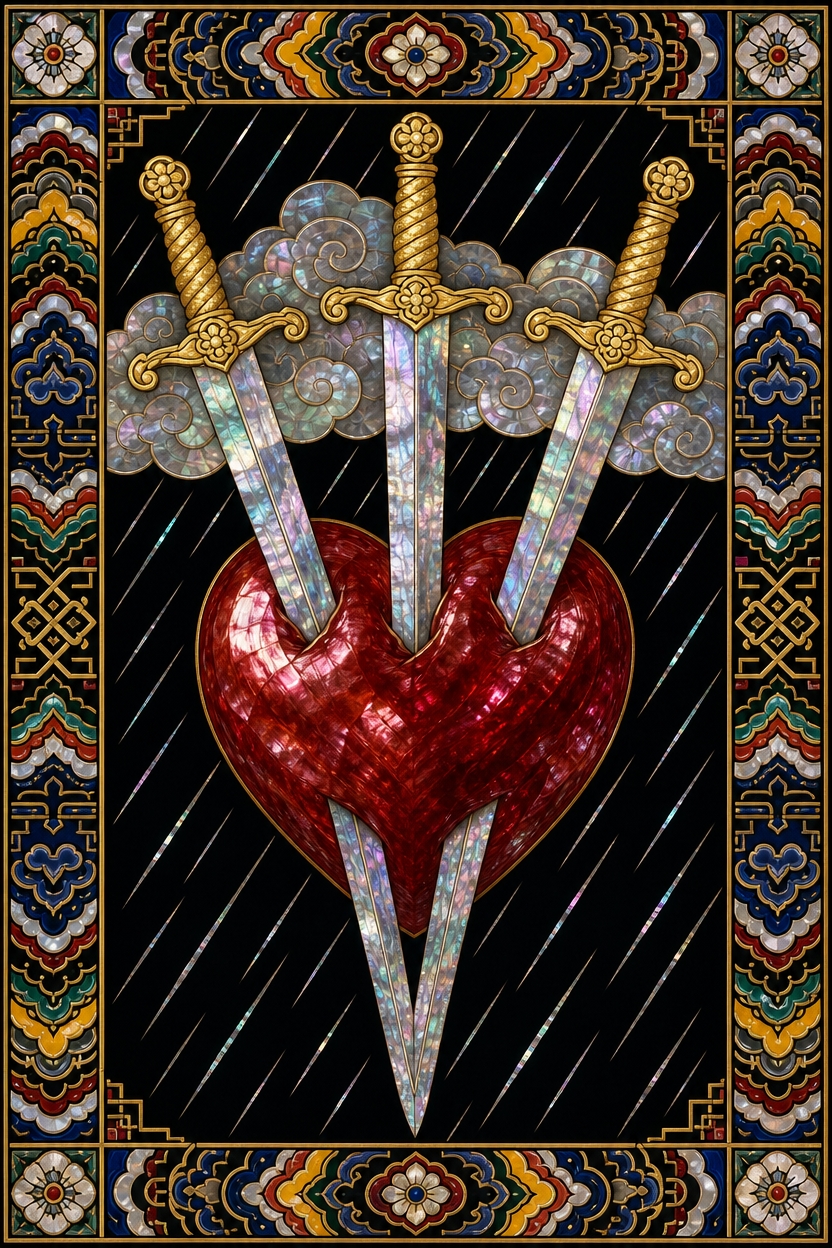
Swords · Three of Swords
Three of Swords — Three Blades in the Clouds, One Red Heart
What does a heart pierced by three swords have to tell us? Following the arrangement of the image, this piece looks at how the card handles sorrow and at its history, which began not with fortune-telling but with card games.
『Three of Swords』 — what this card actually draws
At the centre of the image lies a single red heart. Three swords are driven down into it side by side, their blades passing clean through. The first thing to catch the eye is not the swords but the red of the heart. The composition tells you what has been wounded before it tells you anything else.
Raise your gaze and you see the hilts caught in the clouds. No hand grips them, and no figure is shown driving them in. Because we cannot tell who struck the blow, the arrangement leaves the impression that the source of the pain is unclear.
Widen your view to the whole image and rain is falling on the diagonal. It streaks down evenly toward the swords and the heart, creating a sense that something keeps being added to the wound. And because there is no figure in the picture, the viewer ends up standing in that empty place.
Symbols and meaning
The heart has long been read as the place where feeling resides. Swords driven into that place point to an event that passed through the centre of the heart, such as a loss or a betrayal. That there are three swords is worth noticing too. It is not one event but pain layered in several folds: the fact itself, the way the fact was delivered, and the silence that followed, all lodged there together.
The hilts caught in the clouds can also be read as meaning that this pain has no clear perpetrator. The card depicts a situation in which it is hard to blame anyone, or one in which blaming does not resolve anything. That is why the card focuses less on sorrow itself than on the act of facing it.
Reversed, the card shows the process of drawing the swords out. The wound begins to close, or long-held feelings are settled through forgiveness. Yet recovery is not the same as erasing what has already happened, and this period often overlaps with a time of looking again at old wounds that have resurfaced.
When this card appears
At work, a situation comes up in which you were hurt in the process rather than by the outcome. An evaluation or piece of feedback may have landed harder than expected, or trust with a colleague may have cracked. What you need now is not to argue back but to name precisely what hurt.
In relationships, this is a phase in which a truth that words could not fully carry comes into the open. It may be a clear event such as a breakup or a rejection, or it may be long-suppressed resentment rising to the surface. With money, it is a time when a loss or a cancelled contract is confirmed, and the card advises separating feeling from figures.
At a point of choice, it is often the case that pain remains whichever way you go. Here the card says not to postpone the feeling but to acknowledge it first. The card's place is often summed up in a sentence like "admitting that this decision hurts is where it starts."
History and culture: Marseille tarot and the fifteenth-century card game
The card's number, three, sits within the numbering system of the minor arcana. In the seventy-eight-card system that began in the Tarot of Lombardy and became standard in Marseille, France, the numbered cards were originally the suit cards of a trick-taking game. Three swords was itself a strong number, and the picture was a marker that made the card easy to recognise.
What is interesting is that this image carries an emotional scene, which is unusual for a game card. Whereas the other numbered cards of the same suit simply increase the count and arrangement of swords, the Three of Swords brings in a narrative of heart and rain. Even in its days as a playing card, this must have been a picture that stood out at a glance.
Marseille printing was centred on lines cut into woodblocks. The impression this card makes therefore comes less from fields of colour than from black outlines and repeated diagonals. The story goes that when the seventy-eight cards later split into major and minor arcana and settled into place as a tool for interpretation, this iconography was carried over almost untouched.
Common misreadings
Some people conclude that a breakup or an accident will arrive as soon as this card appears. But the picture is not a forecast of events; it shows the shape of a wound already left in the heart. This is also why the pain each person recalls before the same image differs.
Another is the notion that this is a bad card. A card that deals with sorrow and a card that summons sorrow are not the same. Because this image makes you see the wound precisely, it can also be the place where recovery begins.
It is also hasty to read the reversed card as everything being resolved. Reversed is closer to meaning that healing is under way, and it includes a period in which old wounds resurface. Don't rush; check where you are standing right now.
Draw a card yourself
The picture you have just read can be placed against your own question. The same card answers differently when the question changes.
- A deck drawn in-house — 78 cards in the colours of nacre and dancheong
- Readings that read the picture, not a keyword list
- Keep asking — draw one more card for your next question
- A record you can return to and compare
- Let a friend draw for you with a single link
- Seventeen languages, one deck, one reading
More from this suit
