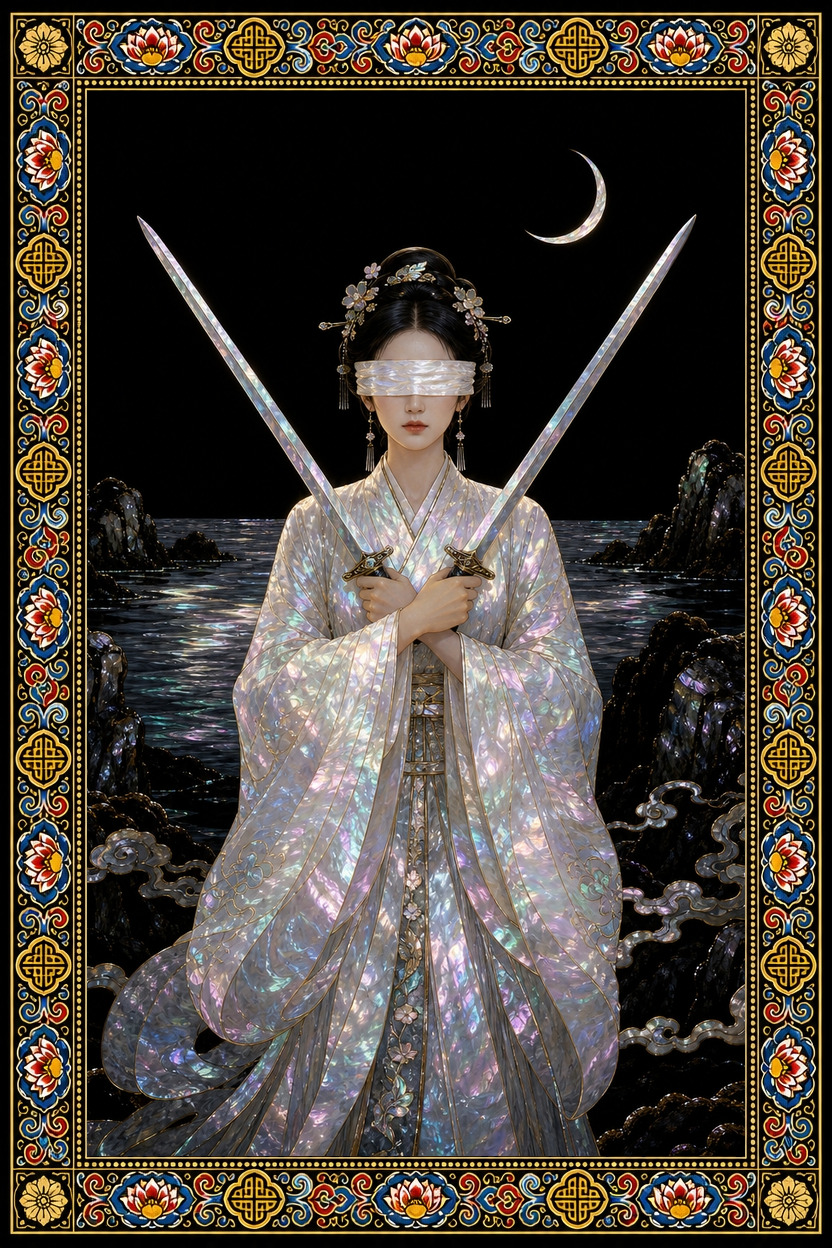
Swords · Two of Swords
Two of Swords — The Blindfolded Woman and Two Crossed Blades
What is the blindfolded woman holding two crossed swords to her chest unwilling to see? This piece starts from the details of the artwork and rereads the state of stalemate not as a failure of judgment but as a technique of delay.
『Two of Swords』 — what this card actually draws
At the center of the image stands a woman in a white long robe (traditional dress). She has drawn both arms before her chest and holds two swords crossed in an X, the blades reaching past her shoulders. Her eyes are bound with cloth, so there is no telling where her gaze is turned.
Behind her the sea opens out, and a crescent moon hangs above the horizon. A low rock sits at her back, showing that she stands on a narrow strip of ground between water and stone. The first thing that catches the eye is how little room she has underfoot.
The gaze moves from the covered eyes to the swords, and from the swords back to the horizon. Someone who cannot see ahead is holding her balance with both hands.
The image does not tell us which choice is right. It only leaves one fact clear: this person is standing in place with her decision postponed.
Symbols and meaning
The blindfold is judgment brought to a halt. The swords are firmly in hand, so the power is there, but she cannot confirm where to send it. She neither sets the blades down nor swings them, and in that sense the card draws not helplessness but suspension.
The crossed shape of the two swords shows two directions blocking each other. People fold their hands like this when they feel that whichever side they choose, the other will be hurt. The sea and crescent moon behind her suggest emotional depth and passing time, but like the rock at her back, there is no real room to retreat.
Reversed, this balance is shaken. As if the cloth were coming loose, postponed information comes to light, and the decision is pushed through not by her but by circumstance. When avoidance drags on, anxiety grows; when something long blocked finally gives way, it tends toward what was denied being sorted out.
When this card appears
At work it reads as a state of putting off an answer between two offers. The wish to learn more about the terms and the habit of delaying a decision may be overlapping, so start by writing down what you do not yet know.
In relationships it is a phase where conflict has been sealed away by keeping quiet. Not fighting and being resolved are different things, so it is worth asking yourself how long the present truce can hold.
With money it shows judgment stalled between spending and saving. Facing a choice, both options will look like a loss, and you will be frozen in place.
A line about untying the blindfold yourself fits here: "Do you know that not deciding right now is also a decision?"
History and culture: najeon chilgi — inlaying crushed shell into lacquer
The najeon process is the work of setting pieces of nacre (mother-of-pearl) into a lacquered base. The shell is ground thin, cut out along the pattern, and fitted into grooves carved in bamboo or in the lacquered surface. The story goes that this technique was carried on in Tongyeong and Wonju. The blindfold here is painted, not inlaid; what it borrows is that stage of the work.
The blindfold in this card resembles that cutting stage. Nacre only reveals its pattern once it catches the light, and while it is covered there is no seeing what has been engraved. Just as the hands holding the swords are still, the inlay says nothing of its form until the pieces settle into their grooves.
Looking at the lineage of patterns on najeon boxes from Goryeo through Joseon, the design is always laid onto the base afterward. The grain appearing once the base dries belongs to the craft; in this card, it is a way of reading the form behind the blindfold.
Common misreadings
First, the card is often read only as a sign of indecision. But holding two swords and enduring takes a strength of its own, and it is also a defense that prevents a hasty decision.
Second, it is easy to assume the blindfold means ignorance. The figure in the painting is closer to someone who has chosen not to look, and no one knows better than she does what she is turning away from.
Third, there is the reading that reversed simply means a bad outcome. Being revealed can hurt, but it is also a signal that the stalemate is breaking, so what really matters is what you do once the information is out.
Draw a card yourself
The picture you have just read can be placed against your own question. The same card answers differently when the question changes.
- A deck drawn in-house — 78 cards in the colours of nacre and dancheong
- Readings that read the picture, not a keyword list
- Keep asking — draw one more card for your next question
- A record you can return to and compare
- Let a friend draw for you with a single link
- Seventeen languages, one deck, one reading
More from this suit
