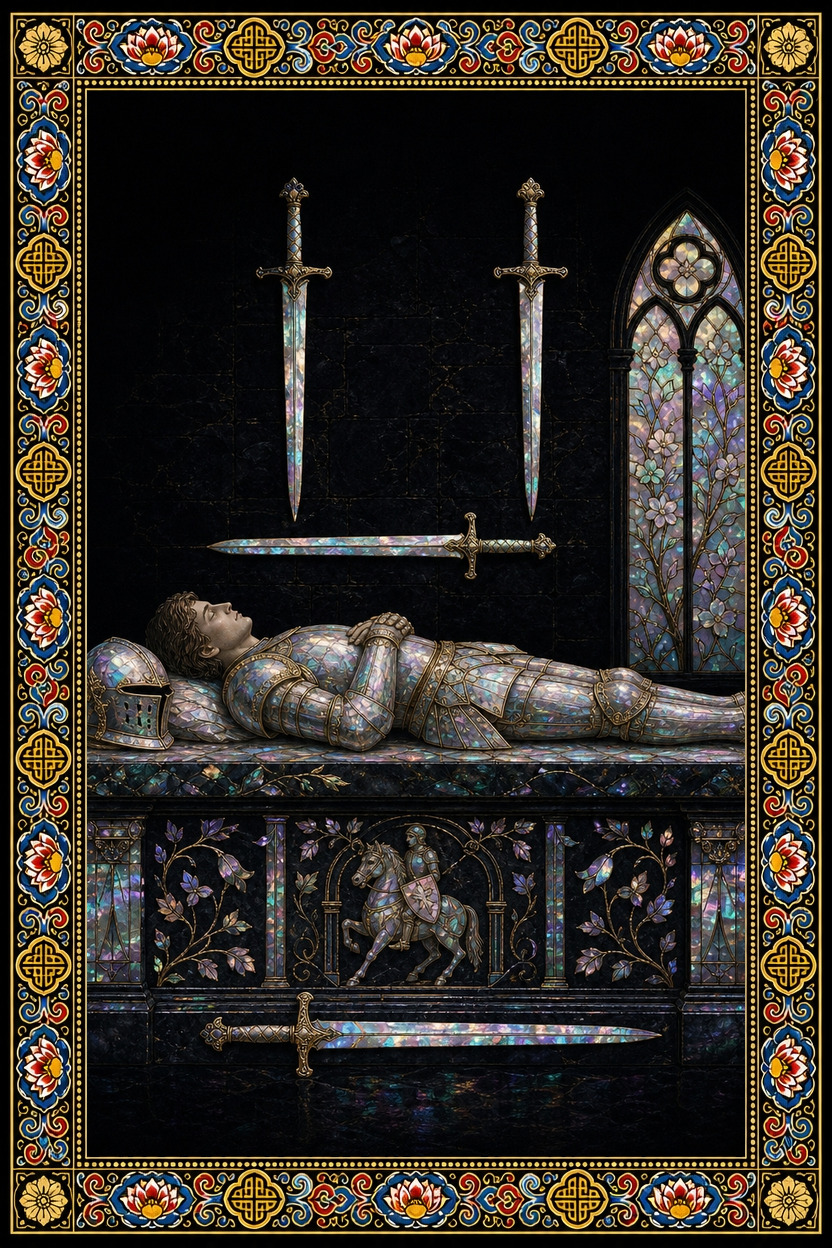
Swords · Four of Swords
Four of Swords — The Knight on the Tomb and the Four Swords
Can you lie down even with a sword in hand? The image of the Four of Swords shows the stillness of a place where the fighting has stopped, and it asks under what conditions that stillness becomes recovery.
『Four of Swords』 — what this card actually draws
At the center of the image sits a carved tomb, and on it a knight lies with both hands folded. He is in armor, but he holds no weapon, and it is not clear whether his eyes are closed or open. Your gaze climbs of its own accord from the lying figure's face to the wall above.
Three swords hang side by side on the wall, points down. On the floor lies a fourth sword, set crosswise, close enough that the knight could touch it if he reached out. None of the swords have disappeared; they have merely slipped from his hand.
The stillness of this scene is not an empty stillness. The fact that the weapons remain in the room suggests that this rest is not the end of battle but a pause between battles.
Symbols and meaning
A tomb is, by origin, an object for the dead. The setup of a knight who seems alive lying on top of it symbolizes the act of setting yourself down for a while as though you were dead. The three swords on the wall are weapons that have declared they will not be used just now, and the sword on the floor is the residue of a mind that has not quite let go.
Upright, this card speaks of withdrawal and recharging. Because the sword has been set down from the hand, the room has at last gone quiet, and that quiet becomes fuel for the next judgment. Rest here is not laziness but the act of paying a maintenance cost.
Reversed is another reading of the same picture. It is the state of needing to lie down while the body will not comply, or of lying down while still counting the swords on the wall. When ignored fatigue accumulates, rest is forced, and forced rest comes closer to delay than to recovery.
When this card appears
At work it points to the place where you need to stop. Read it not as an instruction to put off decisions but as a signal to secure the time needed to digest the information your judgment requires. It is not a demand that you abandon what you have already begun.
In relationships, keeping a little distance for a while can be the answer. Words exchanged while emotions are running high tend to become words spoken with a sword in hand. Whether silence is avoidance or recharging becomes clear with time.
The same principle applies to questions of money and choice. Set down the sword in your hand and leave a day or two empty, and the flaws in a hastily made decision begin to show. "If it's something you don't have to decide right now, you can hand it to tomorrow morning's you."
History and culture: dancheong — the five colours of timber painting
Dancheong is the painted decoration of Korean timber buildings — colour laid onto beams, brackets and rafters. Alongside the practical purpose of protecting the wood from damp and insects, it serves to reveal a building's hierarchy and to give the space a symbolic order. Colour is a device for preservation and distinction before it is decoration.
Obangsaek (the five cardinal colours) are arranged according to direction and role. Just as pattern units such as meoricho or hongchang mark the ends and boundaries of a member, colour tells you where something begins and where it ends. There is almost no colour in this card's image, yet the arrangement of three swords hung side by side on the wall resembles the repeating patterns of dancheong.
In dancheong, repetition creates rhythm, and that rhythm steadies the space. The room of the Four of Swords is ordered in the same way. The more regular the arrangement of the swords, the quieter the room, and only in a quiet room can the person lying down finally rest.
Common misreadings
This card is often read as an instruction to do nothing at all. But the swords in the picture have not vanished; they remain in the room. What this card recommends is not interruption but regrouping.
Another is the interpretation that assumes that when this card appears, your body must be ill or your work must be blocked. The burnout of the reversed card is only a possibility, and if it appears upright it is closer to a signal that resting now would in fact be better.
Finally, there is a tendency to see the lying knight only as listless. The folded-hands posture means a state that has been put in order, and that corresponds to the preparation of settling yourself for the next action.
Draw a card yourself
The picture you have just read can be placed against your own question. The same card answers differently when the question changes.
- A deck drawn in-house — 78 cards in the colours of nacre and dancheong
- Readings that read the picture, not a keyword list
- Keep asking — draw one more card for your next question
- A record you can return to and compare
- Let a friend draw for you with a single link
- Seventeen languages, one deck, one reading
More from this suit
