Cups · King of Cups
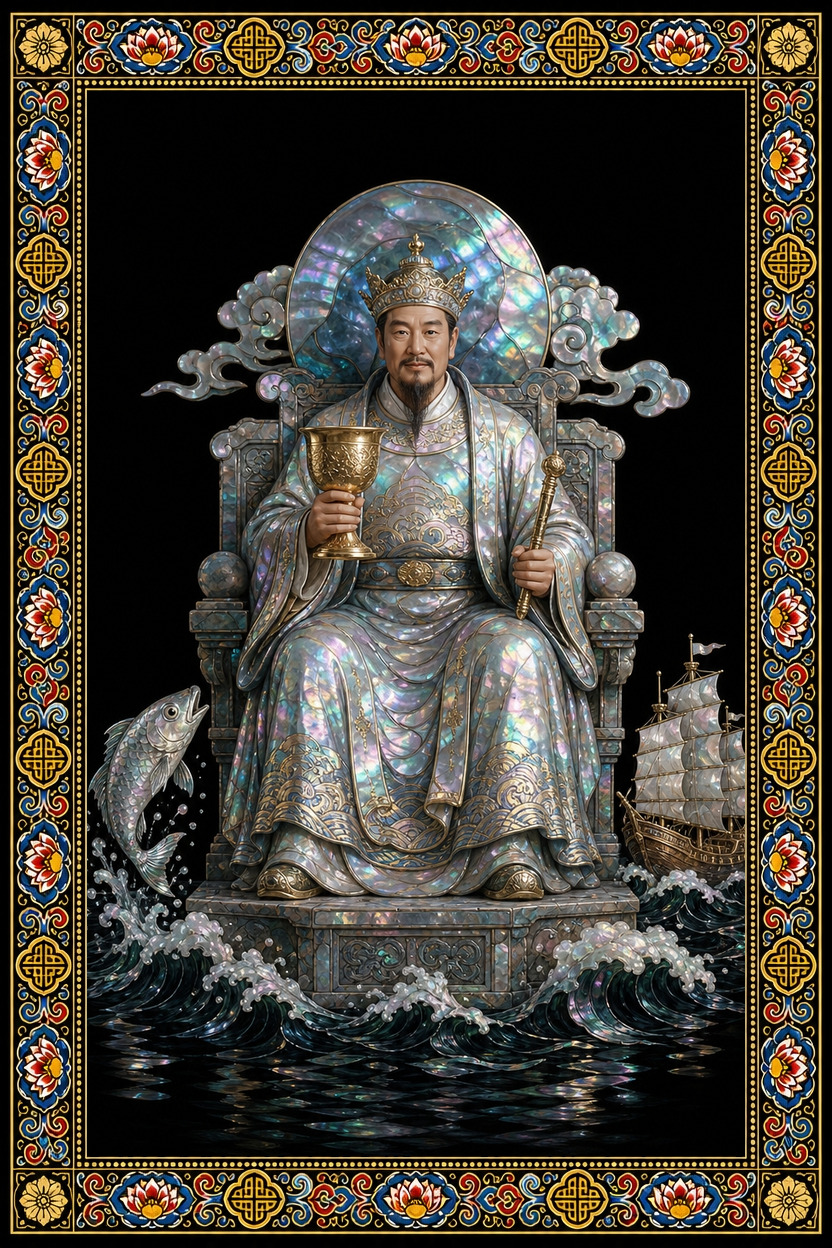
King of Cups — A Man Seated on a Throne Afloat on Water
What holds up a throne that floats on water? This piece reads, in each element of the King of Cups's artwork, the grammar of an authority that handles emotion.
『King of Cups』 — what this card actually draws
At the centre of the image sits a bearded king. His seat is not land but a throne afloat on water, and the throne does not sink but stays on the surface. In this card water is drawn not as the floor beneath his feet but as the medium that bears the throne up.
In the king's two hands are held a cup and a sceptre. The cup is the vessel of emotion and relationship, and the sceptre is the authority that governs that emotion. That the two hands hold two different tools is the heart of this image, and neither hand is empty.
Moving your gaze back, a fish leaps up from the water, and beyond it a ship floats. Behind the king's head a nacreous halo is drawn large. The halo is not a saint's but one given to a figure seated on water, and it reads as a device marking an authority established within the realm of emotion.
Symbols and meaning
The throne afloat on water draws a state of standing above emotion without being submerged in it. This posture, which neither removes the water nor falls into it, leads to the upright card's calm authority and emotional mastery. Holding cup and sceptre together shows the balance of heart and head through the two tools in his hands.
The fish lives in the water and then brings its body out of it. It can be seen as a scene of insight dredged up from the depths of emotion coming to the surface, and this is why the card leans toward wise counsel and diplomacy. The ship behind quietly points to the course along which that insight has travelled.
Read reversed, the same elements turn over. When standing on the water becomes a pushing away of the water, it becomes repressed emotion and coldness, and when the hand holding cup and sceptre turns toward another person, it becomes manipulation. When the halo becomes decoration for moodiness rather than authority, emotional volatility shows through.
When this card appears
At work it points to standing in a position of handling people without putting emotion first. A role mediating conflict or settling a team's atmosphere suits it, and the counsel comes from attitude rather than from voice.
In relationships it speaks of a period of taking in the other person's emotions while not losing your own centre. The key is a balance that is deeply involved but not swept away, and when that balance breaks it slides toward coldness or interference.
In money and choices it draws a situation of weighing emotional satisfaction and practical gain on the same scale. Read it as a signal to compare what is held in the two hands rather than deciding by looking at only one side. "What you need now is not a conclusion but a single sentence that settles things without shaking this person's heart."
History and culture: the old grammar of number and figure
In the suit of Cups the king is the fourth and last court card. The four stages of court cards running page, knight, queen, king were read in medieval Europe as a four-tier structure of rank, and the number four has been used as a completed unit in both East and West. The king is placed at the top of that four-tier structure.
Yet this king's image divides from the other kings in that the top is not land but water. Water was regarded in Pythagorean number theory as the place of flux and change, and the idea of sitting on it draws not a fixed authority but a balance atop what flows. The contrast of the square structure of the throne set upon the formless water is the grammar of this iconography.
The halo behind the head is a trace of the card borrowing the iconographic idiom of European religious painting. The halo is placed as a circle, the throne as a square, and the water as the plane filling below them, so circle, square, and plane overlap on one picture surface. The story goes that this overlap is a familiar composition in medieval symbolic diagrams.
Common misreadings
The King of Cups is often read only as a person rich in feeling. But the king in the image is not submerged in the water; he sits above it. The point of this card is not the quantity of emotion but where you stand in relation to it.
Some also conclude that reversed simply means a bad person. Reversed points only to a state in which the same figure's balance has been shaken, and the words coldness or manipulation are for you to judge within the context of the relationship.
Another misreading is that this card always means only a gentle adviser. The hand that also holds the sceptre shows that this figure stands in a position of exerting influence. You have to see that warmth and influence are in the same hand to come closer to the image.
Draw a card yourself
The picture you have just read can be placed against your own question. The same card answers differently when the question changes.
- A deck drawn in-house — 78 cards in the colours of nacre and dancheong
- Readings that read the picture, not a keyword list
- Keep asking — draw one more card for your next question
- A record you can return to and compare
- Let a friend draw for you with a single link
- Seventeen languages, one deck, one reading
More from this suit

