Cups · Page of Cups
Page of Cups — A Messenger on the Rocks, a Fish Leaping
Why does the young messenger on the rocks look at the fish rather than down into the cup? This essay reads the moment when feeling first sprouts, taking the Page's gaze and posture as its clues.
『Page of Cups』 — what this card actually draws
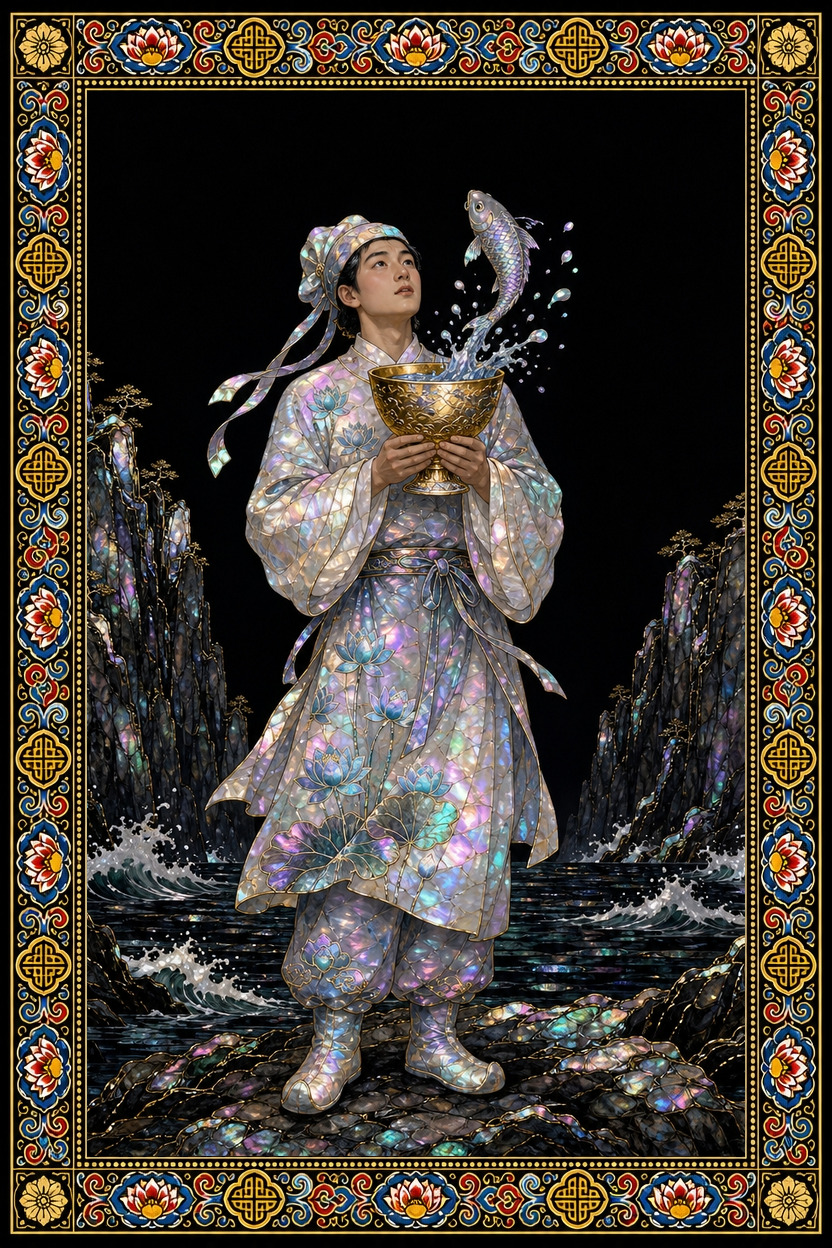
At the center of the picture stands a young messenger on rocks by the sea. Dressed in long robe (traditional dress), the figure holds a golden cup in both hands, eyes turned toward it. Above the cup, a fish is caught in the instant of leaping out.
Behind the figure, dark cliffs and surf stretch away. The rocks, cliffs, and waves divide the scene front from back and show that the figure stands at the water's edge, on a boundary. What stands out brightly in the picture is the cup, the fish, and the hands that hold them.
The eye travels naturally from bottom to top: from the feet touching the rock to the hands holding the cup, and on to the fish springing above it. Follow that order and it becomes clear what this card is open toward.
Symbols and meaning
The cup is a vessel for feeling. Holding it in both hands shows an attitude that handles emotion carefully rather than letting it spill. The fish adds another layer of meaning, because something that was underwater leaping up above the cup is a scene of an inner feeling coming to the surface.
Upright, the card points to a time when the heart opens and intuition and creativity begin to bud. Even against the dark backdrop of cliffs and waves, the figure's hands do not waver. That contrast hints that delicate feeling can grow even in an uneasy environment.
Reversed, the same picture reads differently. If the hands still hold the cup but the fish cannot leap, then feeling has arisen while the channel for expressing it is blocked. Here moodiness, oversensitivity, and escapism appear as the things obstructing the flow.
When this card appears
At work, this is when an unfinished idea shows its first face. Rather than rushing toward results, it is better to note down the sensation as it arrives. In relationships, it touches the scene of revealing your feelings to someone for the first time. With money, check your sense of small expenses rather than making a big decision.
At a point of choice, this card gives more weight to feeling than to logic. Still, if your feeling is unsteady, postponing the decision is also an option. There is no harm in waiting until the hands holding the cup stop trembling.
The moment the fish rises above the cup brings a line like this: "That feeling that just surfaced — you haven't quite put it into words yet, have you?" That one sentence shows this card's place well.
History and culture: figures East and West — immortals, emblems, diagrams
In East Asian immortal paintings, the figure usually faces forward while holding an object. The hand holding a cup or bottle opens toward the viewer outside the frame, and the gaze rests not on the object but beyond it. The tone differs from this card's messenger, who holds the cup but keeps his eyes on it.
European emblem books, by contrast, weave object and gaze tightly together. The thing a figure holds becomes a sentence in itself, asking the viewer to read out the relationship. The cup and fish of the Page of Cups sit closer to this tradition.
The figure in this card therefore stands between two currents. Like an immortal painting, he holds up an object to be seen; like an emblem, he leaves that object as a task to be read. A single posture and gaze become the point where Eastern and Western ways of depicting a figure divide.
Common misreadings
The Page of Cups is often seen as a card of childlike innocence alone. But dark cliffs and waves hold their ground in the background of the picture. Innocence here is closer to an attitude of opening the heart while knowing the risk than to a state of not knowing it.
It is also hard to insist that this card must mean the start of a romance. What the cup holds is feeling in general, and it can appear as a creative notion or a form of intuition. Don't narrow the situation; first look at what kind of feeling is opening.
Reading the reversed card as a stigma of immaturity goes too far as well. Reversed merely points to a state in which feeling has not yet found the place where it can be expressed. Opening that channel remains the next task.
Draw a card yourself
The picture you have just read can be placed against your own question. The same card answers differently when the question changes.
- A deck drawn in-house — 78 cards in the colours of nacre and dancheong
- Readings that read the picture, not a keyword list
- Keep asking — draw one more card for your next question
- A record you can return to and compare
- Let a friend draw for you with a single link
- Seventeen languages, one deck, one reading
More from this suit
