Cups · Ten of Cups
Ten of Cups — Ten Cups Beneath a Rainbow, and the Family Who Faces It
When you look at the ten cups hanging from a rainbow, what catches your eye first? This piece reads the card's meaning from the arrangement of those cups and that family.
『Ten of Cups』 — what this card actually draws
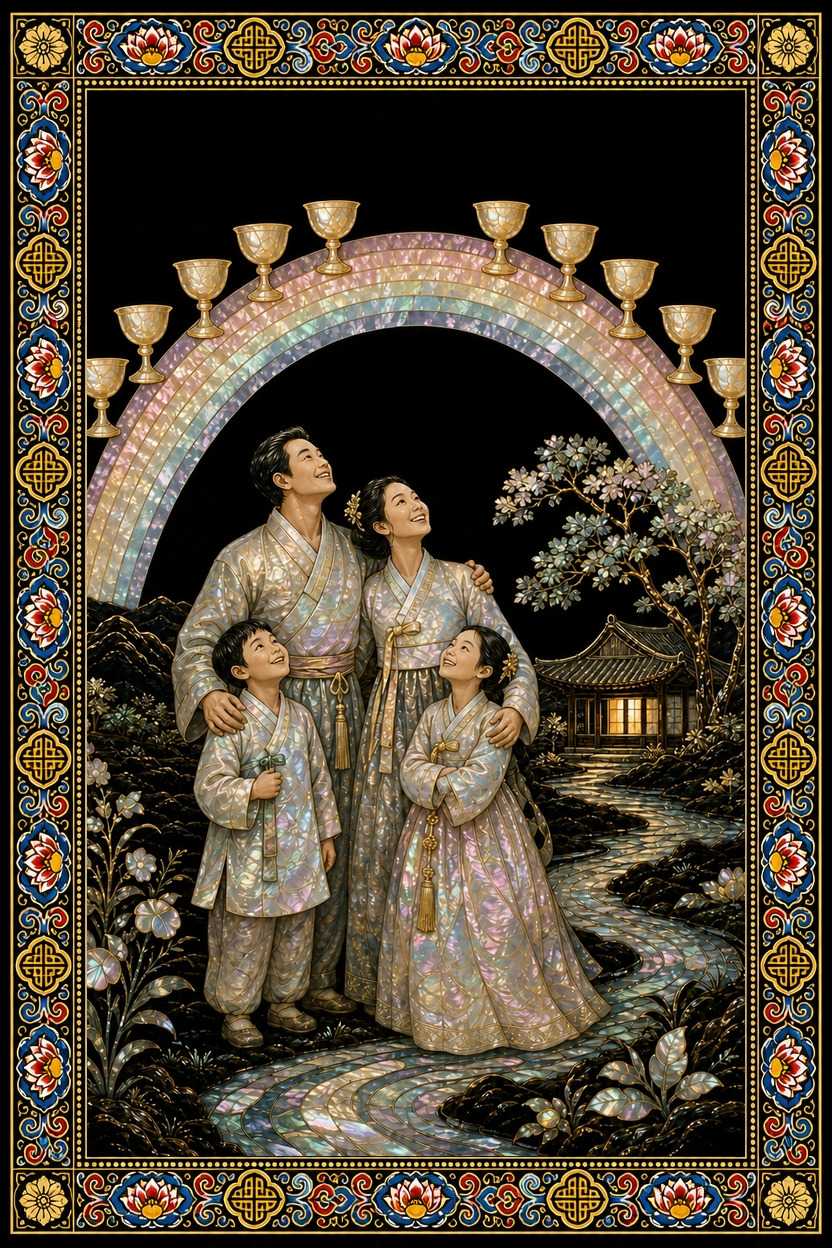
Across the top of the image a rainbow arcs like a bow, and along its curve ten cups hang at even intervals. Every cup has the same shape, its mouth open toward the sky, so they look like vessels waiting to catch and hold what comes down from above.
Lower your gaze and four people stand side by side. Two adults and two children, it seems; they hold each other's hands and, with their backs turned, look up toward the same patch of sky. Their faces are hidden, and only their gaze converges on the rainbow.
Behind them a tiled-roof house and a river run on. The house is where people live and the river is the current that passes by that place, and both sit quietly at the back of the scene, holding up the family in front.
Symbols and meaning
The ten cups are the final number in the suit of Cups. If a single cup is the beginning of feeling, ten cups hung in the sky draw a state in which feeling has spread past one person's interior into a shared place. A rainbow appears after the rain has stopped, so this scene reads as a point reached after a hard stretch of time.
Upright, the card points to fulfilment within relationships. That the family looks in one direction means their gazes do not pull apart, and the turned faces can also be read as trust — no need to check on one another. Belonging comes from a state like this, where things are understood without being said.
Reversed, the same picture is set upside down. With the rainbow sagging low and the cups placed where they would spill, the gap opens between the harmony we pictured and the relationships we actually have. You come face to face with discord pressed down under the name of family, or with a lack that being together does not by itself fill.
When this card appears
At work, the question becomes less about the achievement itself than about whether there is anyone to share it with. This may be a time when your place within a team or organisation feels steady, or, conversely, a time when you begin to see the underside of a group that looks harmonious from outside.
In relationships, the theme is a bond you have kept for a long time. Reassurance and reconciliation may pass between people already close to you, family or old friends, or you may need to face squarely what has built up between you. Around money, shared resources come to the fore — joint property, household expenses, things divided among several people.
Faced with a choice, the fork in the road is whether to put your own satisfaction first or the satisfaction of being together. Looking at the family's backs as they gaze up at the rainbow, a sentence like this often comes up: "Is what you want right now the achievement itself, or the person you would share it with?"
History and culture: the Egyptian origin myth and its refutation
In this card's imagery, the element that touches the origin debate most directly is the rainbow with ten cups hung from it. In the late eighteenth century, Court de Gébelin argued that tarot came from an ancient Egyptian book of secrets, explaining each picture on the cards as a trace of hieroglyphs. His claim gave force to a way of reading the details of the pictures as mysterious symbols.
No document supporting that claim, however, has ever been found. The current consensus is that tarot's seventy-eight-card system began not with an Egyptian text but with a card game played in fifteenth-century Italy, and the idea of a Cups suit with ten cups took shape within the European playing-card tradition.
This composition — rainbow, cups, and family in one frame — was completed in the early twentieth century in the illustrations of Pamela Colman Smith. The lineage of this picture therefore reaches back to modern European print culture, not to ancient Egypt. The origin story remains a tale that inflates the age of the cards; the picture itself is better read as an illustration carrying the mood of its own era.
Common misreadings
Some read this card as confirming that a marriage or a family celebration is just around the corner. The picture does show a family, but the card points to a state of emotional fullness, not to a forecast of events. What form that fullness takes depends on the surrounding cards and the situation.
By the same token, it is worth being careful about reading the card through the rule that families ought to be harmonious. What the reversed card points to is not the failure of a relationship but a phase of recognising the difference between idealised harmony and reality. The card's question is less whether conflict exists than how you will handle that gap.
Reading the ten cups only as completion or an ending is a shame too. The last number of the suit is the point where the journey of feeling closes, and also the place where you ask again who you will share that feeling with. Remember, as you read, that the family in the picture stands with their backs turned.
Draw a card yourself
The picture you have just read can be placed against your own question. The same card answers differently when the question changes.
- A deck drawn in-house — 78 cards in the colours of nacre and dancheong
- Readings that read the picture, not a keyword list
- Keep asking — draw one more card for your next question
- A record you can return to and compare
- Let a friend draw for you with a single link
- Seventeen languages, one deck, one reading
More from this suit
