Cups · Nine of Cups
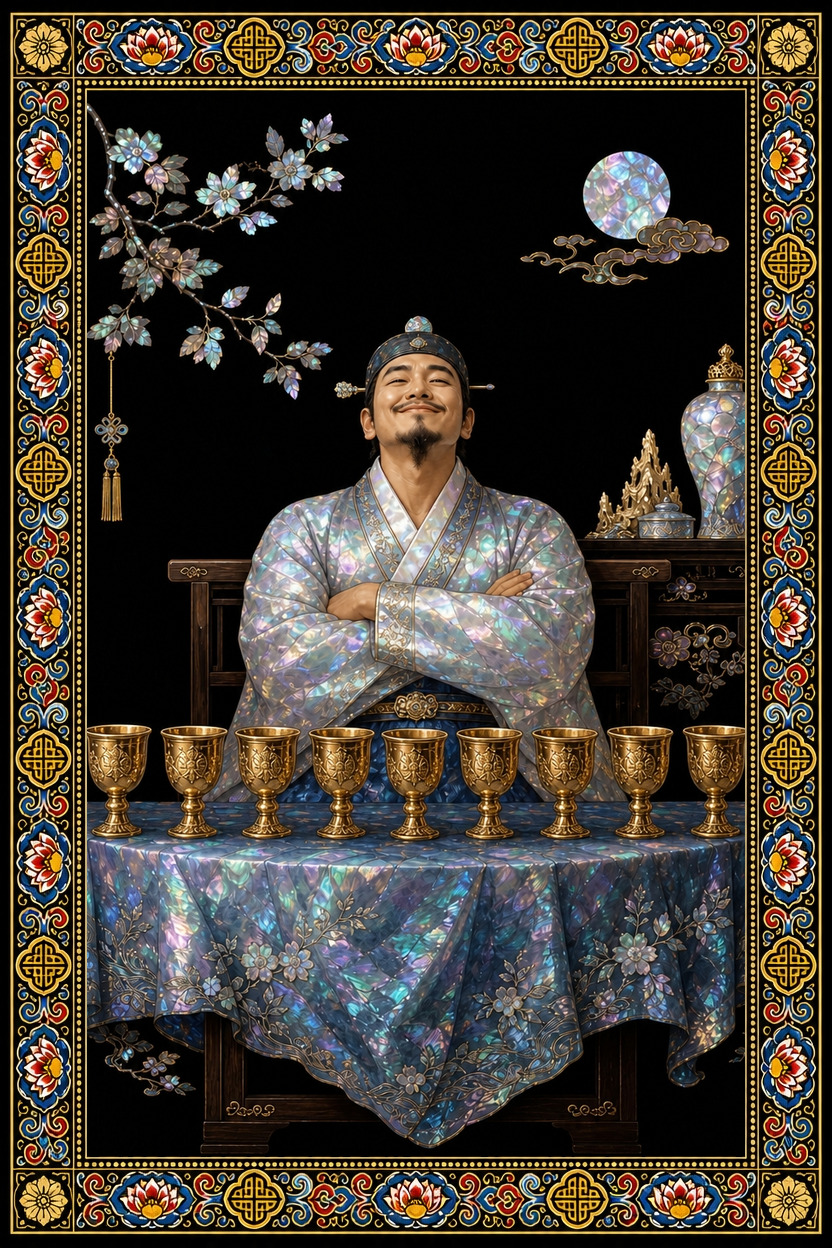
Nine of Cups — a cloth-covered table, nine cups, and a man sitting alone
Nine cups are set out, so why does he sit there without lifting a single one? This piece follows the picture of the Nine of Cups and looks at the place that remains after achievement.
『Nine of Cups』 — what this card actually draws
At the centre of the picture is a table. A blue cloth is spread over it, and on top of the cloth nine cups are set out in order. The cups do not scatter but form a single flowing line, filling the front of the table.
Behind the table sits a man. He does not hold a cup in his hand; his arms rest easily at his sides and he looks straight ahead. The distance between where the cups are placed and where the man sits is the first impression this picture gives.
Behind the man a plum branch reaches out and the moon hangs in the sky. A table that seems to be indoors and a background that seems to be outdoors overlap in one frame, so the scene is not fixed to either one.
Symbols and meaning
The nine cups gathered in order on a single table show feeling that has not scattered but has piled up in one place. In the Cups suit a cup is a vessel of feeling and relationship, so nine of them laid out one by one means that what was wished for has arrived within sight.
The blue cloth is the fabric that covers that achievement. The cups are covered rather than proudly displayed, and in that sense this satisfaction is closer to gratitude kept quietly than to showing off.
When the card stands reversed, the same cups look different. The cups are still there, but the man cannot enjoy them — a gap between what is outwardly furnished and what actually feels filled. Just as the plum branch and moon stay in the background, the joy does not enter his life but hangs there like scenery.
When this card appears
At work it tells you that a task you have held onto for a long time is entering its final stage. This is a moment for confirming results, so rather than starting the next thing, try tidying what is already in your hands.
In relationships it shows that things with the people around you have reached a stable point. But if you do not express your heart, like the man who does not lift a cup, the other person will find it hard to know that fullness.
With money, along with satisfaction in what has come in, the remaining question is how to keep it. At a moment of choice this card tilts you toward counting what you already have rather than toward gaining more.
To the person who has filled every cup and still does not reach for one, this is what the card says: "Have you ever counted what you have right now?"
History and culture: Traditional dress — silhouette, colour and station
The first thing to catch the eye in the man's dress is the shoulder line. The generous sleeves and roomy upper body show not clothing that clings to the body but a layered garment that leaves space inside.
This ease is not mere decoration but the result of layering. In a structure that builds up underclothes and outer clothes in several layers, each layer needs spare fabric, so the silhouette naturally swells and the shoulders broaden.
The question is whether that ease was permitted to everyone. Even with the same shape, the value varied greatly with the kind of fabric and the number of layers, and so it became possible to guess a person's station from the silhouette alone at a distance. This man's clothes sit in the picture as an object of exactly that kind of reading.
Common misreadings
The Nine of Cups is often introduced only as the card of perfect happiness. But the man in the picture sits without lifting a cup, showing that there is a time lag between achievement and the enjoying of it.
It is also common to read a reversed card as a flat prediction that misfortune is coming. Here it is truer to the picture to read the reversal not as disaster but as a signal to look at the gap between what is furnished and what is felt.
There is another view that takes the nine cups as all filled with what belongs to the man. The cups are on the table and the man is behind them, so this card leaves the question of facing rather than of owning.
Draw a card yourself
The picture you have just read can be placed against your own question. The same card answers differently when the question changes.
- A deck drawn in-house — 78 cards in the colours of nacre and dancheong
- Readings that read the picture, not a keyword list
- Keep asking — draw one more card for your next question
- A record you can return to and compare
- Let a friend draw for you with a single link
- Seventeen languages, one deck, one reading
More from this suit
