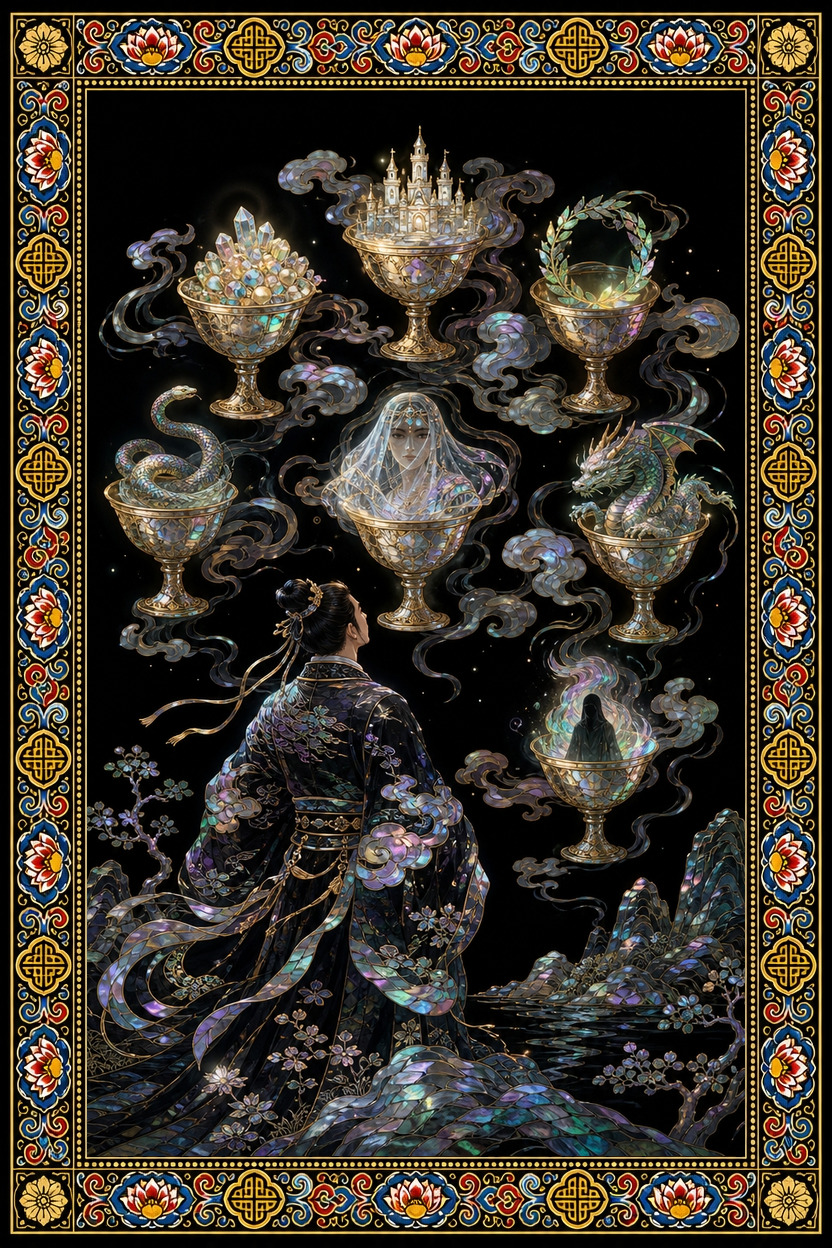
Cups · Seven of Cups
Seven of Cups — The Turned Back and the Shadows in Seven Cups
Seven cups float above the clouds, and a person stands before them with their back turned. Let us follow the gaze in the picture to see what they are refusing to look at, or perhaps what they are looking at.
『Seven of Cups』 — what this card actually draws
At the centre of the picture stands a figure dressed in long robe (traditional dress) with a dark pattern. The figure does not face the viewer but has turned their body away, sending their gaze upward. Behind them the clouds are scattered, and among those clouds float seven cups.
The cups are not arranged neatly. Their heights differ slightly, and some hang toward the front while others toward the back. Inside each cup something different is reflected: a jewel, a castle, a laurel wreath, a snake, a shrouded figure, a dragon, and a distant tower.
The figure does not pick up any one of them. Nothing is held in the hand, and the feet have not stepped in any direction. The picture captures not the moment of choice but a state halted just before choosing.
Symbols and meaning
The seven cups resemble the several desires that rise in the mind at once. The jewel, the castle and the laurel wreath each point to a different kind of achievement, while the snake and the shrouded figure point to the fear and loss that come with it. The dragon and the distant tower reflected together in one cup read as a sign that the boundary between reality and fancy has blurred.
Upright, this card describes a state in which the sense that anything is possible runs ahead of what is actually possible. The key point is that the cups float above the clouds. Enticing things hang at a height the hand cannot reach, so the mind is already over there while the body is still in place.
Reversed is the side where those clouds clear. As the contents of the cups dim or vanish one by one, what remains is the ground beneath your feet right now. Fantasy is not so much a bad thing as a signal that the moment has come to move from fantasy into an actual decision.
When this card appears
At work, you may be in a state where several things have been set in motion but none has been begun. If the ideas are plentiful but the deadline is approaching, it is better to choose one cup and hold it in your hand today. In relationships, it prompts you to ask whether you are imagining many sides of the other person while putting off the actual conversation.
With money, several offers that look highly profitable may arrive at once. The jewels in the cups glitter, but that does not mean all of them will come true, so a step of confirming the terms in writing is needed. In a phase of choosing, rather than waiting for the one perfect option, try using the size you can handle now as your standard.
While you count the cups, your gaze is still up in the clouds. This is where a story begins with a sentence like: "There are seven things I've pictured in my mind, but only one I can touch this week."
History and culture: minhwa and sipjangsaeng — the lineage of symbolic creatures
What touches the history of East Asian symbols in this picture is the snake and the dragon. In minhwa (folk painting), the dragon pairs with clouds to symbolise rain and ascension, while the snake, coiled around the body, points to something old or something hidden. In this card, however, the snake and the dragon are confined inside the cups rather than set against the sky.
The clouds of sipjangsaeng (the ten symbols of longevity) are originally painted as a medium linking sun and mountain. In flower-and-bird paintings or chaekgeori, clouds were not background filling the frame but a passage crossing a boundary. That the clouds here serve as the stage that floats the cups can be called a picture of that passage having slipped from human hands.
In magpie-and-tiger paintings the tiger appears as a watching presence, and a gaze directed off the frame creates the picture's tension. Here the owner of that gaze has shifted to the person. The composition in which seer and seen are reversed is this card's particular symbolic arrangement.
Common misreadings
First, there is a tendency to conclude that several good opportunities have arrived when this card appears. But the cups float above the clouds and the figure's hands are empty. It is more accurate to see this not as a card that counts opportunities but as one that reflects a state not yet grasped.
Second, there is the misreading of the reversed card as failure or regret. In this phase, reversed is closer to the process of fog clearing. It only makes clear what has been given up; it does not predetermine that the outcome will be bad.
Third, there is the view that treats the snake and the shrouded figure in the cups only as ominous signs. They are drawn in as the risks that accompany a choice, so try reading them as a signal to know the risk and choose anyway.
Draw a card yourself
The picture you have just read can be placed against your own question. The same card answers differently when the question changes.
- A deck drawn in-house — 78 cards in the colours of nacre and dancheong
- Readings that read the picture, not a keyword list
- Keep asking — draw one more card for your next question
- A record you can return to and compare
- Let a friend draw for you with a single link
- Seventeen languages, one deck, one reading
More from this suit
