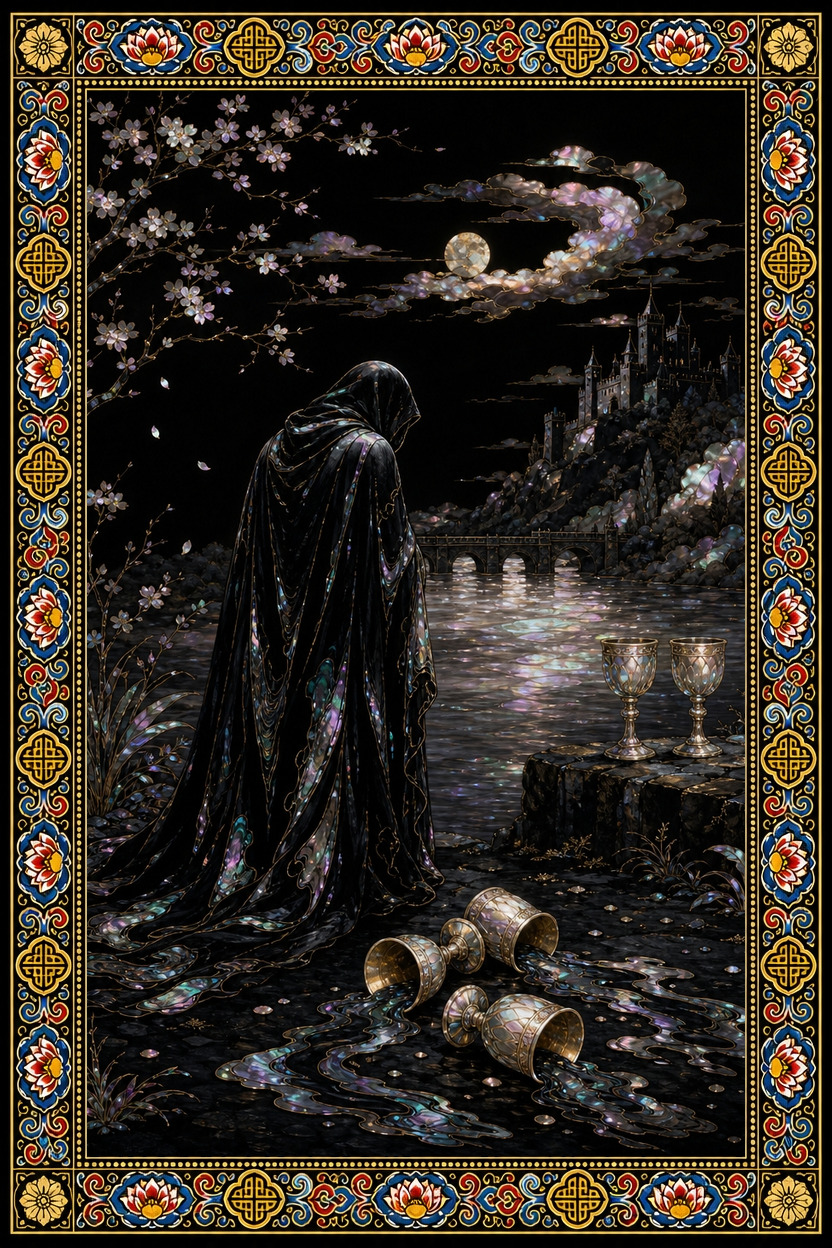
Cups · Five of Cups
Five of Cups — Three Fallen Cups, Two Still on the Stone
The cups at your feet have already fallen — so why won't your gaze move to the cups on the stone? This essay looks at how loss and acceptance are placed in a single frame in the Five of Cups.
『Five of Cups』 — what this card actually draws
At the centre of the image stands a figure wrapped in the dark folds of a long robe (traditional dress). Head bowed, turned toward a moonlit riverbank, the figure pulls the eye of the picture naturally downward. Three cups lie tipped over at their feet, and a little apart, two cups still stand upright on a stone.
Push your gaze a little further and a bridge spans the far side of the water. The figure neither turns their back on it nor moves toward it — they simply stand there. The arrangement reads as a composition meant to set what remains and what has already slipped away side by side within one frame.
The picture holds only the figure and the cups, the stone and the bridge, and the light and shadow the moonlight makes. The number and placement of the cups carry virtually the whole narrative of this card.
Symbols and meaning
The three fallen cups point to what has already left your hands. What matters is that the figure's head is turned that way. It isn't the loss itself but the direction of a gaze that keeps watching the loss which produces this card's upright meaning.
The two cups standing on the stone, by contrast, have not yet fallen. The reversed meaning begins with noticing them. You stop counting what you have lost and start counting what is left — that turn is what leads to acceptance and healing.
The bridge in the distance hints at a road not yet crossed. But because the bridge is the faintest element in the picture, this card doesn't tell you how to cross; it quietly leaves only the fact that there is somewhere to cross to.
When this card appears
At work, it mirrors a mind still attached to a project that has already collapsed or an opportunity already missed. It can be read as a signal to recount the people and resources you still have. In relationships, it asks you to check whether you are counting only what the other person has failed to give you.
With money, the stage of confirming a loss is distinct from the stage of planning recovery. Look the numbers in the face, but set aside a fixed time for looking at nothing else. Before a choice, the useful question isn't which option is perfect but which of the conditions you still have can be used.
Turning the gaze of the person standing by the river toward the stone is a smaller motion than you'd think. "Instead of counting the three you've lost, let's pick up the two still standing first" is a sentence that passes often before this card.
History and culture: dancheong — the five colours of timber painting
Applying colour to wooden architecture was a matter of preservation before it was one of decoration. Pigments were laid on to prevent the timber from shrinking and from insects and to conceal the joints, and hierarchy and symbol were layered on top. Obangsaek (the five cardinal colours) were arranged to divide direction and role, and pattern units such as meoricho and hongchang mediated between one colour and the next.
This card's image uses the opposite colour grammar. Where dancheong uses colour to draw boundaries sharply, the Five of Cups distinguishes what is lost from what remains by light and shadow alone. The difference between the fallen cups and the standing ones is marked only by position and tilt, not by colour.
Just as a fading colour blurs the hierarchy of a pattern in dancheong, so in this picture, once the gaze is fixed downward, the remaining cups are pushed into the background. Deciding where to lay colour and where to leave it empty is, in both dancheong and this card, a matter of distributing the viewer's attention.
Common misreadings
Some read the Five of Cups as a card of misfortune or of loss already settled. But the picture clearly shows two of the five cups still standing. This is not a scene of losing everything but of losing some of it.
Another common reading is that the card urges you to get over sadness quickly. The reversed position means less that you should erase the feeling than that you are ready to change the direction of your gaze. This is not a card that makes you skip the time of mourning.
Finally, some take it as an instruction to cross the bridge at once. The bridge is the most distant and faintest element in the picture. Rather than hurry your next step, this card asks you first to confirm where you are standing now.
Draw a card yourself
The picture you have just read can be placed against your own question. The same card answers differently when the question changes.
- A deck drawn in-house — 78 cards in the colours of nacre and dancheong
- Readings that read the picture, not a keyword list
- Keep asking — draw one more card for your next question
- A record you can return to and compare
- Let a friend draw for you with a single link
- Seventeen languages, one deck, one reading
More from this suit
