Cups · Six of Cups
Six of Cups — When a Child Raises a Cup in the Plum Garden
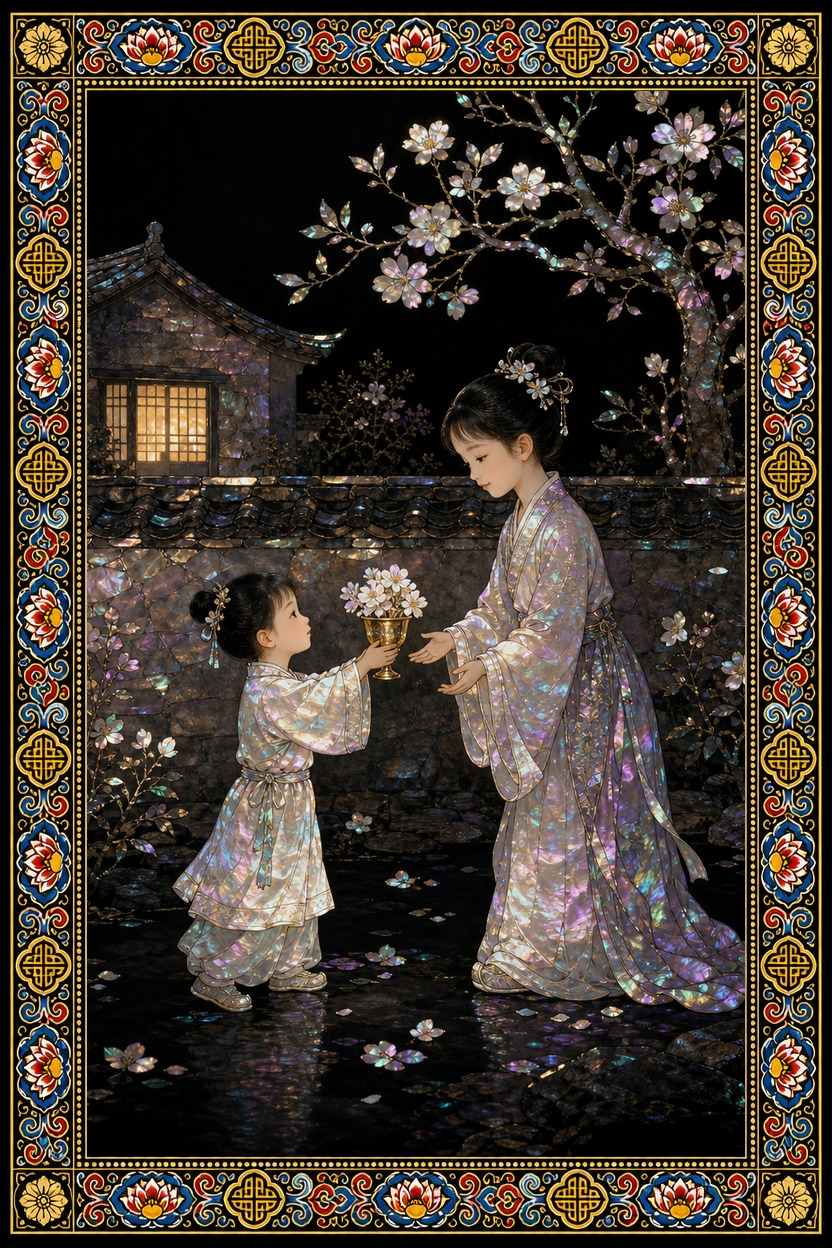
In the garden where a child and a woman stand facing each other, it is the child, not the adult, who raises the cup. What is being handed over and what is being received in this scene?
『Six of Cups』 — what this card actually draws
Your eye goes first to the two figures. In the middle of a garden where maehwa (plum blossom) is in bloom, a woman and a child stand facing each other, and the distance between them is neither close nor far. The child lifts a cup with both hands, and inside the cup are flowers.
Behind the child you can see a house with its lights on. The house is drawn with its door open, which makes it clear that this scene is not indoors but outdoors, with the house at one's back. At the bottom of the image, on a stone, several cups are set out in a row.
Put simply, this picture captures the moment just before an act of handing something over is completed. The one holding the cup is the child, and the one preparing to receive is the adult — and this arrangement largely determines the character of the card.
Symbols and meaning
It matters that what fills the cup is flowers, not wine. This is not a cup meant to intoxicate or to fill someone up, but one that carries something already in bloom from one place to another. That is the ground on which this card, upright, reads as nostalgia and simple kindness. A gesture that hands over something with no price attached — and a gesture that comes from a child's hands — is what gives it its texture of innocence.
The house behind and the cups on the stone form layers of time. The house is a place already passed through, and the cups on the stone are the past's share, left sitting there not yet sorted out. So this card is a card of reunion and at the same time holds the sense that there is still somewhere to return to.
Reversed, the weight of the same picture shifts. The hand that lifts the flowers no longer moves forward but becomes a force holding you back, and a beautified memory clouds your present judgment. You might call it a state of standing with your back to the house while still checking on it again and again. What the card points to here is growth — leaving old ties where they belong and departing from your own place.
When this card appears
At work, this is a phase in which a method learned long ago is summoned back. It reads as a signal to return to the feel of when you first learned the job, though it does not mean repeating that method exactly as it was. With money, your attention goes to places where you repay help you received in the past, or where favours that are hard to convert into a price change hands.
In relationships, reunion or contact with an old connection becomes the topic. But the reunion this card describes is closer to a simple hello than to a dramatic reconciliation. Facing a choice, you find yourself weighing what you already hold in your hand against what is newly being offered.
Like the moment in the garden when the child raises the cup, this card points to a brief silence before you decide what to accept. Sometimes a sentence like "so what that person gave me back then was really a cup full of flowers" is what reveals where this card sits.
History and culture: the Visconti-Sforza deck and the Milanese court
What is worth noticing in this card's picture is the height of the hand holding the cup. In the gold-leaf deck painted at the Milanese court in the 1440s, cups are often drawn as costly metal vessels, but the cup in this scene is small and plain enough to hold flowers. It is used not as a prop showing off courtly luxury but as a device that explains the exchange between the figures.
This deck was a noble family's possession, and each picture reflected the patron's taste and the court's way of seeing. A composition in which a child hands something to an adult in a garden was a familiar motif in the court culture of the time. But the fact that the scene was carried over into a picture for card play means this card was also an object to be held and shuffled, not only a picture of ceremony.
Expensive handcrafted cards were, from the start, objects that could not spread widely. So the story goes that details such as this card's cup and plum blossoms were simplified or altered bit by bit across later editions. This is also why it is hard to pin down the original precisely.
Common misreadings
First, the card is often read as an instruction to go back to the past. It is true that the picture holds nostalgia, but the card is closer to a mirror that lets you notice what you are missing now than to an order to return.
Second, there is the interpretation that, since this is a card of reunion, you must necessarily reconnect with an old tie. The reunion in this card says less about the meeting itself than about the temperature at which it arrives. Third, there is the view that narrows the reversed card to a warning that you must cut things off. The growth the reversed card points to is closer to sorting a relationship into one chapter of your life than to cutting it away.
Draw a card yourself
The picture you have just read can be placed against your own question. The same card answers differently when the question changes.
- A deck drawn in-house — 78 cards in the colours of nacre and dancheong
- Readings that read the picture, not a keyword list
- Keep asking — draw one more card for your next question
- A record you can return to and compare
- Let a friend draw for you with a single link
- Seventeen languages, one deck, one reading
More from this suit
