Cups · Three of Cups
Three of Cups — Three Glasses Clash at Night, Cut Wheat at Their Feet
The moment three people touch glasses, cut wheat already lies scattered at their feet. This card asks what is being shared and what is being spilled.
『Three of Cups』 — what this card actually draws
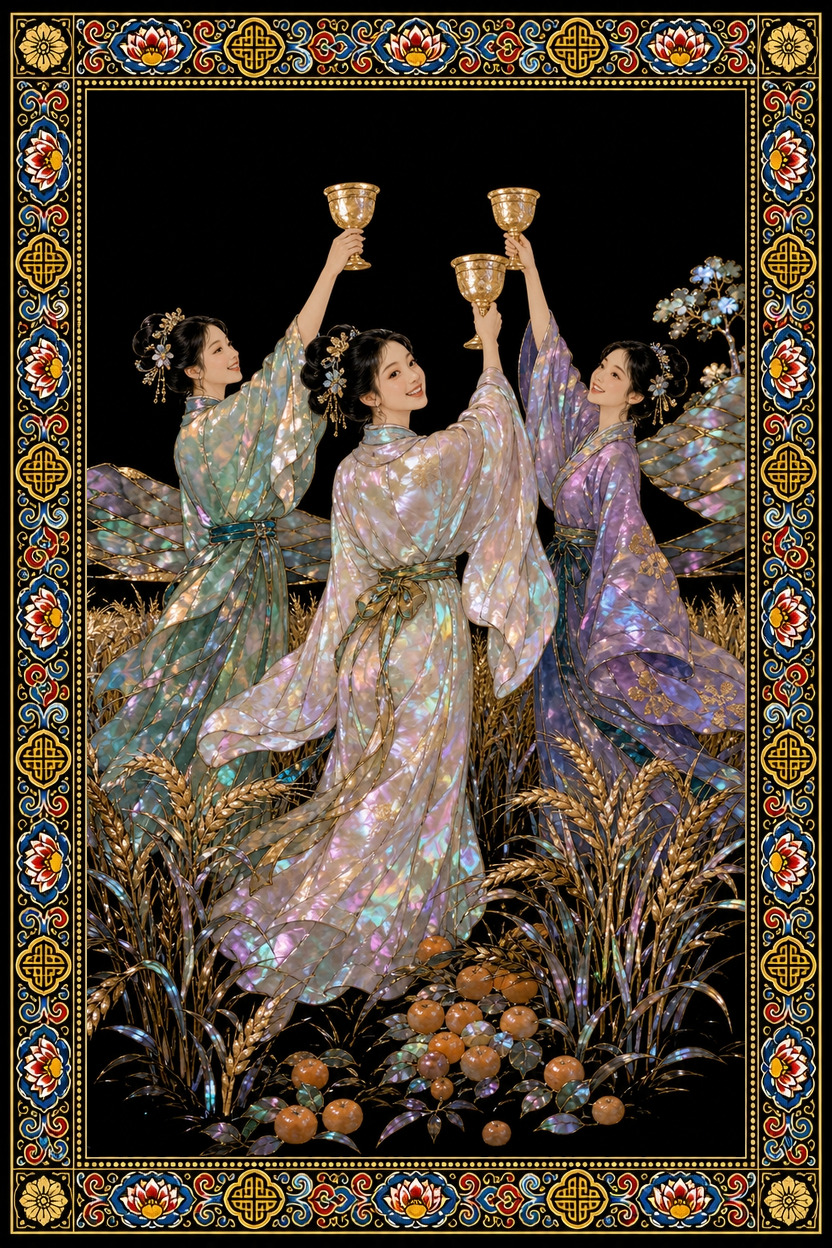
In the center of the scene, three women in long robe (traditional dress) stand side by side, raising golden cups. The moment is caught as the two women on either side of the central figure lean in slightly to touch glasses. Laughter spreads across their faces, and their gazes travel between one another's cups and faces.
Lower your eyes and cut ears of wheat and scattered fruit lie strewn at their feet. The arrangement suggests someone has brought in a harvest and is sharing it on the spot. The background is covered by the night sky, hinting that this scene takes place after the day's work is done.
The triangle formed by the three cups is the central axis of the picture. The narrow gap between cup and cup, and the laughter that fills it, is the brightest part of this card.
Symbols and meaning
The three cups mean a portion shared rather than a portion kept for one. The reason the cups stand in a row of three rather than in pairs is that this joy is not a private room for two but a gathering where many take part. It also matters that the wheat and fruit are scattered at their feet. The abundance has already been gathered, and now is the time to lift it together.
Placed in reverse, the same picture shows a different face. When the force of touching glasses goes too far, it becomes drunkenness, and the number three at some point becomes a place for a third party. This is a phase in which you must read from the relationships, not from the picture, who has intruded on these cups and who has been left out.
Just as the scattered fruit has left the gatherer's hands and remains on the ground, consider too the possibility that someone has been left out of the sharing. The brightness of this card may always be standing on someone's exclusion.
When this card appears
At work, a moment lies ahead in which achievements built alone are shared among many. The flow of collaborative work or a team-level finish is going well, but it is better to say in advance how the shares will be divided. In money matters, spending for people, such as congratulations and condolences or gatherings, may increase.
In relationships, an old connection may grow close again, or new people may naturally gather in one place. Still, look as well at who was not invited to that place. When facing a choice, rather than reaching a conclusion alone, talk it over with someone you trust, and the thread will come loose.
Where the sound of clinking glasses can be heard, a sentence like this comes up. "I think the people I worked on this with should hear about it first."
History and culture: najeon chilgi — inlaying crushed shell into lacquer
Thinking of the night sky and golden cups of the Three of Cups, the najeon craft of Tongyeong and Wonju comes to mind. The nacre artisan cuts shell thinly, sets it onto bamboo or a lacquered surface, and coats it several times with lacquer to bring out the sheen. The moment the piece is set into the dark ground, the light rises not from the surface but from beneath it. The cups and night sky here are painted, not lacquered; what they borrow is that light.
The scene of three people touching glasses resembles this as well. For each person's piece not to stand apart but to join into a single pattern, lacquer that fills the gaps between pieces must be applied several times. The lineage of patterns passed down on Goryeo and Joseon najeon boxes is, in the end, also the result of someone's fingertips filling them in again and again.
The joy of community that this card speaks of is completed in just that way. The single motion of raising a glass catches the eye, but beneath it are many unseen coats of lacquer.
Common misreadings
When the Three of Cups appears, it is easy to assume it always foretells a pleasant gathering. But this card only draws the place of sharing; it does not guarantee that the place was good for everyone. Reversed, it is a signal to look first at the person left out of that place.
Reading the three cups as only three people is also a narrow interpretation. The cups can be read as the number of portions shared rather than the number of people, and the same picture appears as collaboration at work and as a place of reconciliation in relationships. Do not carry the number of figures in the picture straight over into the number of people in a relationship.
Draw a card yourself
The picture you have just read can be placed against your own question. The same card answers differently when the question changes.
- A deck drawn in-house — 78 cards in the colours of nacre and dancheong
- Readings that read the picture, not a keyword list
- Keep asking — draw one more card for your next question
- A record you can return to and compare
- Let a friend draw for you with a single link
- Seventeen languages, one deck, one reading
More from this suit
