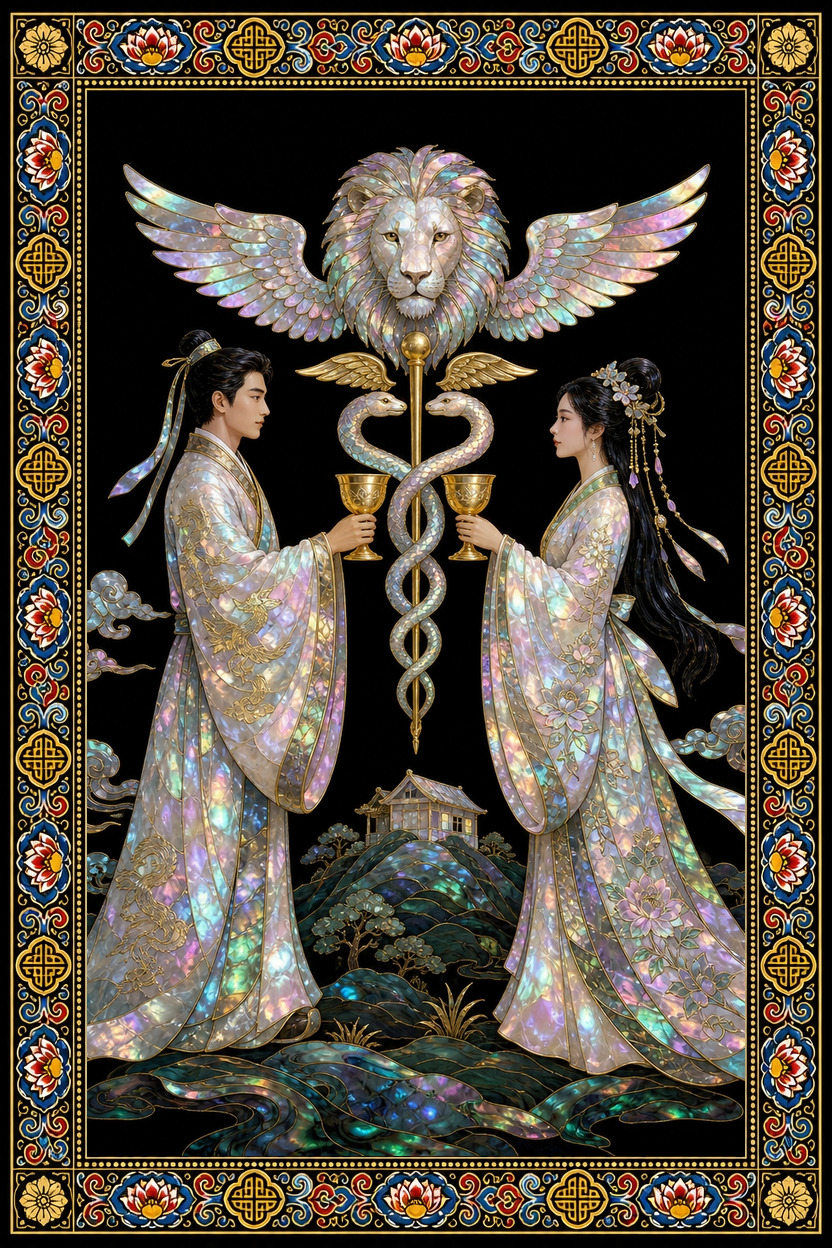
Cups · Two of Cups
Two of Cups — The Man and Woman Facing Each Other, Cups in Hand
What does it mean for two people to raise their cups at the same height? Starting from the image on the Two of Cups, this piece works through connection and balance in the language of self-reflection.
『Two of Cups』 — what this card actually draws
At the centre of the image, two people stand facing each other. A man and a woman in long robe (traditional dress) each hold a single cup, and the two cups rest at the same height. That neither is lower nor higher is the first thing to catch the eye.
Shift your gaze a little and you find, in the space between them, a staff wound with serpents and a winged lion's head hanging there. It sits neither as a thing that divides the two nor as a thing that fuses them completely. On the hill behind stands a house, showing that this scene keeps a place to return to in its background.
The figures do not tilt their cups; they lift them. Since this is not a scene of drinking but of offering to one another, the card's image catches the moment a relationship comes into being rather than its outcome.
Symbols and meaning
That the two cups sit at the same height depicts a state in which giving and receiving do not tip to one side. This is also why the Two of Cups upright points to partnership and mutual attraction: the attraction is drawn not as an excess of feeling but as a union of equals.
The staff and lion's head hung between the two read as a third element entering this union. The serpent-wound staff is an old symbol, but in this image it mediates between the two rather than fully filling the space. The harmony of this card, then, is not one that maintains itself; it is a harmony that carries, together, whatever is placed between.
The reversed position deals with the state in which that balance has slipped. When the cups sit at different heights, only one side ends up tilting to drink, and that is where tension and misunderstanding arise. What this card says when it appears reversed is not that a relationship has failed, but a signal to check where your own cup stands before you look at the other person's.
When this card appears
At work, harmony with the person you work alongside comes to the fore. Progress comes when you align opinions at the same height rather than deciding alone. Conversely, if roles have piled onto one side, that distribution is what needs fixing first.
In relationships, you look at the attraction between two people and its balance together. It is the moment feelings are confirmed, but the question is whether those feelings lead to an equal exchange. In matters of money, joint expenses or contracts — things two people sign together — come into relief.
At a point of choice, the question is not which of two options to pick but how to align the terms between two people. Ask yourself whether the hands holding the two cups are at the same height. "This was a story about checking where your own cup stands before you go peering into the other person's."
History and culture: America, Britain and the modern tarot
What is worth noticing in this card's image is that the two figures wear the clothing of a particular era. Because the Waite-Smith deck appeared in the early twentieth century and then travelled across America, this scene was printed not as a universal image of man and woman but in a specific style of dress. It means the picture stayed a concrete scene rather than resting in abstract symbol.
As New Age thought met psychology in the later twentieth century, the way people read tarot changed too. The Two of Cups in particular was often reread in psychological vocabulary — projection and mutuality in relationships. As the simple visual element of the cups' height meshed with the concept of mutuality, the card's meaning widened from a card of romance to a card of relational dynamics.
Modern reading accepts this expansion with care. What is grounded in the image is the equality of the two cups and the mediating object between them, and it is safer to leave any psychological interpretation beyond that to the reader.
Common misreadings
Many people conclude, when the Two of Cups appears, that it means a romantic relationship. But what the image shows is two people meeting as equals, and that need not be a romance. It could be colleagues or friends, or even two sides of yourself.
Another misreading is that this card means harmony and nothing else. The staff and lion's head hung between them suggest that a union always comes with a mediator. It does not mean the absence of conflict; it asks whether you can still raise your cups with conflict set between you.
Reading the reversed position as the end of a relationship is also an overreach. Reversed is only a signal that the balance has shaken, and that signal usually points not at the other person but at checking where your own cup stands.
Draw a card yourself
The picture you have just read can be placed against your own question. The same card answers differently when the question changes.
- A deck drawn in-house — 78 cards in the colours of nacre and dancheong
- Readings that read the picture, not a keyword list
- Keep asking — draw one more card for your next question
- A record you can return to and compare
- Let a friend draw for you with a single link
- Seventeen languages, one deck, one reading
More from this suit
