Cups · Ace of Cups
Ace of Cups — A Hand from the Clouds Lifts an Overflowing Chalice
What does a hand holding a cup that spills over invite you to do? Starting from the details of the picture, this essay looks at how the card draws the first scene of emotion.
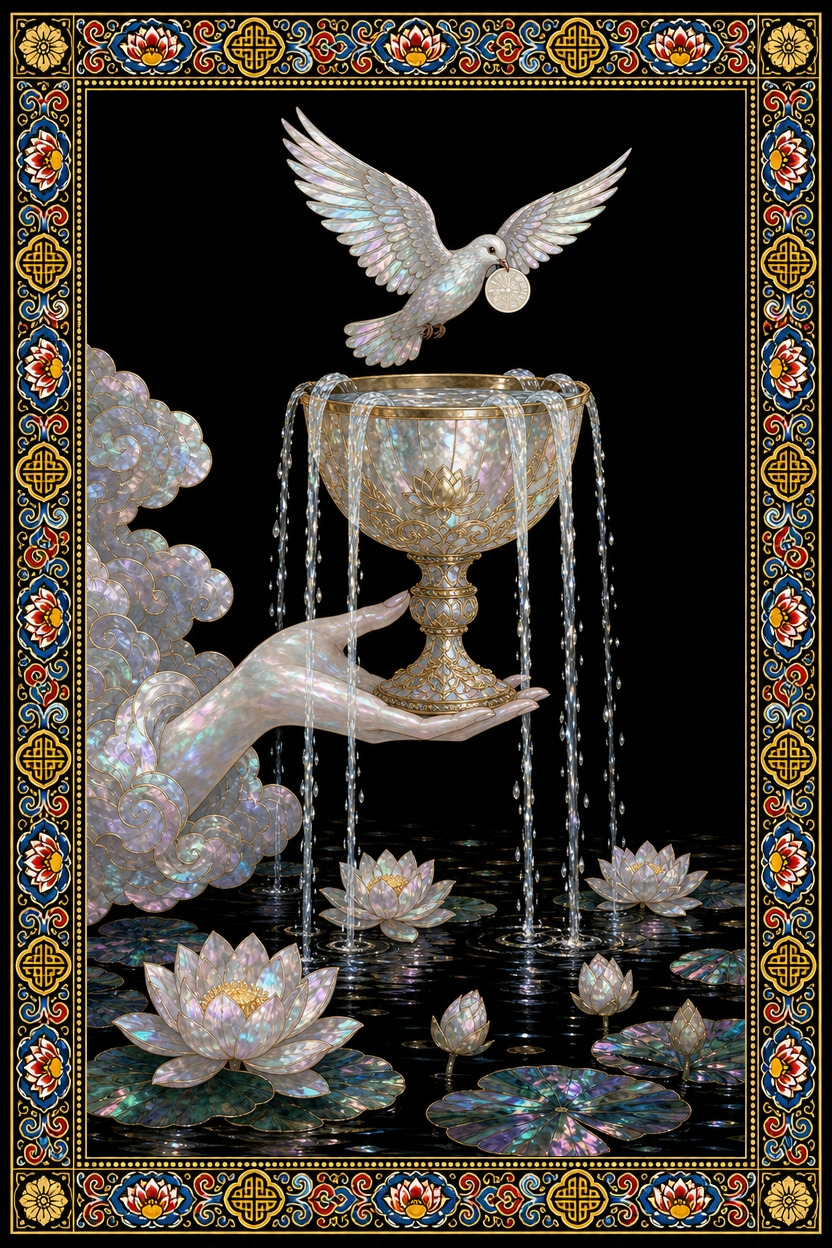
『Ace of Cups』 — what this card actually draws
At the top of the image a cloud billows up, and from the cloud a single hand emerges. The hand holds a wide golden chalice, tilting it slightly. From the rim of the cup water streams down in several branches and falls into the pond below.
Lotus flowers float on the pond, and the water keeps flowing over them. Just above the chalice a white dove is flying, carrying a small round piece in its beak. There is no human face in the picture, and no landscape behind it. There are only the hand and the cup and the water, and the bird.
The eye moves naturally from top to bottom. From cloud to hand, from hand to cup, from cup to streams of water, from streams to pond — this downward path is the backbone of the card. The picture is complete in the single fact that something is being carried from above to below.
Symbols and meaning
The chalice is a vessel that holds feeling. What matters is that the vessel is not closed but tilted. It is not a vessel for keeping things in but one for letting them out. That the water never runs dry but keeps overflowing is the picture's promise that feeling comes from a source that does not run out.
The round piece the dove carries is set above the mouth of the chalice. The arrangement — a bird looking down from above and heading toward the cup — gives the nuance that feeling does not simply well up on its own but is handed down from above. The lotus in the pond shows that the water flowing in has already found its place and bloomed.
Read in reverse, the card brings to mind a scene where this flow is blocked. The cup does not tilt, or the water overflows but nothing below receives it. It is closer to the picture to see this not as an absence of feeling but as a flow whose direction has gone wrong. The card becomes a question: are you ready to receive, or is now the time to let something out?
When this card appears
At work, this is a phase in which your heart moves before anything else on something long postponed. You may want to begin before the plan is finished. Build on that feeling, but since it overflows, try to pace yourself so you don't rush.
In relationships, it is a sign that feelings you had not expressed are about to come out. You may lean toward speaking first or revealing your heart to the other person. But look at the size of the vessel the other person can receive alongside the amount you pour out.
With money, resources may come in from an unexpected place, or, conversely, spending driven by feeling may arise. When you face a choice, check where your heart leans before you check the logic. This card enters a reading with the words, "I'd like to look once at where this feeling is coming from."
History and culture: the old grammar of number and figure
The card's number, 1, does not mean the first term in a count but the ground on which the other numbers are stacked. In ancient number theory, 1 was treated as an undivided state, a wholeness before it splits into two. The picture of the chalice's water running down in several branches yet coming from a single cup is a visual translation of that idea.
The shape of the cup has its own grammar. A vessel wide at the top and narrow at the bottom has a structure that separates the opening that receives from the body that holds. In medieval European chalice iconography this form was used as a vessel marking consecration and reception at once. The depiction of overflowing water draws not fullness but spilling over, which brings it closer to the image of a source that does not stop at being filled.
The lotus set in the pond is an element borrowed from East Asian iconography. A flower that rises from the mud yet floats on the water was long used as a symbol of a mind that is not clouded. The point where vessels from two different traditions meet on one screen is the iconographic signature of this card.
Common misreadings
The card is often read only as a forecast that "new love is certain to arrive." But what the picture shows is not a weather report of events but the starting point of feeling. The hand holding the cup came down from above; a person did not seize it.
Another misreading is to conclude that the overflowing water means an excess of emotion. Spilling over is overflowing, not out of control. The streams of water are heading toward a fixed place, the pond.
Finally, there is the view that treats this card as one that guarantees an outcome. The chalice draws only a beginning, not a completion. Try using this card to check where your heart is heading right now.
Draw a card yourself
The picture you have just read can be placed against your own question. The same card answers differently when the question changes.
- A deck drawn in-house — 78 cards in the colours of nacre and dancheong
- Readings that read the picture, not a keyword list
- Keep asking — draw one more card for your next question
- A record you can return to and compare
- Let a friend draw for you with a single link
- Seventeen languages, one deck, one reading
More from this suit

