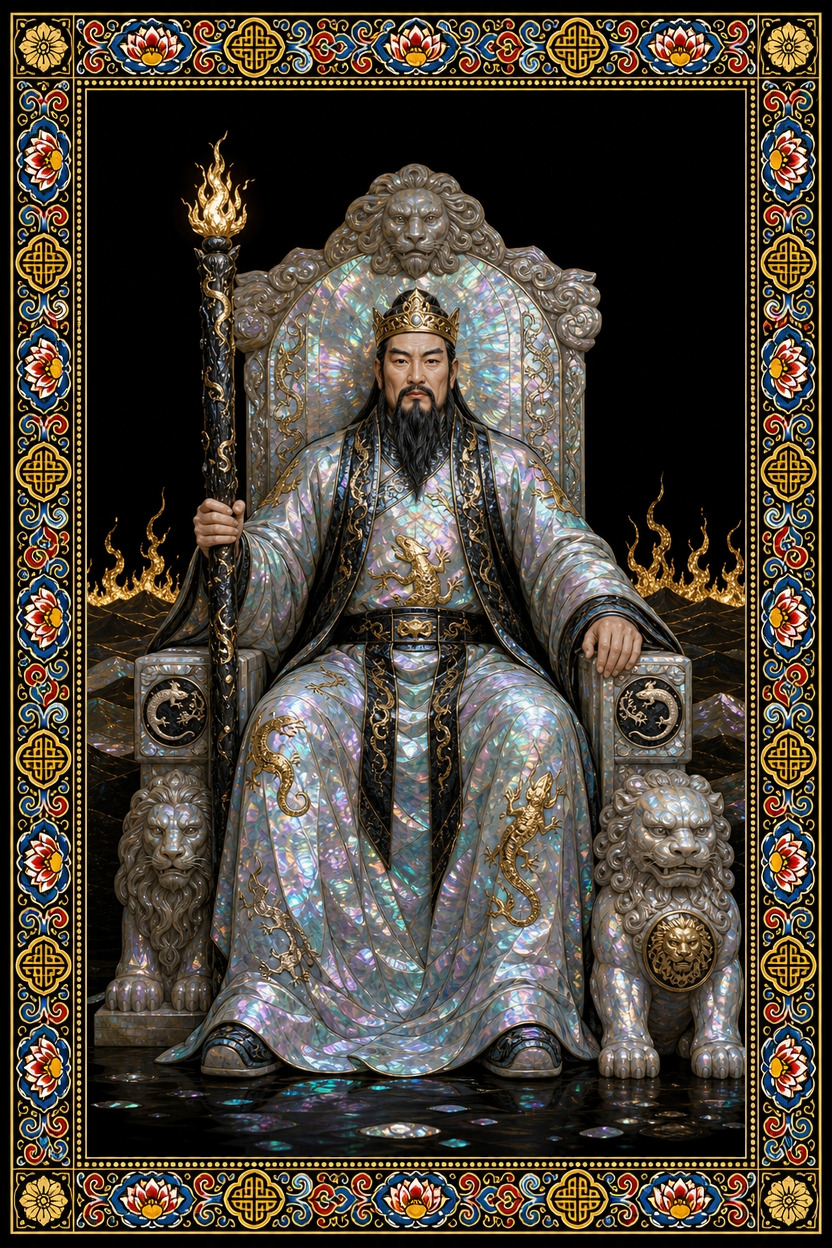
Wands · King of Wands
King of Wands — A Bearded King on a Lion-Carved Throne
Why does the king with the flaming staff sit above carved lions? Following the arrangement of the picture, we look at the light and the shadow of the leadership this card describes.
『King of Wands』 — what this card actually draws
A bearded king occupies the middle of the card, seated on a stone throne. A lion is carved into the backrest, and more lions crouch along the base of the throne. The king has turned his body slightly to one side but gazes straight ahead.
Follow his gaze upward and you find the staff in his hand. A flame burns at its tip, and a second flame burns separately beside it. The crowned head and the straight staff together form the vertical axis of the picture.
The lions of the throne and the flame in his hand are the two centres of the image. His posture, seated yet angled forward, leaves an impression closer to departure than to rest.
Symbols and meaning
The lion is an ornament carved into the throne, but it also speaks for the king's character. What stands out is that it is placed as a structure that supports power rather than a seat that shows it off. So the upright card reads less as inborn dominance and more as the drive that carries other people forward.
The flame at the end of the staff can be seen as a will that has chosen its direction. That there are two flames is interesting as well: one is in his hand and the other is outside it. One way to read it is as a situation in which he handles his own passion and the heat burning around him at the same time.
Reversed, the same elements twist. The force the lion stands for turns toward pressing other people down, and only the flame in the hand remains while the flame beside it goes out. It can be read as a state in which only stubbornness is left where the vision used to be.
When this card appears
At work it reads as a sign that you are in a position where you have to step forward and set the direction. Still, rather than reaching conclusions alone, it is better to check the flames around you, meaning your colleagues' enthusiasm, and match your pace to theirs.
In relationships, both the wish to lead the other person and the wish to respect their pace come to the surface. It is worth asking whether the arrangement has hardened so that one side always holds the initiative.
In matters of money and choice, boldness becomes a strength, but confidence without grounds should be watched for. Sitting on the throne means you are in the position to decide; it does not mean you can skip the checking.
The card's question often continues in a sentence like this: "You are the one leading, so ask once whose sake that flame is burning for."
History and culture: card printing — woodblock, stencil, lithograph
If you look for traces of printing technique in this card, the lions carved into the throne are worth noticing. In early woodblock cards, fine patterns like these were expressed only through the lines of the engraving. The thickness of a line was the light and shade, so the engraver's blade stood in for the lion's mane.
Fifteenth-century cards used stencils to lay on colour. The outline was printed from the block and then filled in by hand, so even cards from the same block could differ slightly in the colour of the flames. That the two flames in this card look different in character is not unrelated to that tradition.
As mass printing took hold in eighteenth-century France, the division of labour between outline and colouring grew more refined, and nineteenth-century lithography and chromolithography opened the way to printing several colours in a single pass. It was in this period that the stone texture of the throne and the shading of the flames became sharper on the printed surface.
Common misreadings
People sometimes conclude that the King of Wands means success is on its way. But this card draws an attitude rather than an outcome. Being in the leader's seat does not guarantee results.
It is also common to take the reversed card as a sign of power hunger or of a bad person. In practice it more often points to a state in which the vision has wavered or the way of pushing things forward has grown rough, so it is not well suited to judging someone's character.
Another misreading limits this card to people who are always leading others. The attitude of pushing one's own work through to the end can be read from the same picture as well.
Draw a card yourself
The picture you have just read can be placed against your own question. The same card answers differently when the question changes.
- A deck drawn in-house — 78 cards in the colours of nacre and dancheong
- Readings that read the picture, not a keyword list
- Keep asking — draw one more card for your next question
- A record you can return to and compare
- Let a friend draw for you with a single link
- Seventeen languages, one deck, one reading
More from this suit

