Wands · Page of Wands
Page of Wands — A Youth Plants His Staff in a Dry Field
Why does the youth standing alone in the dry field plant his staff in the ground and gaze at something far away? This essay looks for the card's meaning in the direction of that gaze.
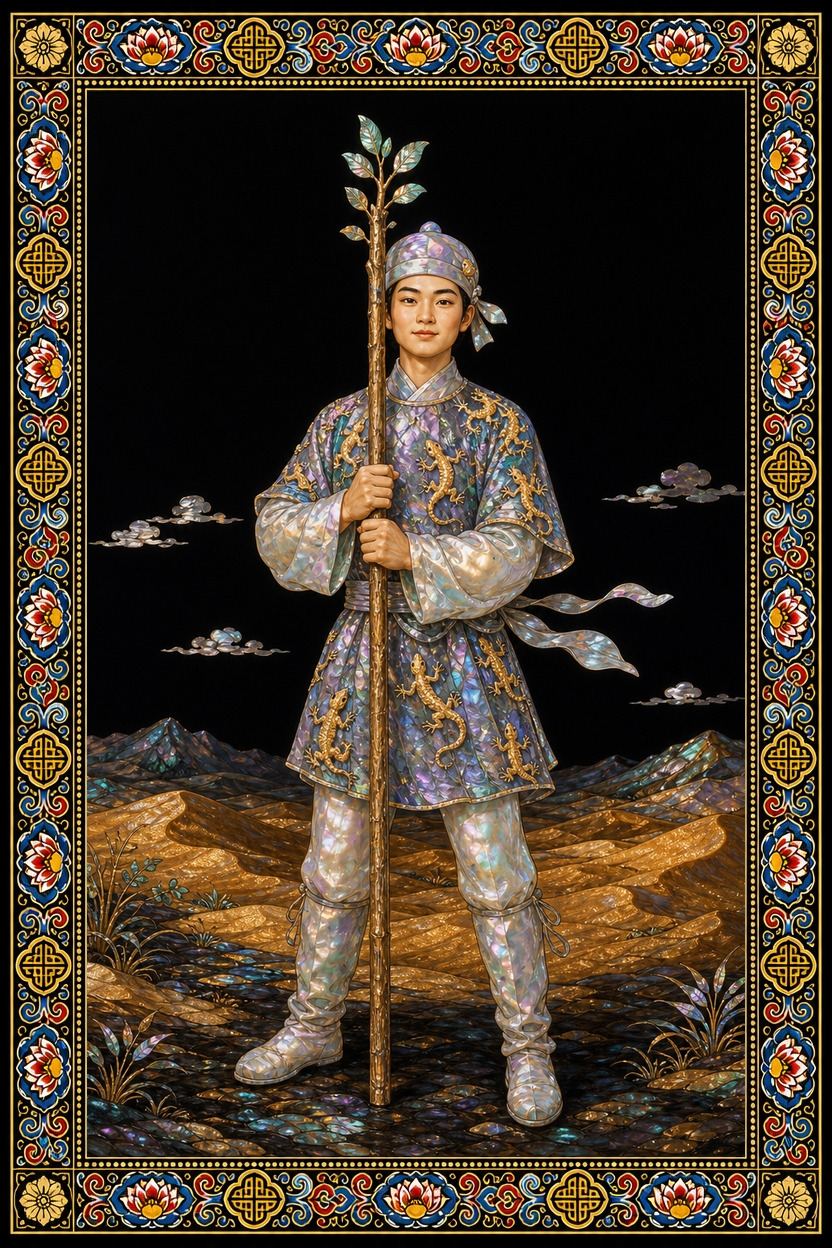
『Page of Wands』 — what this card actually draws
At the center of the picture stands a young person with a hood over his head. Dressed in patterned clothing, he holds a single staff planted upright in both hands, and the staff rises a little above his body. Beneath his feet is a dry field without a single blade of grass.
Shift your gaze a little and hills roll gently in the background, with clouds resting above them. The figure has his head raised toward those hills and clouds. Nothing grows in the field, yet there is no hesitation in his posture.
The scene holds only the person, the staff, the field, the hills, and the clouds. So it reads first as a question of what he is looking toward rather than what he is doing.
Symbols and meaning
The planted staff resembles fire energy that has not yet bloomed. The vitality of the Wands suit is still at the youthful stage of the Page, so it appears as a posture of beginning rather than of achievement. The dry field is the place where results are not yet visible, and the hand that will not let go of the staff is the heart of this card.
Upright, the card points to the moment curiosity turns into movement. The wish to try something leads to a concrete first action, and along the way welcome news arrives. The gaze toward the hills and clouds reads as the thrill of somewhere you have not yet been.
Reversed, the same energy fails to gather in one place. The staff is still held up, but the field is still dry, and beginnings repeat over and over. News you were expecting may sound hard to trust, or, the other way around, nothing stirs your excitement and you spend the day restless.
When this card appears
At work it reads as a signal to try your hand at something you are not yet used to. The weight falls on the first step itself rather than on a big result, so start small with the attitude of a learner. In relationships, this is a time when you feel like speaking to the other person first. Still, if your excitement runs ahead you may lose track of their pace, so it is better to match steps one at a time.
With money, it suits the stage of lightly testing a new source of income or a side project. Small attempts come before big decisions, and it is safer not to rush the results. At a point of choice, the card leans toward picking one thing and moving rather than waiting for a perfect answer.
From the person standing with the staff planted, looking at the hills, comes a line like this: "There's something I want to try, but I don't know if it will work out." The sentence comes not from a lack of conviction but from not having walked the road yet.
History and culture: the Egyptian origin myth and its refutation
The Egyptian origin story spread widely in the late eighteenth century, when Court de Gébelin argued that tarot came from the visions of Egypt. But once historians traced the deck to a card game, that claim was refuted in the literature. The imagery of this card sits within that current of refutation.
It is hard to find anything Egyptian in the Page of Wands. The hooded youth, the dry field, the hills, and the clouds are closer to the dress and landscape depiction of nineteenth-century European prints. The custom of drawing a court figure on Page cards likewise continued from European playing-card imagery.
In the end, the roots of this card lie not in ancient Egypt but in modern European print culture. Whether or not you believe the origin story, telling apart where the picture itself came from is more practically useful for reading this card.
Common misreadings
It is common to read the Page of Wands only as childlike innocence or immaturity. But the figure in the picture holds the staff straight and stares into the distance, so a gaze that has set its direction stands out more than naivety. Youth here means not immaturity but a state in which results are still to come.
It is also hasty to take this card as confirming that good news will soon arrive. The card reflects the curiosity and preparation directed toward news more than the arrival of the news itself. Even when news comes, the task of catching hold of it still belongs to the reader.
Some read the reversed card as failure or a lack of talent. The field in the picture is drawn dry no matter the orientation, so it is closer to the artwork to see the reversal as energy scattered rather than as a question of ability.
Draw a card yourself
The picture you have just read can be placed against your own question. The same card answers differently when the question changes.
- A deck drawn in-house — 78 cards in the colours of nacre and dancheong
- Readings that read the picture, not a keyword list
- Keep asking — draw one more card for your next question
- A record you can return to and compare
- Let a friend draw for you with a single link
- Seventeen languages, one deck, one reading
More from this suit
