Wands · Ten of Wands
Ten of Wands — A Man Carrying Ten Staffs Home Under the Moon
There is a limit to what one person can carry. This card reads the weight of responsibility in the back and the stride of someone who has reached that limit.
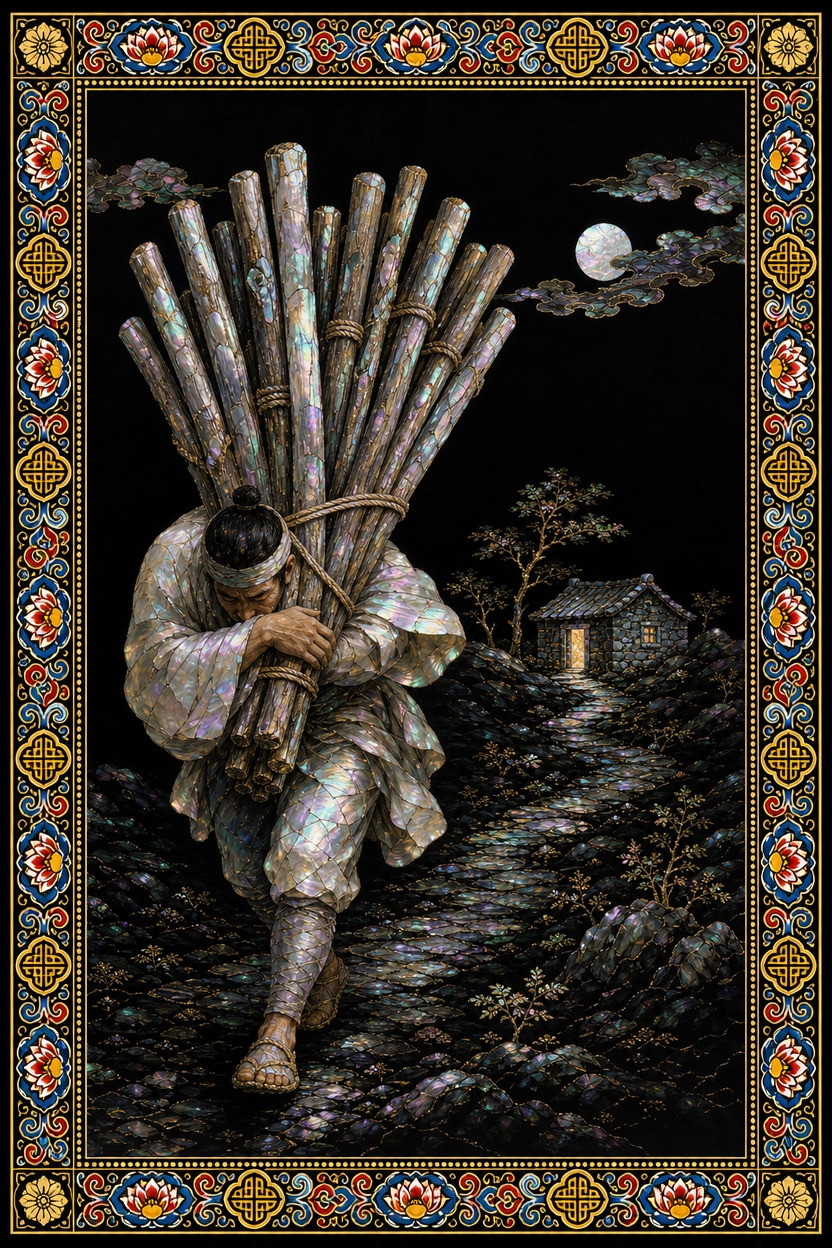
『Ten of Wands』 — what this card actually draws
Near the front of the image, ten staffs are bound together. A man carries them on his back and walks forward with his waist bent almost to a right angle. The staffs are longer than he is tall, so the first thing that catches the eye is that the load is bigger than the person.
Lower your gaze and you see what he is wearing. It is long robe (traditional dress), a short jacket (the short jacket of long robe) and trousers, and it is practical: the sleeves are not wide, and the ankles are exposed. Both hands grip the cord that holds the staffs, and his head is bowed so that his face is hard to see.
Above in the background, clouds hang and a full moon rises behind them. He is heading toward a path that leads to a house, and the moonlight only just lights that path. There is only one person in the frame, and no one appears to share the load.
Symbols and meaning
Ten is the highest number in the suit of Wands. If one staff is one will and one responsibility, then the moment ten are bound onto a single body they stop being strength and become weight. The man in the picture is bent not because he is weak but because the total load has grown larger than the human body.
Upright, this card points to the stretch where you squeeze out the last of your strength. It is the state in which the house looks close but your steps slow down, the state in which the list of things to do does not get shorter. The setting of a risen moon also suggests that the day's work is not yet over.
Reversed, the direction changes. It is the choice to set the staffs down or hand some to someone else, and the practice of saying you will not carry them any longer. But since the only thing in the picture is the figure bearing the load, reversed may be the moment after collapse or the moment of acting before it.
When this card appears
At work, this card lands when the share you have to handle alone has reached its limit. If a deadline is close and no one comes to mind to delegate to, the card points to that very blankness. In money, it reads as a phase in which fixed expenses and responsibilities overlap and cash flow grows tight.
In relationships, it shows up as a sign that one side keeps carrying the load. Roles may have hardened before the other person noticed. In matters of choice, you find yourself weighing whether to push on recklessly because the remaining road is short, or to set the load down for a while.
To the person looking at the house with the staffs on their back, the message is this: "You have come this far. But must you carry that load through the door as well?"
History and culture: Traditional dress — silhouette, colour and station
What stands out in this man's clothing is the sleeves and the cut of the legs. The short jacket sleeves are narrow and the trouser legs taper at the ankle, far from the wide sleeves of formal attire. This silhouette shows the direction working people's clothing took. In the late Joseon period, commoners' dress was trimmed toward narrower sleeves and legs, weighing movement and cost together.
Colour and material are hard to pin down in this picture. It is widely known, however, that in dress history the kind of cloth and the difficulty of dyeing served as markers of station and ceremony. The clothing of those who could afford costly fabrics and vivid dyes was distinguished from that of those who could not before silhouette ever came into it. The clothes this figure wears sit at the lower end of that divide.
What is interesting is that this figure carries ten staffs in that outfit. It is a movement made possible because these are work clothes rather than formal attire, and at the same time it is a scene of enduring weight precisely because they are work clothes. The silhouette of the clothing tells you where this person stands.
Common misreadings
First, there are readings that take this card only as a notice that "it will soon be over." Because the house is in sight, it is easy to assume the last step is light, but the man's posture shows that this is in fact the heaviest point. The closer the end, the more sharply the weight of the load is felt.
Second, there is the reading that settles on reversed meaning "failure" or "giving up." Setting the staffs down is not the same as collapsing, and sharing them with someone is not a lack of ability. The fact that no one else is in the picture only tells you that this decision is one you must make alone.
Third, there are those who take this card to mean they should avoid responsibility. The card speaks not of avoidance but of distribution. I would encourage you to decide for yourself what you will keep carrying and what you will set down.
Draw a card yourself
The picture you have just read can be placed against your own question. The same card answers differently when the question changes.
- A deck drawn in-house — 78 cards in the colours of nacre and dancheong
- Readings that read the picture, not a keyword list
- Keep asking — draw one more card for your next question
- A record you can return to and compare
- Let a friend draw for you with a single link
- Seventeen languages, one deck, one reading
More from this suit
