Wands · Nine of Wands
Nine of Wands — The Bandaged Figure Leaning on a Staff
A man stands leaning his body on a single staff. Is this the posture of someone who has endured, or of someone whose guard has not yet come down?
『Nine of Wands』 — what this card actually draws
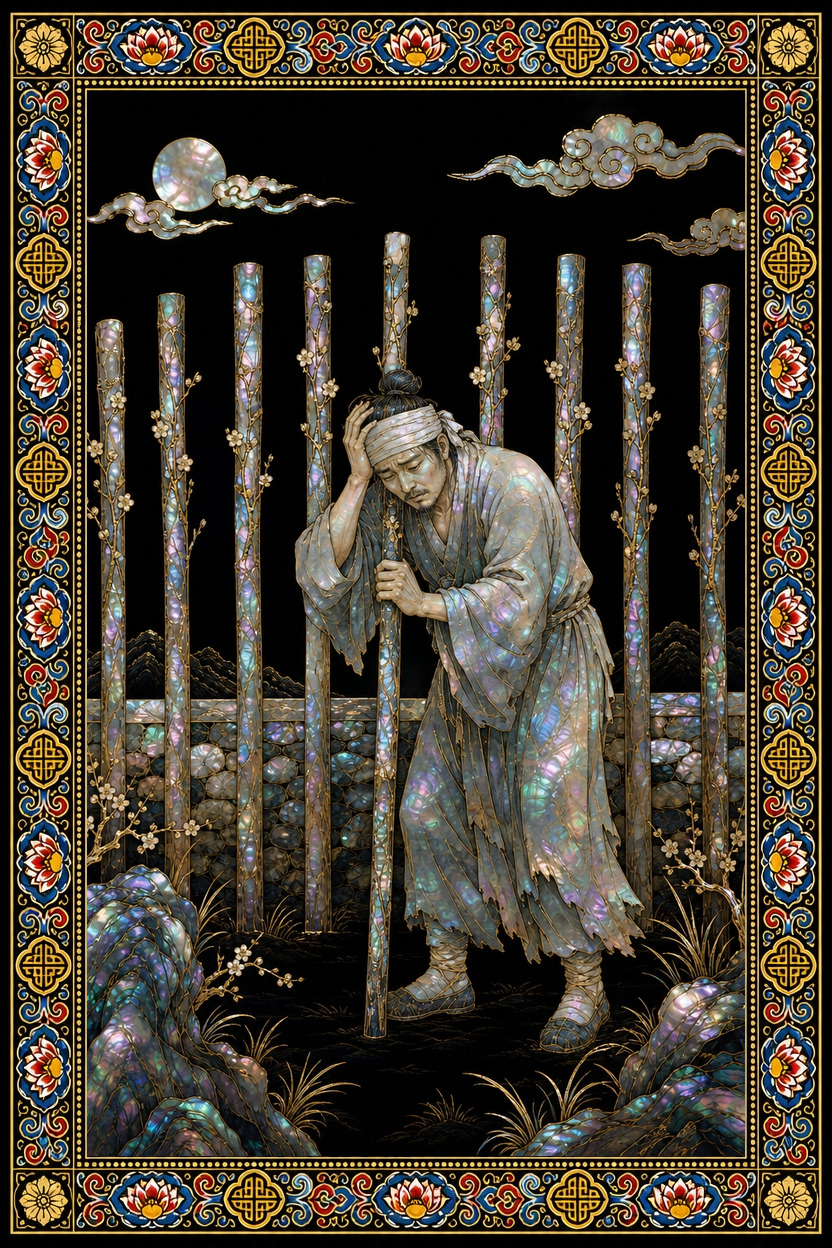
In the foreground of the card stands a man. He grips a long staff with one hand and rests the other against his forehead, his head slightly bowed. A bandage is wrapped around his head, showing some recent injury or strain.
Behind him, eight staffs stand in a row. Lined up like a fence, they seem to mark the ground he has already crossed, and he stands alone before them. Dry grass lies underfoot, and beyond a low wall there are clouds and a pale moon.
The eye moves from the figure's face to the bandage and the hand at his brow, then back to the arrangement of staffs behind him. There is no one else anywhere in the frame. This card does not draw a scene of many people together but a scene of one person holding out alone.
The stance of leaning his body against a single staff looks like that of someone who has spent all his strength. Yet he has not fallen. This subtle difference is the starting point for reading the card.
Symbols and meaning
Upright, this card speaks of the sense that you are almost there. The eight staffs behind him are the share already passed, and the one he holds is the last stretch still remaining. The bandage reads not as a wound but as the trace of what piled up while he crossed that stretch.
The hand at his forehead is a posture that never quite lets its guard down. He is not resting but catching his breath for a moment while watching what lies ahead. The persistence in this card, then, is not a blind charge but a patience that keeps watching the situation even while exhausted.
Reversed, the same posture shows another face. Leaning becomes clinging rather than enduring, and vigilance hardens into suspicion. It reflects a heart that wants to give up because the strength will not release even with the end in sight, or a state in which defences have grown so rigid that no one is let in.
The moon and clouds in the picture tell us this scene is taking place at night. The fatigue of someone who had to keep standing even in hours when no one was watching lies over the whole card.
When this card appears
At work it points to exhaustion just before a task that is close to finished. The results may be in sight while body and mind are already spent, so check the pace of your recovery before you check how much work is left.
In relationships it reads as a phase in which you wear yourself down by constantly watching the other person. There are moments when caution is needed, but once it hardens, the room to grow close disappears. With money, look after what you have protected this far all the way to the end, but ask yourself whether anxiety has made you shrink back more than necessary.
Before a choice, you stand at the point where the wish to step back collides with the wish to see it through to the last. Even bandaged, he is standing. The sentence "I've come this far — is it right to set it down now?" comes up often before this card.
History and culture: the 1909 Rider-Waite-Smith deck and the standardisation of symbols
What is worth noticing in this card is the specific gesture the figure makes. The hand at the forehead, the lean on the staff, the stance facing the staffs behind him — these details cannot be found in the minor cards of the era before illustrated scenes.
Drawn by Pamela Colman Smith under the direction of Arthur Edward Waite, this deck gave the minor suits scenes as well. As a result, the basis for interpretation shifted from the combination of number and suit to what the figure is doing. In the case of the Nine of Wands, the bandage and the leaning posture are read before the number nine.
This change widened the range of interpretation but also increased reliance on the picture, since the same nine can mean different things depending on the posture the figure stands in. When you look at this card, I would suggest checking the figure's body language first.
Common misreadings
Some read this card as a card of assured victory. But the figure in the picture is still only standing with one staff in his grasp, and the last stretch remains. This card draws not completion but the tension just before it.
Conversely, it is also common to see it only as a card of injury and failure. The bandage is evidence of a wound and at the same time a sign that the dressing has been finished. Balance comes only when you read together the fact that he is standing, not fallen.
Another misreading takes this card as recommending isolation. It is true that there is no one else in the picture, but that is a description of the situation, not advice. Whether what you need now is time alone or someone's help is decided not by the card but by your circumstances.
Draw a card yourself
The picture you have just read can be placed against your own question. The same card answers differently when the question changes.
- A deck drawn in-house — 78 cards in the colours of nacre and dancheong
- Readings that read the picture, not a keyword list
- Keep asking — draw one more card for your next question
- A record you can return to and compare
- Let a friend draw for you with a single link
- Seventeen languages, one deck, one reading
More from this suit
