Wands · Knight of Wands
Knight of Wands — Where the Sparks Rise Beneath the Hooves
When the horse rears and the staff points at the sky, has the rider already set off? In the Knight of Wands we follow the direction of the movement and the line of the gaze.
『Knight of Wands』 — what this card actually draws
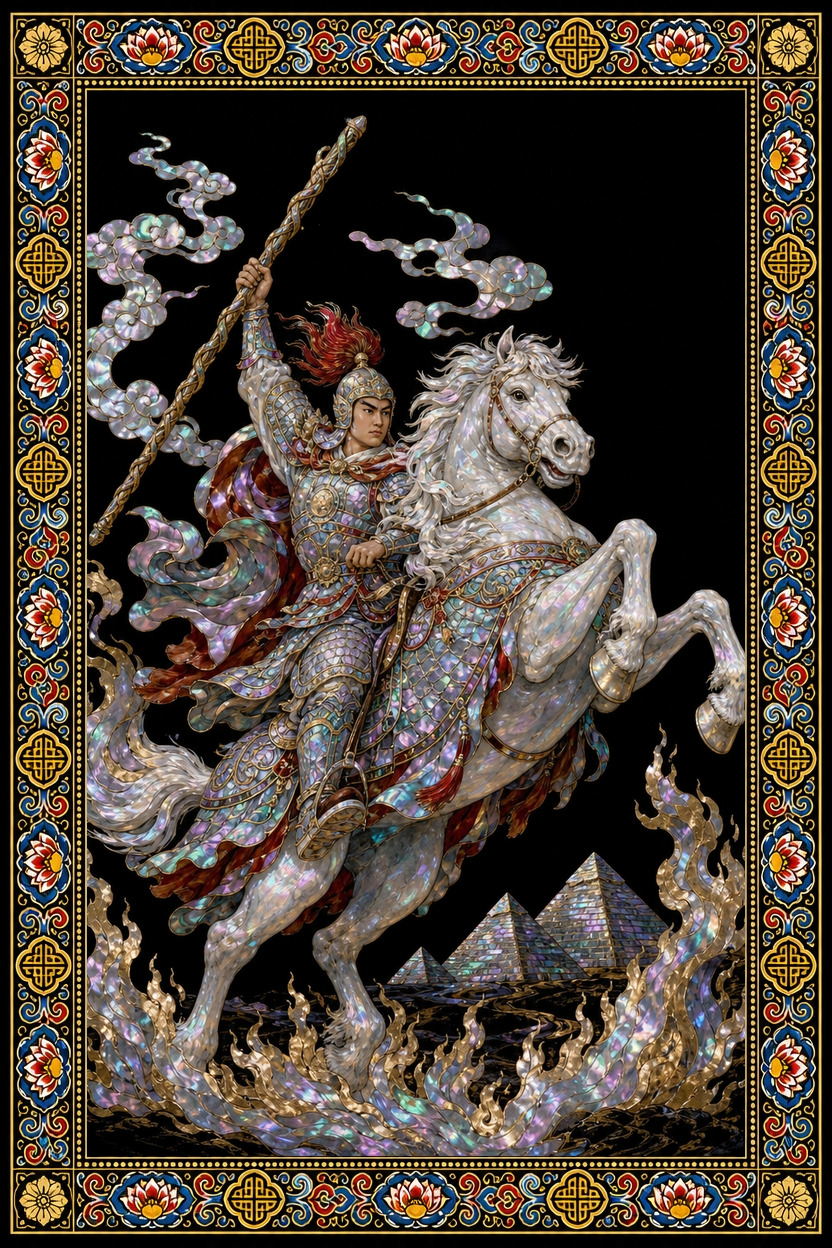
At the centre of the image sits a knight in red armour on a white horse. His right hand lifts a staff overhead, its tip reaching toward the top of the picture. The horse has raised its forelegs and stands still, yet the pose itself already announces the next step.
Lower your eyes and flames rise near the hooves. They begin in the ground the horse and rider stand on and surge upward, moving in the same direction as the figure. Far in the background, pyramids sit low on the horizon, hinting that this scene is one point on a journey toward somewhere distant.
The knight's body runs parallel to the horse's line of travel, but only the arm holding the staff reaches upward. This twofold movement, from below to above and from earth to sky, sets the rhythm of the whole picture.
Symbols and meaning
The horse halted with its forelegs raised is a still frame caught at the instant of departure. The body already leans into the motion, but the feet have not yet left the ground. Upright, the action and adventure this card speaks of resemble exactly this tension just before a full start.
The lifted staff is a marker that sets the direction. To hold something aloft in your hand is to say that passion has not stayed a vague feeling but has been gathered into a single aim. The flames at the feet show that this passion rises from the ground beneath you.
Reversed, the tension of the picture tips the other way. As a horse with raised forelegs sways in place, unable to choose a direction, passion scatters across too many places or impulse outruns decision. The staff is still held high, but where it points has gone blurry.
When this card appears
At work it reads as a nudge to begin what you have long put off. Rather than polishing the plan further, start with what is already in your hands, and it is fine if that start is a little rough. Just remember that speed alone can blur the finish, so set yourself a checkpoint along the way.
In relationships the theme is the courage of whoever moves first. If your heart has already leaned in but you cannot bring yourself to speak, that stillness may weigh on you more than the words would. With money, places that call for a quick decision sit right beside places where impulse creeps in, so a habit of leaving a purchase for a day before paying helps.
Faced with a choice, look for the side where the flames catch. The question of where the sparks rise beneath the hooves suits this card well. "Let me work out whether it is excitement or hurry that is moving me right now."
History and culture: figures East and West — immortals, emblems, diagrams
In East Asian paintings of immortals, figures are usually drawn floating toward the sky. Their feet rest on clouds or on a beast, lifted off the ground, their sleeves stream on the wind, and their gaze goes to some far place beyond the frame. The key to this tradition is that the movement never touches the earth.
The knight of Wands stands in contrast. The hooves press the ground, the flames rise from beneath the feet, and the staff aims at the sky while staying firmly in the hand. The European emblem-book habit of compressing a figure into a single sign appears here too: pose and prop take on the work of a sentence.
Unlike Buddhist iconography, which draws even a single finger to specification, the knight in this picture is marked less by proportion than by direction. Where the gaze goes and which way the staff leans speak for the figure's character. It is striking that traditions drawing the same kind of figure fix different things and leave different things in motion.
Common misreadings
Some read the Knight of Wands as a certainty that something big is about to happen. But the horse in the picture stands still with its forelegs raised. This card is closer to showing the will to set out than the arrival of events.
Others brand the reversed card as a reckless person. Reversed, however, points not to the size of the passion but to a state in which its direction has blurred. Read it as a matter of tidying up, not a verdict on character.
It is also common to remember this card only as a card of victory. The pyramids are far away and the flames are still at the feet. Holding on to the fact that this is the point of departure, not of arrival, keeps you faithful to the picture.
Draw a card yourself
The picture you have just read can be placed against your own question. The same card answers differently when the question changes.
- A deck drawn in-house — 78 cards in the colours of nacre and dancheong
- Readings that read the picture, not a keyword list
- Keep asking — draw one more card for your next question
- A record you can return to and compare
- Let a friend draw for you with a single link
- Seventeen languages, one deck, one reading
More from this suit
