Cups · Eight of Cups
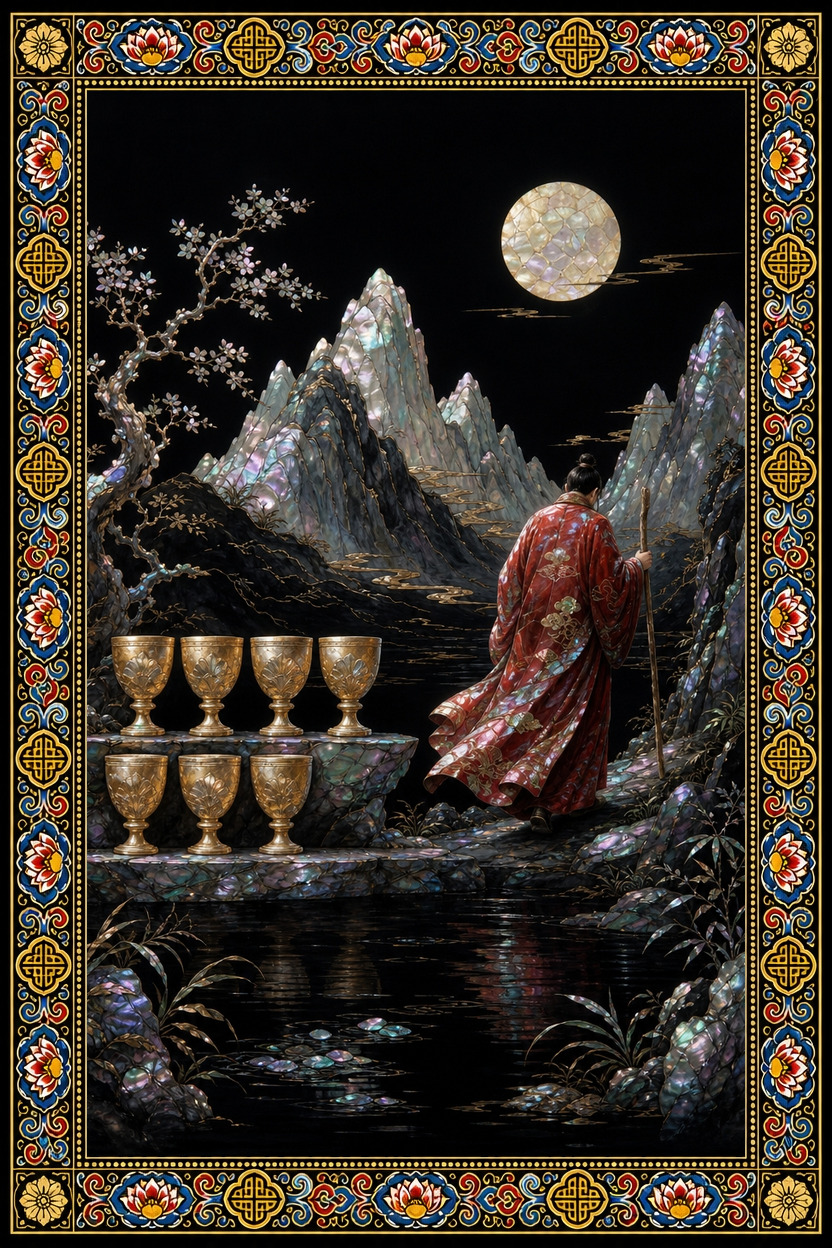
Eight of Cups — Walking away from the cups toward nacre mountains
Are the eight cups behind the figure a sign of failure, or a sign of having already drunk one's fill? This essay reads from the picture where the figure of the Eight of Cups is walking.
『Eight of Cups』 — what this card actually draws
In the foreground of the picture stands a figure dressed in a long robe (traditional dress) with a red pattern. Behind the figure is a stone ledge, and on it eight golden cups are stacked in neat rows. The cups lie entirely outside the figure's field of view.
The figure's feet have left the water's edge and point toward the mountains. In the distance, nacre (mother-of-pearl) mountains rise in layered ridges, and a maehwa (plum blossom) branch hangs over the still water. The figure walks on without holding on to any of it.
The eye moves naturally from the cups to the figure's back, and then to the mountains the figure is heading for. This card shows first what is being left behind rather than what has been gained.
Symbols and meaning
The stacked cups stand for the total quantity of feeling that has already been filled. The key point is that all eight remain intact, yet the figure does not look back. This is not a departure because the cups are empty; the judgment comes first that what has been filled cannot take them any further.
The nacre mountains point to a meaning not yet within reach. The water's edge and the maehwa branch are the familiar, quiet place — the environment that is comfortable to stay in. The composition, in which the direction the figure has turned from differs from the direction the figure walks, makes up the upright reading of this card.
Placed reversed, the card reads as the figure's feet having stopped. It is a state of standing with one's back to the cups yet unable to walk toward the mountains. Like fear of leaving or an unfinished parting, it draws a mind that stays in the same place with the decision postponed.
When this card appears
At work, it reads as a period of wanting to find another meaning even though the current results are sufficient. In relationships, it points to the moment of feeling that the person beside you no longer fills you. With money, it appears as a weighing between holding on to what is in hand and spending it somewhere new.
At a point of choice, this card puts weight on the side of leaving. But leaving does not mean being right; it is a signal to think through, as well, what to do with the cups left behind.
From a person setting foot toward the mountains comes a line like this: "It's not that what's here is lacking — it's that I can't find any more here, so I'm going."
History and culture: the 1909 Rider-Waite-Smith deck and the standardisation of symbols
In this deck, drawn by Pamela Colman Smith around 1909 under the direction of Arthur Edward Waite, the minor suits changed from cards with only numbers to cards with scenes. It is thanks to this change that the direction the figure of the Eight of Cups walks became grounds for interpretation.
In earlier decks, the cup cards lined up cups so that you counted their number. Smith put in their place a person turning away and a direction to walk, so that the same eight came to be read not as 'what remains' but as 'what is being left.'
Details such as the figure's clothing and the maehwa branch at the water's edge are elements found only on this card. With a scene attached, interpretation became a matter of observing the action in the picture rather than the result of a draw.
Common misreadings
There are cases of concluding that the Eight of Cups is a card of failure or betrayal. But all eight cups in the picture remain, and the figure is not being driven out but walking with a direction chosen by themselves.
The reading that everything ends once you leave is also common. This card draws the moment of movement rather than the completion of a parting, and in its reversed position it deals instead with the stagnation of not being able to leave.
By contrast, one should also be careful about reading this card as always meaning the right decision. The very image of walking on without looking back at what is being left behind remains as a question.
Draw a card yourself
The picture you have just read can be placed against your own question. The same card answers differently when the question changes.
- A deck drawn in-house — 78 cards in the colours of nacre and dancheong
- Readings that read the picture, not a keyword list
- Keep asking — draw one more card for your next question
- A record you can return to and compare
- Let a friend draw for you with a single link
- Seventeen languages, one deck, one reading
More from this suit
