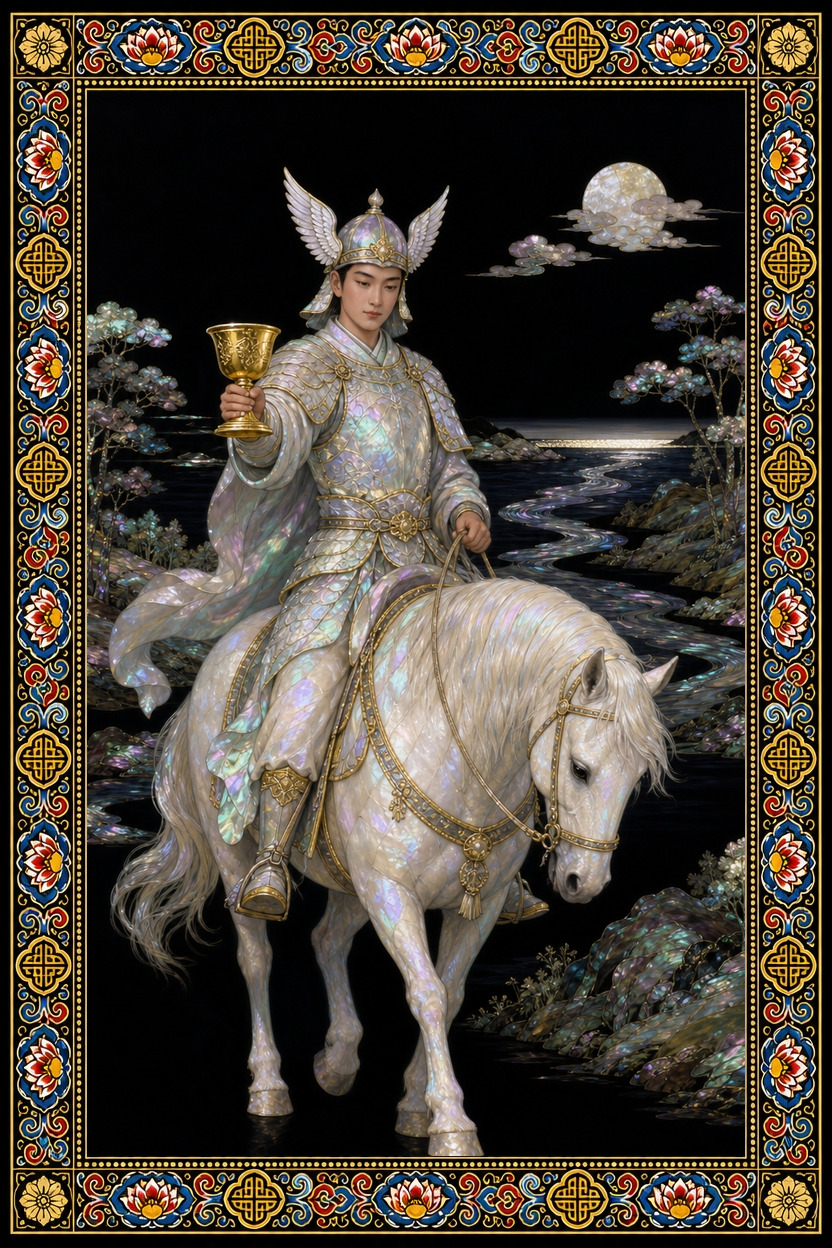
Cups · Knight of Cups
Knight of Cups — A Knight Advancing Slowly Under Moonlight, Raising a Gold Cup
The horse walks slowly, but the cup is held high. How much of this card's "heart-first approach" is in the picture, and where does the later interpretation begin?
『Knight of Cups』 — what this card actually draws
At the center of the picture is a knight on horseback. He wears a helmet with a winged ornament and, on a white horse, raises a single gold cup high in his right hand. The cup sits above his line of sight, so what draws the eye first is not where he is heading but what he is holding out.
The horse does not gallop. It is drawn at a slow walk, and there is no haste in this figure's movement. Behind the knight flows a moonlit river, with clouds settled above it. The river and clouds in the background are rendered in darker, softer tones than the figure, so the gold cup in front stands out relatively clearly.
The eye moves naturally from the cup to the knight, and from the knight back down to the river and clouds. Read in that order, the scene comes across as a contrast between "someone trying to hand something over" and "the quiet night around him."
Symbols and meaning
The knight's raised cup reads as an attitude that does not hide feeling but displays it. Since the cup is the central tool of the Cups suit, what this figure puts forward is not judgment or a plan but the heart. The horse's slow walk shows an unhurried approach, which is why the card is described upright in terms of invitation, charm, and following the heart.
Conversely, a raised cup is also a posture whose balance can easily waver. The effort not to set down what rests on the fingertips connects to situations where, when feeling leads, a promise looks larger than it is. The moonlight and clouds filling the background also create conditions in which the object appears to lean on atmosphere rather than stand out clearly.
The reversed card touches this point. If what the cup holds is handed over without being verified, it remains as moodiness and flattery, and the one receiving it is left disillusioned. The picture itself draws goodwill, but the card does not guarantee whether that goodwill turns into a real promise.
When this card appears
At work, this is a position where attitude is noticed before ability. Proposals or requests to collaborate may arrive together with an emotional appeal, so try separating the goodwill from the terms and checking each. In relationships, it reads as a time when the one wanting to express feeling meets the one waiting for that expression.
With money, be wary of situations where a person is put forward ahead of the amount. The more a transaction begins from trust, the safer it is to leave the terms in writing. Before a choice, keep in mind that the most appealing option and the most verified one may differ.
This is the kind of line that comes up when you ask yourself whether the hand holding the cup was steady. "The affection is clear, but I still can't see when the promise that person made will be kept."
History and culture: French fortune-telling and the occult rearrangement
The element worth noting in this card is the winged ornament on the knight's helmet. When cards were reorganized as a fortune-telling tool in France from the late eighteenth to the early nineteenth century, interpreters enjoyed rereading the details of the pictures as symbols. The rank of knight itself belongs to the original layer of the medieval warrior, and the wings were material well suited to later layers of meaning.
Card use in the era of Mademoiselle Lenormand was far from a method of matching each detail of the picture one to one. The current running through Éliphas Lévi and on to the Golden Dawn, by contrast, added layers by mapping elements, planets, and Kabbalistic paths onto the cards. The assignment of the element of Water to the Knight of Cups belongs to this latter layer.
So reading this card requires a distinction. The picture of a knight on horseback holding a cup is the layer that was there from the start, while the explanation of the element of Water and the knight of feeling is a layer added later. Look at the two layers together, but remember which one started from the picture.
Common misreadings
People often take this card as a confirmation of romance. But what is in the picture is an approach, not the outcome of a relationship. Invitation and affection do not by themselves guarantee a result.
Conversely, when the reversed card appears, some conclude fraud or betrayal. What the reversal points to is closer to a state in which you were swept up in feeling and put off checking. It is better to look at what you did not verify than at the other person's intentions.
Another misreading is seeing this card as a passive figure. A slow horse does not mean it has stopped, and the hand holding the cup is in fact reaching out actively. This is a card where you read the direction, not the speed.
Draw a card yourself
The picture you have just read can be placed against your own question. The same card answers differently when the question changes.
- A deck drawn in-house — 78 cards in the colours of nacre and dancheong
- Readings that read the picture, not a keyword list
- Keep asking — draw one more card for your next question
- A record you can return to and compare
- Let a friend draw for you with a single link
- Seventeen languages, one deck, one reading
More from this suit
