Cups · Queen of Cups
Queen of Cups — Two Hands Cradling a Lidded Cup
What is this queen guarding, with both hands wrapped around a closed cup? This essay reads the Queen of Cups as a tool for self-reflection, through the details of the picture and the history of printing technique.
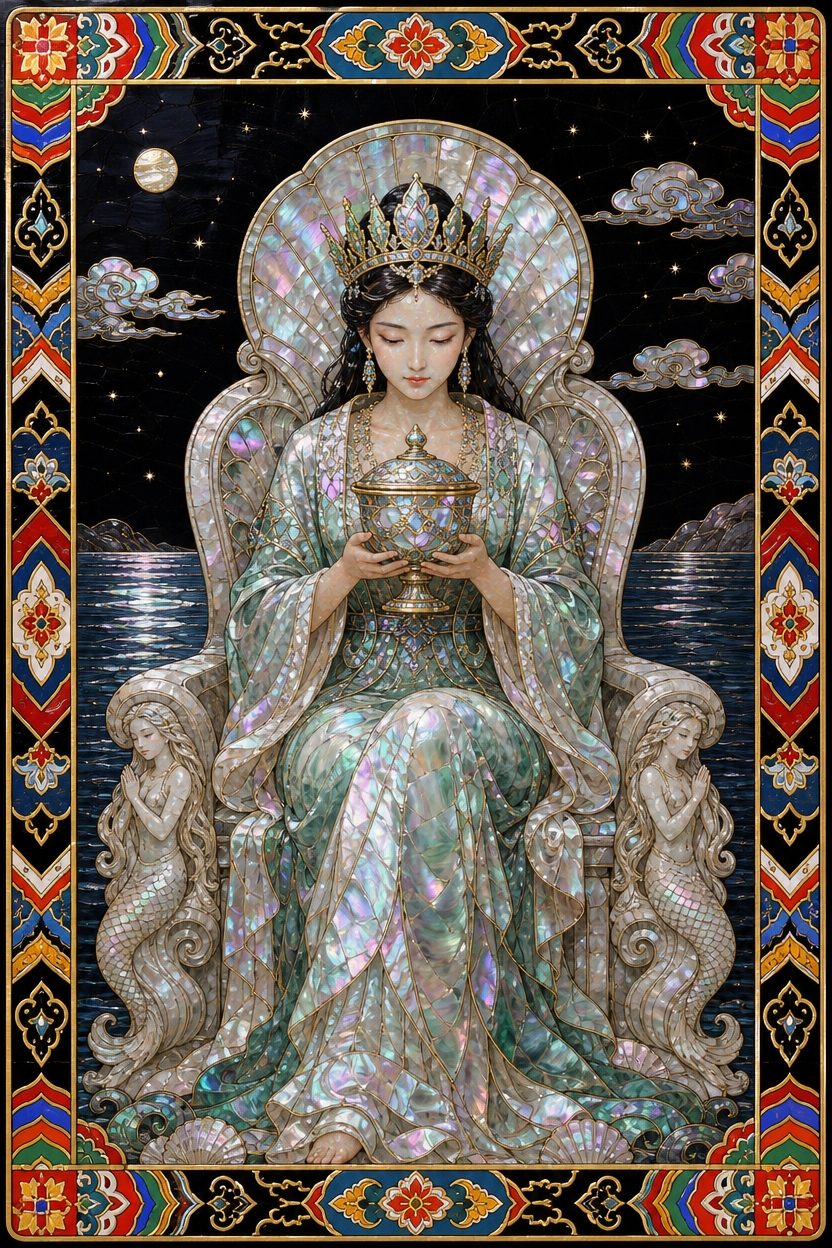
『Queen of Cups』 — what this card actually draws
At the centre of the image sits a queen. The throne she sits on is carved with mermaids, and she cradles a gold cup with a lid in both hands. What catches the eye first is the posture: she neither lifts the cup nor tilts it, but holds it wrapped in her whole palms.
Moving your gaze upward, a pearl-toned halo spreads in a circle behind the queen's head. The halo lights the outline of the figure without pinning down her expression. Behind her, a moon and dark water unfold, showing that the figure sits in the middle of water's emotional register.
The mermaids on the throne, the closed cup and the waves all point in the same direction from different layers. The queen, seated between a water creature and a water landscape, reads as a figure who is inside the medium of feeling while holding it rather than pouring it out.
Symbols and meaning
The lidded cup shows an attitude of not spilling emotion carelessly. What matters is that this is not a picture of tilting the cup to serve, but of wrapping it in the hands. So the compassion and empathy of the upright card appear not as feeling poured toward another person, but as a way of keeping and staying beside.
The halo behind her head hints that this feeling is ordered within herself. Intuition is described here as the power to measure another's feelings only after knowing the bottom of your own. The waves and the moon form the layer of the unconscious running beneath, and the queen sits above it.
Read reversed, the same picture shows another face. When the cradling hands grip too tightly, it becomes codependency, a wish to make another's feelings your own. From here also branch the attitude that casts oneself as a martyr while clutching the cup, and manipulation that uses feeling as a weapon. A state of dissolved boundaries is, in the end, a state in which the distance between cup and hand has vanished.
When this card appears
At work, it reads as a position that calls for taking in a colleague's circumstances. But burnout begins when care crosses the boundary of the job, so it is better to decide how much is your share.
In relationships, this is a time when you read the atmosphere before the words. If an urge rises to carry the other person's feelings for them, try to tell apart whether it is empathy or a wish to take responsibility on their behalf.
With money, you are prompted to watch that feeling does not outrun judgement. This is a point at which to check whether spending follows where your heart goes, or whether you are spending where it is needed. Faced with a choice, a little time to keep the answer in a closed cup, as it were, helps. "I don't have to take responsibility for that person's feelings too."
History and culture: card printing — woodblock, stencil, lithograph
The best starting point for talking about printing technique in this card is the pearl-toned halo spreading behind the queen's head. Soft-edged areas like the halo resemble the way colour was laid on with stencils in fifteenth-century woodblock printing. Because the outline was printed from the block and the colour filled in by hand, the bleed of colour varied slightly even from the same block.
As cards were printed in large numbers in eighteenth-century France, this colouring was folded into the process. As it became standard to lay out several cards on one plate, print them and then apply colour, soft areas like the halo were gradually resolved into fixed colour fields. The mood of the picture was now decided by the design of the plate.
Nineteenth-century lithography and chromolithography overturned this again. As textures drawn directly on stone were transferred to print, the shading of the waves and the gradient of the halo were reproduced far more finely. The soft water tones of the Queen of Cups we see now are the result of the age of hand colouring, the age of designed colour fields, and the age of transferring texture from stone all layered together.
Common misreadings
The Queen of Cups is often read only as the card of a person who is always kind and gentle. But the cup in the picture is closed. This card is closer to holding feeling in without showing it, and that holding sometimes shows up as a burdensome tension.
When it appears reversed, some conclude at once that it means a bad relationship or emotional ruin. Reversed is closer to a signal that boundaries have blurred, so it is better read as a request to retrace what is your feeling and what belongs to someone else.
There is also a common expectation that a person of deep feeling is always the one caring for others. This card speaks of the presence of care, but the cup can be held for a long time only when the first object of that care is yourself.
Draw a card yourself
The picture you have just read can be placed against your own question. The same card answers differently when the question changes.
- A deck drawn in-house — 78 cards in the colours of nacre and dancheong
- Readings that read the picture, not a keyword list
- Keep asking — draw one more card for your next question
- A record you can return to and compare
- Let a friend draw for you with a single link
- Seventeen languages, one deck, one reading
More from this suit
