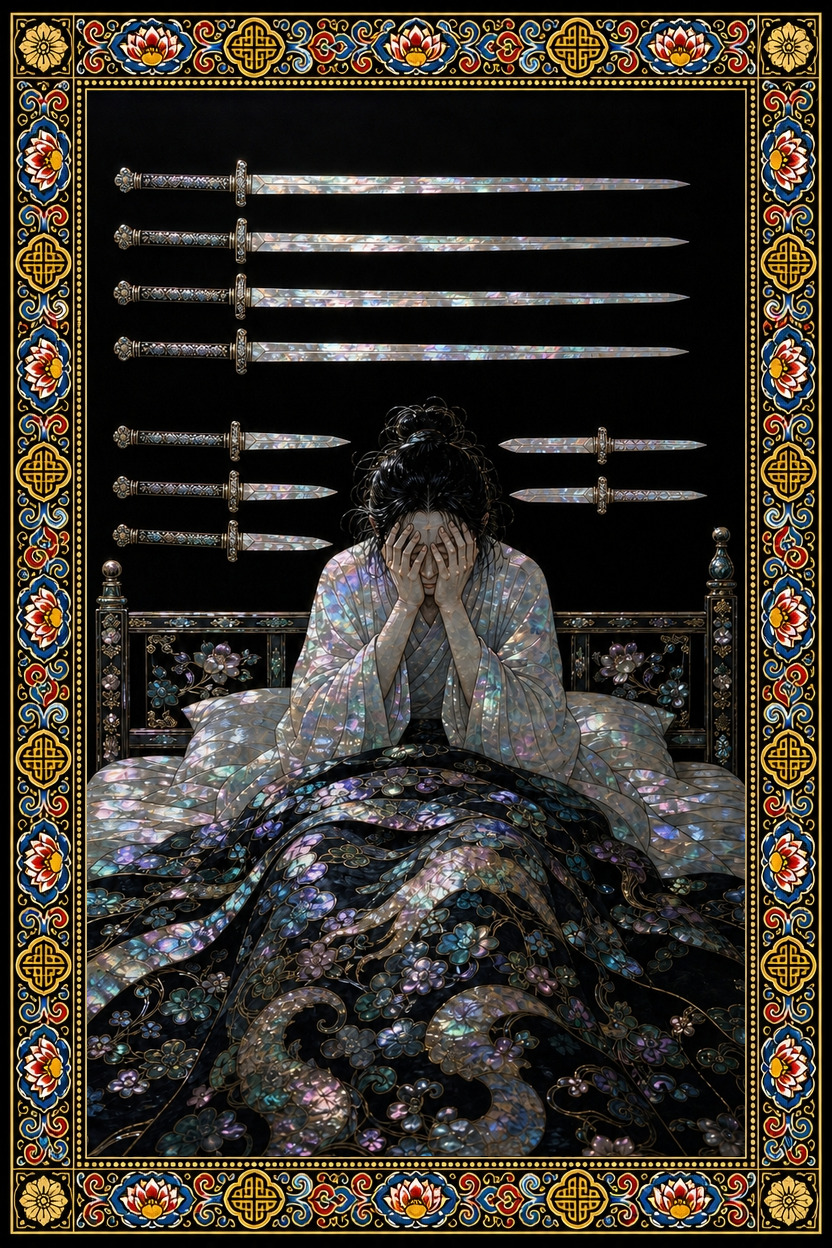
Swords · Nine of Swords
Nine of Swords: The Person Clutching the Quilt and the Nine Blades on the Wall
Are the swords on the wall really pointed at you, or are you the one turning your face toward them? This essay follows the Nine of Swords image element by element and considers how we might meet anxiety.
『Nine of Swords』 — what this card actually draws
At the center of the image is a person who has risen to a sitting position in bed. Both hands cover the face, so no expression is visible. The eye goes naturally to those hands and shoulders.
Behind the figure, nine swords hang in a row on the wall. They do not reach toward the person but lie neatly along the wall's surface. On the bed is a quilt covering the knees, embroidered with a dragon pattern.
No one is asleep in the frame, and no one is approaching. The person is awake alone, and the objects in the room sit quietly in place. This stillness is what creates the scene's tension.
Symbols and meaning
The hands covering the face are a gesture of refusing to look outward. The problem is not in front of the eyes; it grows inside the blocked field of vision. This is why the card stands for sleepless nights and worry.
The nine swords on the wall are closer to a list of thoughts that have already passed. The blades are not in an attacking posture but hung in order. The threat comes less from the swords themselves than from the mind that counts them.
Reversed, the card reads as the hands coming down from the face. It is a current in which anxiety eases or fear is faced, and asking for help belongs here too. The outcome is perspective returning and recovery from despair.
When this card appears
At work, it reads as a situation where thoughts chase each other at night before a deadline. It is when the list in your head is longer than the work actually left. Simply writing the list down on paper eases the burden.
In relationships, the trouble is a conclusion you reached alone without saying anything. The night you read too much into the other person's silence is this card's face. Turn your guesses into questions and the number of swords goes down.
In money and decisions, you see a mind that has already lived through every worst case in advance. The less you can see an answer, the more you should postpone judgment and talk to someone. "Let's look at the plan we made at night again in the morning" suits this card well.
History and culture: the Egyptian origin myth and its refutation
In the Egyptian origin story, the swords of the Nine of Swords are often explained as trials in a temple or night-time asceticism. Yet the swords in the image look like household items hung on a wall, and the bed and quilt resemble a European interior.
Court de Gébelin argued in his 1781 work that tarot came from Egyptian mystery tradition and the Book of Thoth. The claim spread widely, but the documentary evidence he offered has not been confirmed.
As later research traced the deck back to a parlour game, the origin myth lost its force. The iconography of this card comes not from Egypt but from European print culture. The arrangement of the nine swords and the dragon-patterned quilt are the visual language of that era.
Common misreadings
Some take this card as confirmation that something bad will happen. But the image draws not an event but the state of a person awake at night. Anxiety is not a forecast; it is the body's present condition.
Others conclude that when the card appears reversed, anxiety simply disappears. Reversed points to the direction of recovery; it does not mean the process of lowering your hands has finished on its own.
It is also common to count the nine swords as the number of actual enemies. The swords in the image are arranged on the wall and do not face the person. Remember that it is the person who does the counting.
Draw a card yourself
The picture you have just read can be placed against your own question. The same card answers differently when the question changes.
- A deck drawn in-house — 78 cards in the colours of nacre and dancheong
- Readings that read the picture, not a keyword list
- Keep asking — draw one more card for your next question
- A record you can return to and compare
- Let a friend draw for you with a single link
- Seventeen languages, one deck, one reading
More from this suit
