Swords · Seven of Swords
Seven of Swords — The Man Who Looks Back With Five Blades
Why does the man who takes the swords and leaves the camp look back? In this card's image we read a scene of someone wavering between strategy and conscience.
『Seven of Swords』 — what this card actually draws
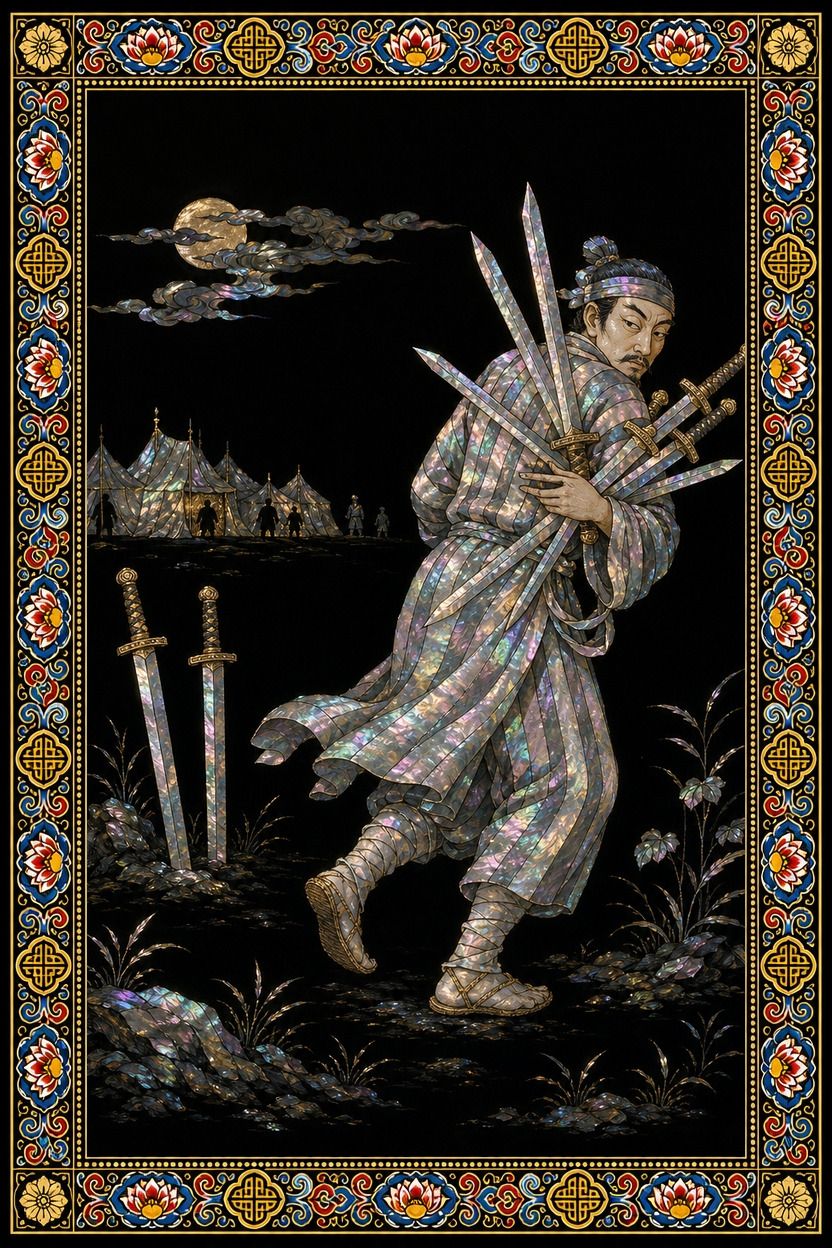
In the foreground stands a man dressed in long robe (traditional dress). He holds five swords bundled against him and walks with hushed footsteps, turning only his head to check behind him. His gaze is directed toward where he came from — toward the camp.
Two swords remain planted in the ground he treads. The five in his arms and the two left behind make seven, and that is where this card's name comes from. In the distance, tents and a lit camp are visible.
The eye moves naturally from the man's arms to the ground, then out to the distant camp. What he took and what he left sit side by side in a single frame.
Symbols and meaning
Upright, what this image speaks of is the act of quietly gathering something and slipping out. Swords signify judgment, speech, and thought; to hold them against the chest reads as moving while keeping one's thinking hidden rather than out in the open. The backward glance is also a signal that the departure is not complete.
The two swords left in the ground are often read as 'what was not fully gathered.' He did not make a clean escape, and so room remains for that spot to be exposed someday. The keywords of strategy and getting away with it come from this unfinished rear view.
Reversed, the direction of the gaze turns inward. This is a phase in which what was hidden comes to light, or the excuses one made to oneself no longer hold. Confession and conscience are close to the act of facing the left-behind swords again.
When this card appears
At work, you are prompted to ask whether there is something you have quietly handled alone. A quick judgment to slip out can be valid, but colleagues may be left not knowing how it happened. Ask yourself whether it is time to share where things stand.
In relationships, you look back on whether things went unspoken and piled up. The other person may already have noticed, and a small trace, like the two left-behind swords, becomes the clue. With money, this is the point to check for hidden spending or items hastily tidied away.
Before a choice, the quietest path is not always the best one. If you decide in advance what to take and what to leave, the urge to look back diminishes. The man's gaze toward the camp once more invites exactly that kind of check.
The line 'That thing you're slipping out of now — who will clean it up later?' is often set down alongside this card.
History and culture: the 1909 Rider-Waite-Smith deck and the standardisation of symbols
What stands out in this card's image is that the figure's action itself becomes the basis for interpretation. In the deck Pamela Colman Smith drew under Arthur Edward Waite's direction, the minor suits gained scenes where before there had been only numbers and suit signs. The Seven of Swords is one of the cards where that change is clearest.
In particular, this image makes counting the swords the very starting point of reading its meaning. Five in the arms, two planted, seven in all — the arithmetic locks into the card's name and produces the question 'what was taken, and what was left?' Earlier decks' Seven of Swords offers no such count.
The camp's tents and firelight are likewise devices that explain the scene. Because we can see where he came from, his action reads not as a simple flight but as a choice made within relationships. It is a representative case of how figural art widened the range of interpretation.
Common misreadings
Some see this card only as a marker of a 'bad person.' But the image holds the hesitation of someone carrying something out rather than the moment of a theft. It is better read as a question about how one makes judgments than as a label of guilt.
Others conclude that reversed must mean failure or punishment. In practice it is closer to a flow in which what was concealed is revealed and sorted out, and that is not necessarily a bad ending. Read as a process of becoming honest, it is far more useful.
Another notion is that this card always means self-interest alone. As the two left-behind swords show, this image carries the trace of an escape that was not complete. Whose share that trace is — that is the card's real question.
Draw a card yourself
The picture you have just read can be placed against your own question. The same card answers differently when the question changes.
- A deck drawn in-house — 78 cards in the colours of nacre and dancheong
- Readings that read the picture, not a keyword list
- Keep asking — draw one more card for your next question
- A record you can return to and compare
- Let a friend draw for you with a single link
- Seventeen languages, one deck, one reading
More from this suit
