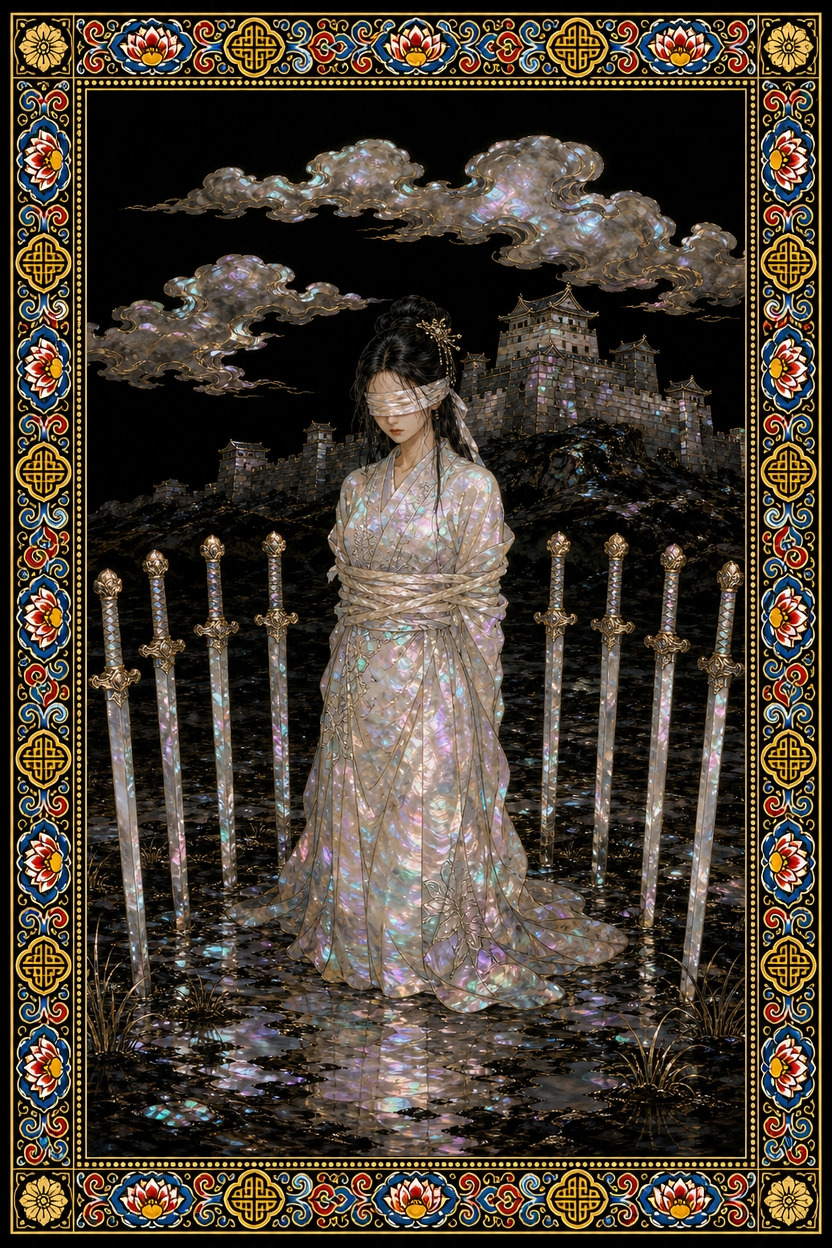
Swords · Eight of Swords
Eight of Swords — The Blindfolded Figure Among Eight Blades
If your eyes are covered but your feet are already placed where they could step out between the swords, what is it that holds you? Following the clothing and the looseness of the rope in the Eight of Swords, we look at what kind of prison this card is describing.
『Eight of Swords』 — what this card actually draws
At the center of the image stands a woman with her eyes covered. A rope is wound around her body, and her feet are submerged in shallow water. Widen your view a little and eight swords surround her, planted in the ground, yet between sword and sword there remains a gap wide enough for a person to pass through.
Behind the figure a hill rises, with a castle set upon it. Clouds have gathered in the sky, but the figure's hem is not drawn as though it were whipping hard in the wind. The order in which we read the picture usually moves from the blindfold to the rope, from the rope to the water underfoot, and then to the arrangement of the swords.
There is no scene of violence or pursuit in this card. Neither the person who tied the woman nor the person who planted the swords is drawn as someone outside the frame. That is the point that makes this picture read not as a simple scene of restraint but as something that has happened to the figure by her own hand.
Symbols and meaning
The blindfold means a state of not being able to see, but at the same time it is a state of having chosen not to look. All eight swords are stuck in the ground and none is aimed at the figure. Even so, one reading is possible: she does not move not because of the swords but because her mind treats them as obstacles.
The loose winding of the rope is also worth noticing. If it is not pulled tight, that means room remains to work it free, and the fact that the water underfoot is shallow rather than deep points the same way. The upright meaning comes out as this kind of mind that binds itself, along with a victim mindset.
Set in the reversed position, the gaze turns to the blindfold. The covering is lifted and the gaps between the swords begin to show, and from there come self-direction and the acceptance of responsibility. Still, liberation is less an event in which the rope unties itself than a choice to move your body.
When this card appears
At work, the focus falls not on conditions being bad but on the side that sees them as bad. In relationships it reads as a signal to distinguish the wall the other person built from the wall you built yourself. With money, simply checking the one item you have not touched and have kept putting off can ease the stifled feeling.
In the place of choice, what surfaces is a state of waiting for a perfect exit and so choosing nothing at all. Even if the gap between the swords looks narrow, if it is wide enough to pass through, what you need now is not certainty but one step.
The moment the blindfold comes loose usually arrives not through a dramatic event but through a small confirmation. The sentence "So I wasn't tied up — I was the one not moving" comes out naturally in this card's place.
History and culture: Traditional dress — silhouette, colour and station
The first thing that catches the eye in this figure's clothing is a silhouette that does not greatly swell the body's outline. In late Joseon, commoners' dress settled into forms that left room for movement rather than structures that clung to the body, such as the short jacket (the short jacket of long robe), the skirt, and the trousers. The setup of a figure standing on water and bound by rope suits clothing premised on movement better than ornate ceremonial dress.
Colour and material were originally devices that revealed station and ritual. In this picture, however, the colour of the clothing does not speak of station; the rope and the blindfold explain the figure's condition instead. In the history of dress, the distinguishing function of colour has been transferred to a different sign within the picture.
Had this been formal attire such as a gat (a wide-brimmed black horsehair hat) or a long coat (a scholar's long coat), the stifled feeling of the scene would have taken on a very different character. The fact that this card's figure wears practical clothing adds to the impression that the restraint comes not from institutions or station but from the figure's own place.
Common misreadings
Seeing this card, it is easy to conclude that someone is being held by someone else. But there is no hand in the picture holding the figure, and no sword is aimed at her. The degree of restraint depends not on the tightness of the rope but on the reason the figure does not move.
Another misreading is that reversed means the problem is solved. The blindfold coming off is not an event in which the situation changes but one in which the way of seeing changes, and after it a process of accepting responsibility remains. Finally, there are cases of reading this card only as a sign of weakness, but you should also see that the figure already has enough mental capacity to have planted eight swords.
Draw a card yourself
The picture you have just read can be placed against your own question. The same card answers differently when the question changes.
- A deck drawn in-house — 78 cards in the colours of nacre and dancheong
- Readings that read the picture, not a keyword list
- Keep asking — draw one more card for your next question
- A record you can return to and compare
- Let a friend draw for you with a single link
- Seventeen languages, one deck, one reading
More from this suit
