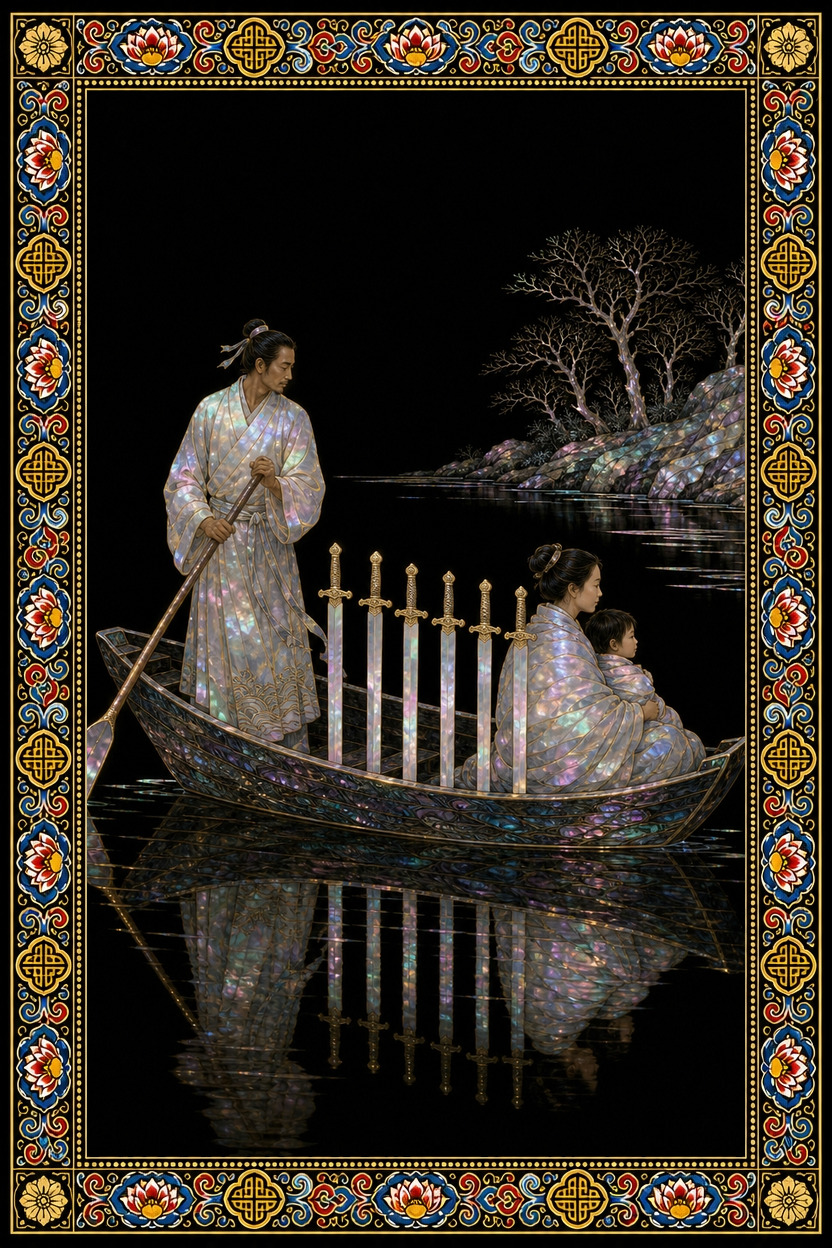
Swords · Six of Swords
Six of Swords — A Boat with Six Upright Swords, a Ferryman Crossing the River
Why does the boat cross the river carrying swords? This piece reads the relationship between baggage and crossing in the image of the Six of Swords.
『Six of Swords』 — what this card actually draws
At the center of the image is a small boat. A ferryman in long robe (traditional dress) is rowing, and a woman and a child sit side by side in the boat. All three face the same direction, which suggests the boat is carrying them across to somewhere.
Shift your eyes a little and you see six swords standing upright in the boat. Rather than pointing at anyone, the swords stand straight up and sit there like cargo. The key point of this image is that the swords stay in the boat even as it moves forward.
On the far side stands a bare tree. It is not a tree thick with leaves but one with only branches left, which gives the impression that neither the place left behind nor the place being reached is whole. Even so, the boat parts the water toward it.
Symbols and meaning
Upright, this image speaks of transition and moving forward. The very act of the boat crossing the river is a process of moving from one state to another. The calm rendering of the water shows that this movement is not a noisy event but a quiet passage.
The swords standing in the boat mean that wounds or conflicts have not entirely disappeared. But rather than gripping the swords and aiming them, the figure has set them upright, and in that we read an attitude that carries the problem along without being held captive by it. The sense of gradual healing comes from here as well.
Reversed, the gaze turns backward. The boat stops moving forward, or turns back to the shore it has already passed. The emphasis falls on a state in which the swords cannot be set down and left behind, on unfinished business and the baggage one is tied to.
When this card appears
At work, it points to a time of changing positions or wrapping up what you have been doing. The focus is less on big results than on reducing commotion and moving to the next stage. In relationships, it reads as a current of stepping back from the swirl of emotion and adjusting the distance.
With money, it looks like a phase of finding stability gradually rather than through sudden change. Rather than wiping out debts or burdens all at once, clearing them little by little suits the image. In matters of choice, it leans toward getting on the boat you can cross in now rather than waiting for a perfect answer.
The scene of the people in the boat not looking back is the face of this card. "The baggage is still in the boat, but now the one rowing is me" is close to that face.
History and culture: minhwa and sipjangsaeng — the lineage of symbolic creatures
Among the sipjangsaeng (the ten symbols of longevity), water is always drawn as flowing. If the sun and the mountains are fixed beings, water is a passing being, and so in minhwa (folk painting) water takes charge of time and movement. The water the boat of the Six of Swords parts can be read within this lineage as well.
What is interesting is that this image has no crane, no deer, no turtle. In the place where the animals symbolizing long life would go, an artificial object, the sword, is set. If the flower-and-bird paintings of minhwa convey meaning through symbols of nature, this card stands on the idea of loading something made by human hands into a boat and carrying it across.
The bare tree on the far shore is worth comparing with the symbolism of the sonamu (red pine). If the pine of the sipjangsaeng means everlasting green, the leafless tree stands on the opposite side and shows the place where the seasons turn. The story it tells is that crossing is not a move to a place that stays green forever but a move to a place that changes.
Common misreadings
There are readings of the Six of Swords as "the card of leaving every problem behind." But the swords in the image are loaded in the boat just as they are. This card speaks of movement, not resolution, and setting the baggage down is left as the task after arrival.
Conversely, it is also common to read it as "a card of stagnation where nothing happens." The calm water is not a standstill but a state of moving forward without a sound. Just because it is not loud does not mean it is not moving.
Another misreading settles on this card as always meaning a parting from others. A woman and a child ride in the boat together, showing a crossing that is not solitary. Who you cross with and what you carry along are the more important questions in this card.
Draw a card yourself
The picture you have just read can be placed against your own question. The same card answers differently when the question changes.
- A deck drawn in-house — 78 cards in the colours of nacre and dancheong
- Readings that read the picture, not a keyword list
- Keep asking — draw one more card for your next question
- A record you can return to and compare
- Let a friend draw for you with a single link
- Seventeen languages, one deck, one reading
More from this suit
