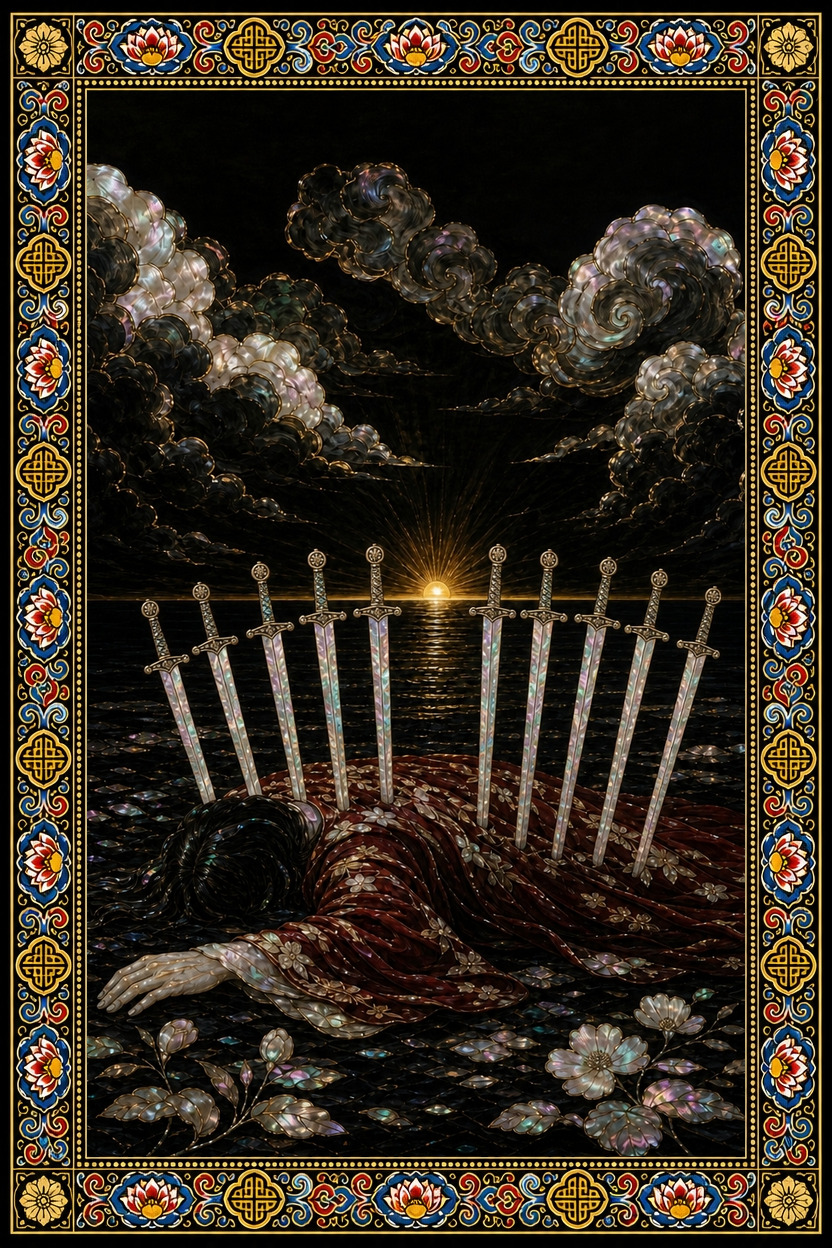
Swords · Ten of Swords
Ten of Swords — Ten Blades in the Back and the Rising Sun
What scene comes to mind when you see someone face down on the ground with swords in their back? This card is a picture of an ending, and at the same time a picture of dawn.
『Ten of Swords』 — what this card actually draws
At the bottom of the image, a figure in a red cloak lies face down on the ground. The face is hidden, and the body lies parallel to the horizon. Ten swords are planted in the back, so the first thing to catch your eye is this repeated vertical line.
Move your gaze upward and dark clouds hang low in the sky. Yet beneath those clouds, the sun is rising over the horizon. It is an ambiguous hour: you cannot quite tell whether the darkness is lifting or still has some way to go.
So the picture layers two events into a single frame. A body touching the ground and a rising sun — the fact that something has ended and the fact that something remains — share the same scene.
Symbols and meaning
Ten is the highest number in the suit of Swords. The placement in the back means the blow did not come from a fight faced head-on but from behind. This is why the image is tied to the word betrayal.
Yet the swords stop at ten. No more go in, and nothing is drawn beneath the body on the ground. In this way, rock bottom points to a state where there is nowhere further down to go, and at the same time reads as a signal that the worst has already passed.
When the card falls reversed, your gaze shifts toward the sun. It reflects the process of wounds healing and a phase of rising again, but it can also appear as a reluctance to accept the final lesson. That is the stagnation that sets in when you have been through an ending but turn away from what it means.
When this card appears
At work, it signals that you have reached a point where you can hold on no longer. If a project has ended or a relationship has broken off, acknowledging that fact is the first step toward recovery.
In relationships, trust may already have collapsed. The task left is not deciding who was right but how to care for the wound. Where money is concerned, confirming the loss and putting the records in order come first.
Faced with a choice, you lean toward the clean cut rather than the way back, because ten blades have already finished the argument. The words that tend to land in the room sound like this: "Holding on to something that's already over will feel like a waste of your time."
History and culture: figures East and West — immortals, emblems, diagrams
In East Asian paintings of immortals, the figure usually lifts their face to the sky or stands treading on clouds. A body floating free of the ground is the mark of transcendence. The figure in this card, by contrast, is pressed flat against the ground and hides their face.
European emblem books arranged a figure's posture so that it would be read directly as a moral lesson. A prostrate body served as a sign of humility or defeat, and the direction of the gaze decided the meaning. That the figure in the Ten of Swords faces downward connects to this tradition.
In Buddhist iconography a prostrate posture is a gesture of reverence, but here it is not worship — it is a fall. The same posture read in opposite ways depending on the culture is part of what makes this image so interesting.
Common misreadings
Some take this card to mean that disaster is now certain. But the sun is already up in the picture, and the swords no longer multiply. This card draws what comes after the peak.
It is also hard to insist that betrayal must come from someone else. The ten swords may be the result of your own judgments and words and actions, built up over time, coming back around.
Be careful, too, about reading the reversed card as recovery alone. Whether the wound is in the process of healing, or whether you are turning away from the lesson and staying where you are, is something to judge together with the surrounding cards and the situation.
Draw a card yourself
The picture you have just read can be placed against your own question. The same card answers differently when the question changes.
- A deck drawn in-house — 78 cards in the colours of nacre and dancheong
- Readings that read the picture, not a keyword list
- Keep asking — draw one more card for your next question
- A record you can return to and compare
- Let a friend draw for you with a single link
- Seventeen languages, one deck, one reading
More from this suit
