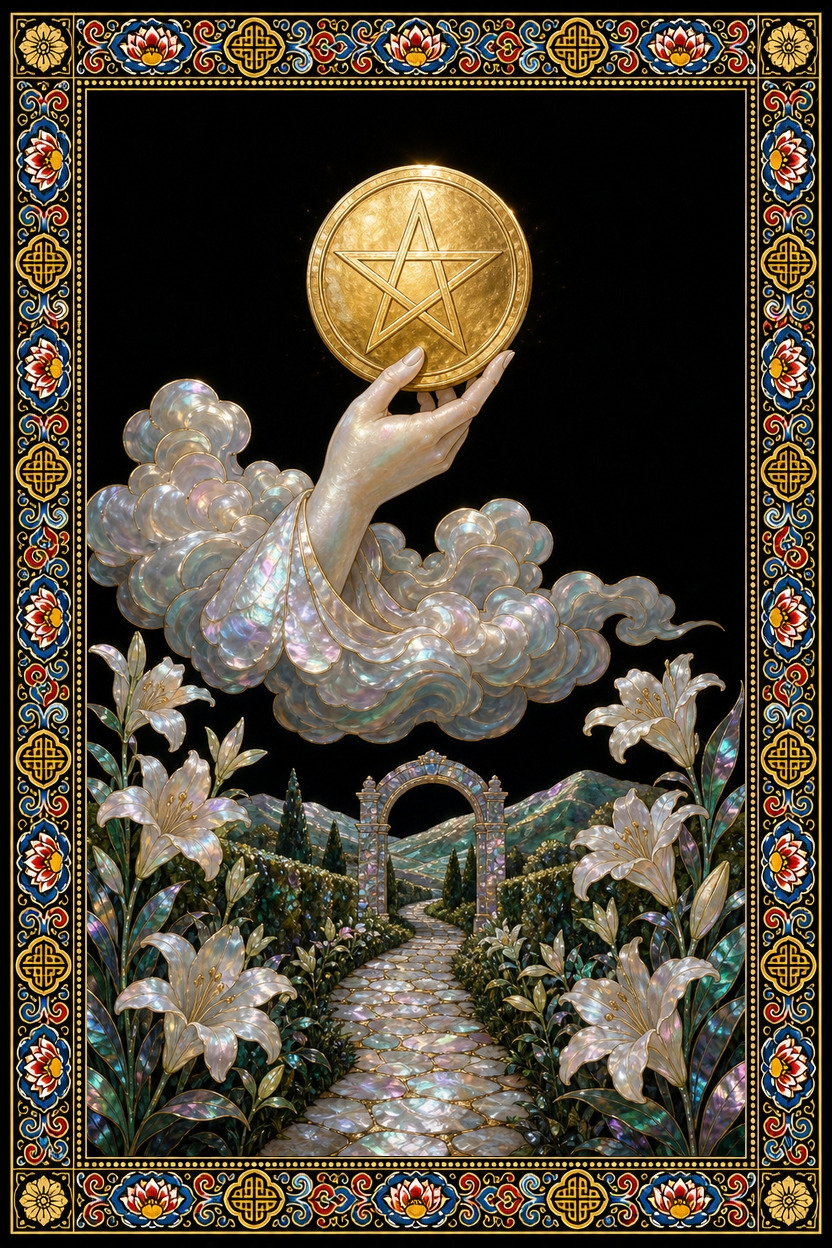
Pentacles · Ace of Pentacles
Ace of Pentacles — A Hand from the Clouds and the Path Before the Gate
What is the golden coin the hand holds out to you? We read this card by following the line the image draws, from the cloud down to the gate.
『Ace of Pentacles』 — what this card actually draws
At the top of the image, a hand emerges from a pearl-coloured cloud. It holds a great gold coin as if bearing it up, and at the centre of the coin is a star traced through five points. Your eye settles naturally on the hand and the coin.
Lower down lies a pale stone path. White lilies stand on either side of it, and the path runs on to an arched gateway between green hills. The gate is not clearly drawn as open or shut; it simply takes charge of where the path ends.
The hand in the cloud, the gold coin, the lilies, and the gate: these four make a single line of movement from top to bottom. Something descends from the sky and continues into a path on the earth, arranged in just that order.
Symbols and meaning
The coin is held in the hand but has not yet been spent. A resource received but not yet tried out — a material opportunity placed at the starting point — is what this single coin stands for. The pentagram looks like a mark denoting the realm of body and daily life that the suit of Earth handles.
The stone path with its lilies is the passage that opportunity will travel. That the path is already laid matters. New money appearing and that money having a road to go down are two different matters, and this card draws them together.
Read reversed, what the hand holds has not yet touched the ground. The coin is held but not set down on the path, or you have reached the gate but not gone in. The weight falls less on the absence of opportunity than on the hesitation that leaves it lying there.
When this card appears
At work, the topic is something just begun or a position you have been offered. There are no results yet, but the seed is in your hand, which means what you need now is not completion but commencement.
In relationships, you find yourself looking at something concrete the other person offers. It reads as a sign that comes not in words but in a form you can hold — time, or an object.
In money, it looks like a season when an incoming channel opens, though the card does not fix the size of the sum. Before a choice, what remains is not picking one of many doors but actually moving your feet onto the path already laid. "I've been handed the seed but haven't planted it in the pot yet" fits this card well.
History and culture: najeon chilgi — inlaying crushed shell into lacquer
The pentagram on the coin brings to mind the work of cutting pieces of nacre (mother-of-pearl) and setting them into a lacquered surface. The najeon chilgi (lacquerware inlaid with mother-of-pearl) technique carried on in Tongyeong and Wonju does not stop at laying nacre down as it is. There is a separate process of grinding shell thin, crushing it fine into powder, scattering it over the lacquered surface, and pressing it down. The coin here is painted, not nacre; what it borrows is the grain of that surface.
This crushed nacre has no crisp edges the way a cut piece does. Only after it is scattered and pressed does a grain appear on the surface, and only when light reaches it does it come quietly alive. If the hand reaching from the cloud in the picture is in a state of having touched nothing yet, crushed nacre is close to that state just before it is applied.
The patterns on najeon boxes handed down from Goryeo into Joseon were mostly continuous forms like vines and flowers. It is a method of not scattering individual pieces apart but butting them against one another to make a single surface. This is the point that overlaps with the composition of this card, where a single coin is drawn together with the whole path.
The story goes that the hands that work nacre first learn to use the material sparingly. A craftsperson's restraint — gathering and using even a handful of crushed powder rather than throwing it away — is said to be part of the skill. It touches the attitude of pondering how to spend the coin you are holding.
Common misreadings
Some look at this card and conclude that a large sum of money is about to arrive. The coin in the picture is still above the hand and has not been moved onto the path. Reading it as a statement that you are now in a position to use something, rather than a promise that something will come in, stays truer to the image.
Conversely, some see it as a card that deals only in material things and has nothing to do with feeling. The lilies placed along the path are no accidental arrangement; they show that the resources of daily life sit on the same passage as relationships and the heart.
It is also common to fix the reversed meaning as loss or failure. The reversed Ace of Pentacles tends to point instead at possibility left unused — postponement and hesitation.
Draw a card yourself
The picture you have just read can be placed against your own question. The same card answers differently when the question changes.
- A deck drawn in-house — 78 cards in the colours of nacre and dancheong
- Readings that read the picture, not a keyword list
- Keep asking — draw one more card for your next question
- A record you can return to and compare
- Let a friend draw for you with a single link
- Seventeen languages, one deck, one reading
More from this suit

