Pentacles · Two of Pentacles
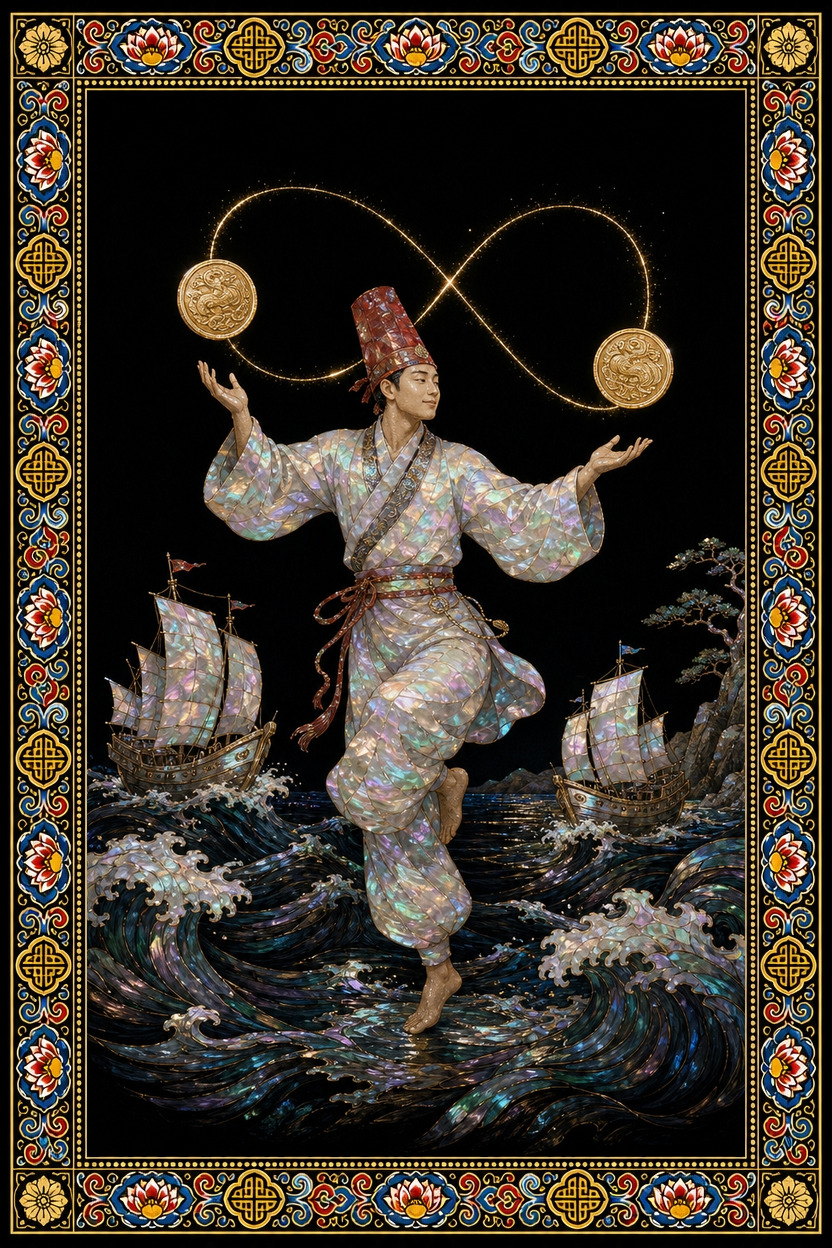
Two of Pentacles — Juggling Two Coins Above the Waves
What is the person standing on one foot, two coins tossed in the air, actually holding on to? This piece reads the card's sense of balance through the waves, the boats, and the infinity-shaped path the coins trace.
『Two of Pentacles』 — what this card actually draws
At the center of the image stands a young person dressed in long robe (traditional dress). They hold themselves up on one foot rather than two, and above them float two large coins. The coins do not move separately; they trace a single path, one after the other.
Lower your gaze and waves break beneath their feet. That this is water rather than solid ground sets the character of the whole scene. Behind them, two sailboats ride the swell, and the boats too are drawn not still but rocking.
In short, there is no fixed footing in this picture. The figure works two coins they are not even holding, in midair, on a moving surface. What comes first is not the sense of having a firm grip on anything but the sense of continually moving and adjusting.
Symbols and meaning
The path the two coins trace is an infinity shape. Two points pass each other and return to where they began, and this flow shows that balance is not a still state but a motion that keeps going back and forth. So the upright card points not to a condition where everything has been sorted into one thing, but to one where several things are handled in turn and the rhythm is kept.
Standing on one foot points the same way. With both feet planted you can hold your ground, but one foot is only completed when the other comes down the next moment. Constantly changing priorities and balancing provisionally — that is the adaptability in this image.
When reading the card reversed, what takes center stage is the water underfoot. When the water is calm, juggling is a matter of skill; when the waves rise, the same motion becomes a strain. The wish not to drop every ball at once is what ends up tying your hands, and that shows up as overcommitment and a feeling of being overwhelmed.
When this card appears
At work, it reads as a period of keeping several tasks rolling at once. Rather than finishing one and moving to the next, handling a few in rotation and keeping the flow going suits you better right now. But if that rhythm is hard to sustain for more than a day, it is already closer to depletion than to balance.
In relationships, you are placed in a situation where the distance between you and the other person is continually being tuned. If things are running so that one side adjusts and the other receives, it is worth checking once whether that balance belongs to both of you. With money, it is a time to check the flow in and out often.
Facing a choice, it is better to pick the combination you can carry now than to pick one perfect thing. The very fact that both coins are in the air at once does not mean you never have to set either one down.
"I'm spinning two things at once right now — would it be all right to put one down?"
History and culture: Marseille tarot and the fifteenth-century card game
The number 2 is the earliest number in the minor suits. If we accept that the deck began as a game rather than an oracle, then the number 2 was a position holding the second-strongest hand in play. The juggling in the picture appears to translate the character of that position into visual form.
In the Marseille deck, the imagery of this suit repeats hands or figures handling coins. The composition with two of them tossed in the air, though, is hard to find in the other numbers. The story goes that the need to place the two circles on the printed woodblock without letting them overlap produced this card's unusually dynamic composition.
Even after the twenty-one trumps and the Fool settled into what we now call the majors, the numbered cards of this suit functioned within the rules of play. So when you look at this picture, try reading it first as a scene of how to play the hand you have been dealt, rather than as a tool of prophecy.
Common misreadings
When this card appears, people often conclude flatly that it means "you are handling two things well at once." But the figure in the picture has not yet caught the coins. It is closer to a description of a state — that you are in the middle of doing it this way — than to a confirmation that you are doing well.
It is also a common misreading to take the reversed card only as "failure" or "a warning of lost balance." Reversed is closer to a suggestion to set something down. Read it as meaning that when the waves are high, you have the option of putting a foot down instead of adding more skill, and it becomes far more practical.
Another is the tendency to narrow this card to financial matters alone. Because coins are drawn, it is easy to read them as money, but what the figure handles is also time and attention. Try widening it into a card that asks what you are putting your hands to today.
Draw a card yourself
The picture you have just read can be placed against your own question. The same card answers differently when the question changes.
- A deck drawn in-house — 78 cards in the colours of nacre and dancheong
- Readings that read the picture, not a keyword list
- Keep asking — draw one more card for your next question
- A record you can return to and compare
- Let a friend draw for you with a single link
- Seventeen languages, one deck, one reading
More from this suit
