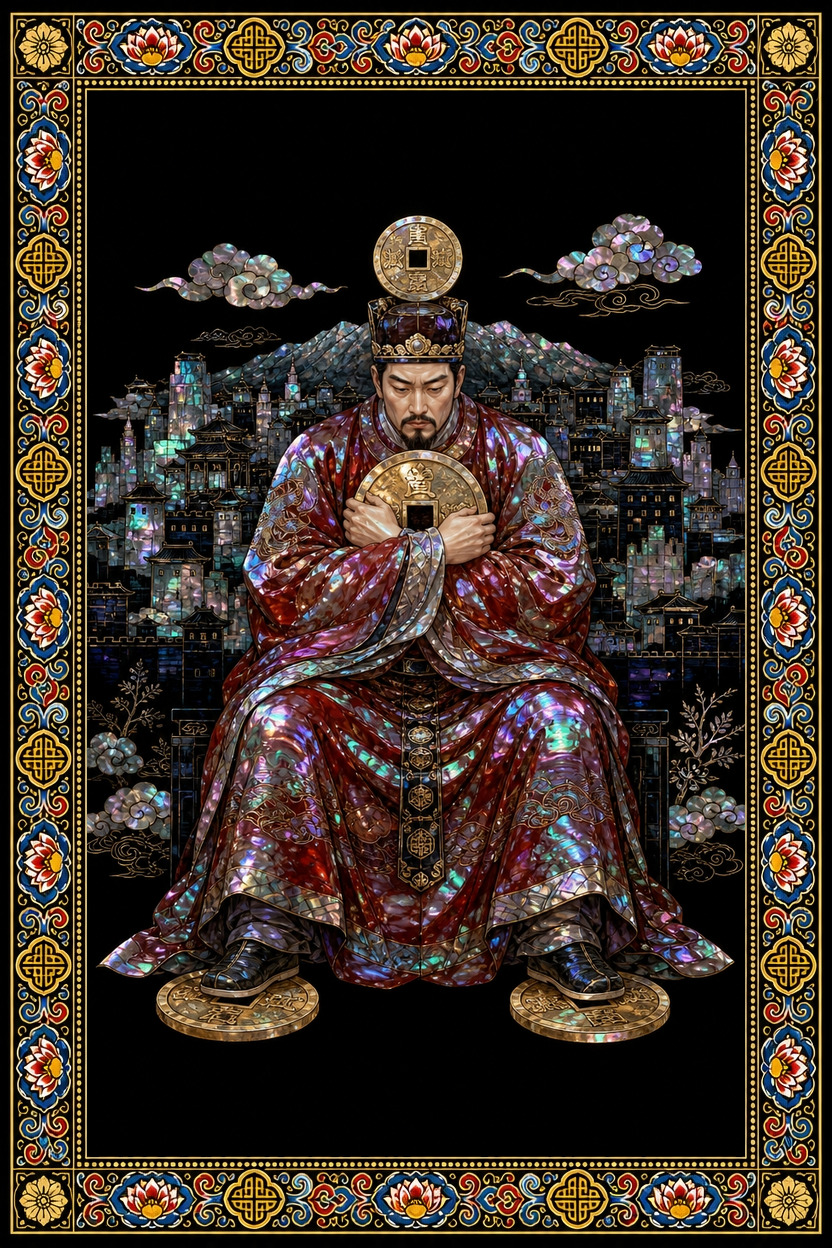
Pentacles · Four of Pentacles
Four of Pentacles — The Man Clutching a Coin to His Chest
How should we read a person who holds a coin to his chest while keeping an eye on the ones beneath his feet? This card's image lets us examine the boundary between security and holding on.
『Four of Pentacles』 — what this card actually draws
At the center of the card stands a man in a red long robe (traditional dress). He has pulled a large coin to his chest as if wrapping his arms around it, and you can feel the force in his arms from the way he holds it. His gaze faces forward, but his chin is slightly tucked, which reads as a posture of someone determined not to let anything slip.
Above his head sits a headdress ornament, and on top of that rests another coin. At his feet, the remaining two lie side by side, so what the man grips and what he stands on share a single frame. Behind him, a city wall and peaks rise to form the background.
The heart of this image is that all four coins stay close to the figure's body. The coins are not scattered far off; they sit only within reach—at his hands, his chest, and beneath his feet.
Symbols and meaning
The coin held to the chest shows a mind set on protecting what is already owned. The gesture of wrapping his arms around it is a sign of possession and, at the same time, a sign of defense. So when this card appears upright, it reads as a period when security, saving, and control rise to the center of life.
The coins at his feet are the portion he has not yet spent but keeps pinned down. The one on the headdress is closer to an invisible asset, like status or reputation, and you can glimpse an attitude that wants even that kept within reach. The wall behind him quietly tells you how far the boundary he is guarding extends.
Reversed, the same image reads the other way around. It is the current of loosening the arms that held on and taking out what lay beneath the feet to use. It is a change that eases control a little and leans toward generosity, and spending or financial release belongs here.
When this card appears
At work, it reads as a phase of protecting your results. Your energy concentrates on maintaining a position or record you have already secured, and present stability takes priority over new attempts. Still, if you grip too tightly, the door to collaboration can narrow.
In relationships, it shows up as an attitude that does not reveal feelings readily and tries to keep the other person inside your own fence. The wish to possess may be mixed in with affection, so ask yourself whether you are leaving room for the other person's share.
With money, the balance between saving and spending is the theme. This is a position where you are good at gathering but prone to growing stingy at the moment of spending. The question "Do I really need to hold this coin to my chest right now, or can I set one down?" often comes up before this card.
At a point of choice, what remains is the work of sorting what to keep from what to give away. The holding force is strong, so deciding what you will not hold onto becomes the real decision.
History and culture: the Visconti-Sforza deck and the Milanese court
The Visconti-Sforza deck is handed down as a gold-leaf handcrafted set of cards made for the Visconti court in the fifteenth century. Pressed with metal foil and colored by hand, these cards were, from the start, less a game than a possession of the court and an object meant to be shown.
What stands out in this card is the size of the coin the figure holds. The large coin that covers his palm calls to mind the costly gold-leaf card itself. Only a few people could handle such cards, and that fact reads as overlapping with the gripping hand of the figure in the image.
The arrangement of a coin atop the headdress ornament also shows the taste of the court. In a court culture that displayed one's place through ornament and heraldry, how possessions were put on display was itself an expression of rank. The figure in this card demonstrates that manner of display with his body.
Common misreadings
This card is often read only as a marker of "a person who is shrewd about money." But what the image speaks of is not calculation but attitude. The focus is on what you want to protect, and how far that protecting has expanded.
It is also common to interpret the reversed position as loss outright. Letting go is not the same as losing. Try reading it as an active scene in which you set down what you were holding and decide to spend.
Some see stability as stagnation. The stability in this card is not a halt but the result of time spent guarding. Still, the real question this card asks is whether you notice the strain growing in your arms as that time grows longer.
Draw a card yourself
The picture you have just read can be placed against your own question. The same card answers differently when the question changes.
- A deck drawn in-house — 78 cards in the colours of nacre and dancheong
- Readings that read the picture, not a keyword list
- Keep asking — draw one more card for your next question
- A record you can return to and compare
- Let a friend draw for you with a single link
- Seventeen languages, one deck, one reading
More from this suit
