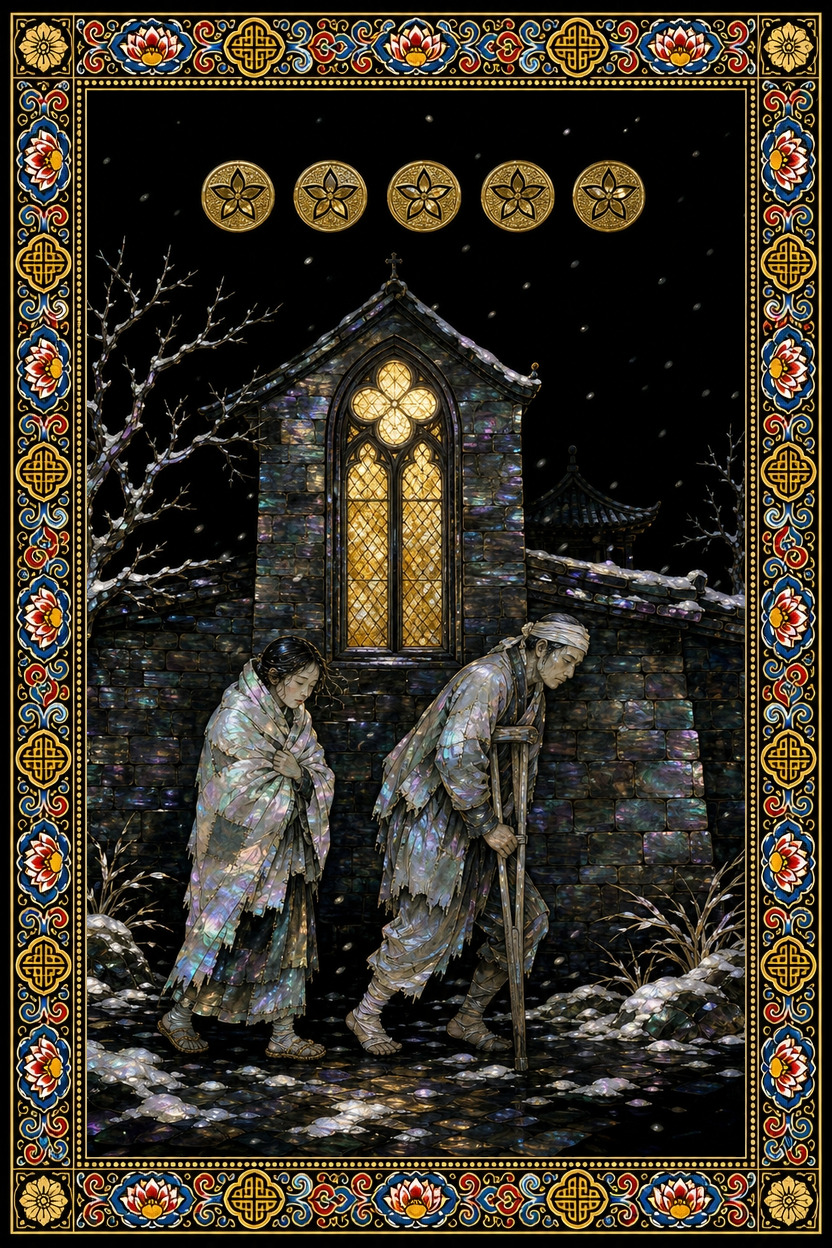
Pentacles · Five of Pentacles
Five of Pentacles — Two Ragged Figures in the Snow and the Light in the Window
On a snowy night, why do two figures in ragged clothes fail to see the light in the window? This essay follows the gaze of the painting and traces the signs of help that remain even in the midst of want.
『Five of Pentacles』 — what this card actually draws
In the lower part of the image, two figures in ragged clothes walk side by side. One leans on a crutch, and the other keeps pace beside them. Both look down at the ground and move only forward, and snow has piled up under their feet.
Raise your eyes a little and a window comes into view on the wall. Five gold coins are fixed to it, and light seeps out through the gaps. The window sits not behind the two figures but above their heads, in a place hard to notice unless the walkers lift their gaze.
On one side of the scene stands a bare tree stripped of its leaves, its branches also bearing snow. The composition, which sets the people, the window, and the tree apart as below and above, outside and inside, creates the impression this card leaves.
Symbols and meaning
What the image says upright is less about scarcity itself than about the gaze that meets it. The rags and the crutch show loss, and the snow-covered road shows harsh conditions. Yet the light in the window is still on. The help has not vanished; it is simply unseen because no one has lifted their head.
It is also worth noting that the five coins are fixed to the wall rather than held in anyone's hand. This is an arrangement in which wealth does not circulate among people but stays fixed within a structure. So the card does not blame poverty on individual idleness; it explains in picture form how exclusion comes about.
Reversed, the direction of the gaze changes. Eyes that were on the ground turn toward the window, and that becomes the starting point of recovery. Accepting help is not weakness; it is closer to stopping in the snowfield and looking around.
When this card appears
At work, it reads as a period when results are not visible and you begin to doubt yourself. Even if you feel your efforts go unrecognized, look for a hand a colleague or senior has already extended. The habit of carrying everything alone can make the situation harder than it actually is.
In relationships, you are placed in a phase where you feel lonely even with people around you. Often hearts have drifted apart without the other person knowing, so it is better to speak up, even briefly, than to guess. In money, the flow shows your margin shrinking because of unexpected expenses.
When facing a choice, you find yourself counting the help you can accept now rather than waiting for perfect conditions. To someone who has stopped walking in the falling snow, the card says this: "Just once, from where you stand now, look up toward the side where the light shows."
History and culture: minhwa and sipjangsaeng — the lineage of symbolic creatures
No creature of sipjangsaeng (the ten symbols of longevity) appears on this card. Instead there is snow, a bare tree, and gold coins fixed to a wall. If the flower-and-bird paintings of minhwa (folk painting) drew abundance with full blossoms and birds, this image leaves a single winter tree on the opposite side.
In East Asian painting, snow and dry branches were often used as symbols of integrity enduring hardship. The best-known example is the Sehando lineage of paintings, which depict a red pine (sonamu) weathering the snow. The tree on this card has lost its leaves, but the mere fact that it stands there connects it to that lineage.
The idea of fixing gold coins to a wall resembles the arrangement in chaekgado, where objects are laid out across a wall surface. The difference is that where chaekgado displays possessions as if showing them off, here the possessions are separated from people and hung on the wall. The same arrangement produces the opposite mood.
Common misreadings
Some conclude that when this card appears, a great loss is sure to follow. But what the image emphasizes is not the size of the event but how a person sees it. The card's intention lies in the lit window drawn alongside the figures.
Another misreading takes the card to depict poor people and so turns their situation into personal responsibility. The rags and the crutch point to conditions created by circumstance, and the image does not mock them. Finally, there is the misreading that takes the reversed card to mean only that everything will be resolved. Remember that recovery begins with the concrete act of accepting help.
Draw a card yourself
The picture you have just read can be placed against your own question. The same card answers differently when the question changes.
- A deck drawn in-house — 78 cards in the colours of nacre and dancheong
- Readings that read the picture, not a keyword list
- Keep asking — draw one more card for your next question
- A record you can return to and compare
- Let a friend draw for you with a single link
- Seventeen languages, one deck, one reading
More from this suit
