Pentacles · Six of Pentacles
Six of Pentacles: The Man with the Scales and the Two Who Receive
When what you hold in your hand is a coin, and when it is a scale, how does a person's manner change? Following the artwork of the Six of Pentacles, we look at generosity and balance.
『Six of Pentacles』 — what this card actually draws
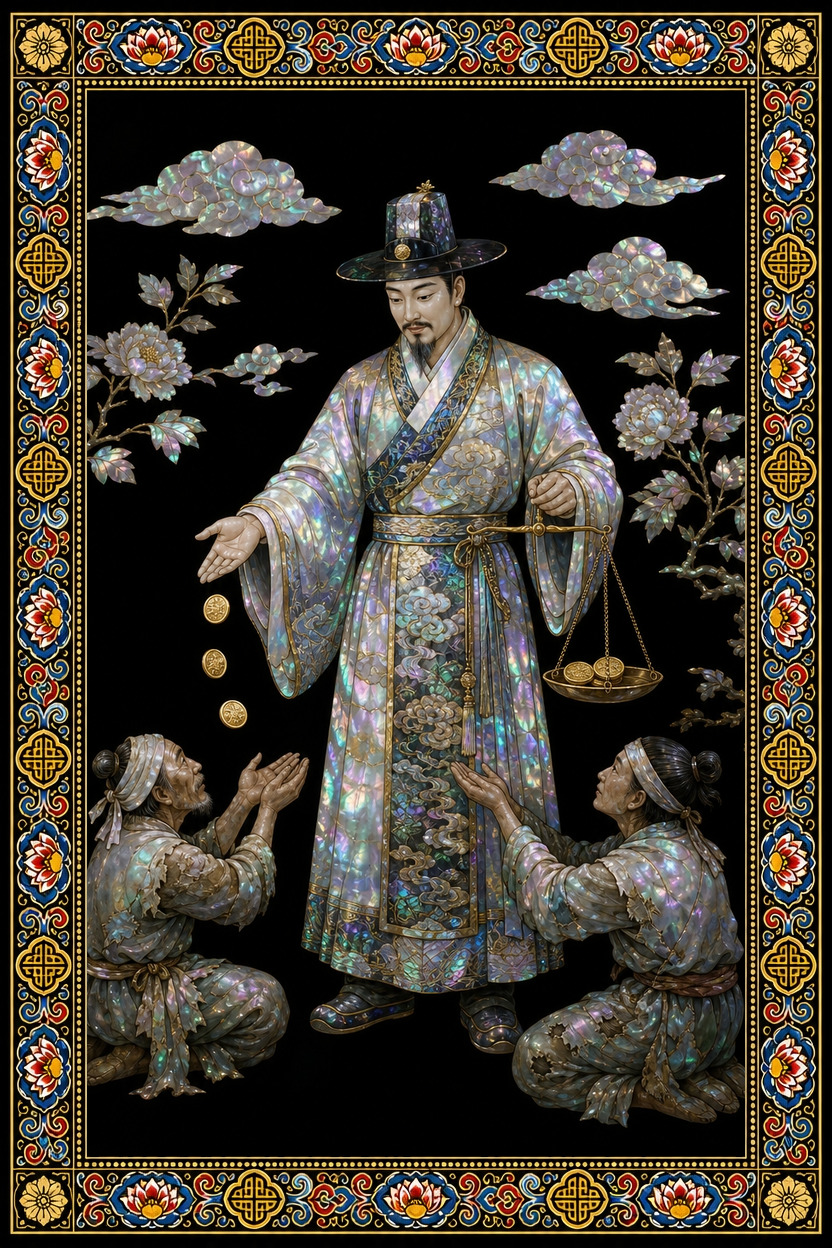
At the centre of the image stands a man wearing a gat (a wide-brimmed black horsehair hat) and dressed with care. In one hand he holds scales; from the other he extends coins as if letting them fall. His gaze runs to the fingertips he holds out and to the two people kneeling below.
The two kneeling figures receive the coins with their hands gathered together. It is not a gift to one alone but something divided between the two. Behind the figures, maehwa (plum blossom) is in bloom, showing that the scene takes the mood of a season or a place as its backdrop.
The point to notice is that the two objects the man holds are different in nature. The scales are a tool for measuring; the coins are a thing being handed over. This card draws a scene in which sharing and weighing are placed together in one person's two hands.
Symbols and meaning
The scales are a tool for measuring what to give and how much. So the generosity of this card does not stand on an overflow of feeling but on calculation. That the act of giving and the judgement of fair division happen in the same hand is the heart of the upright meaning.
The kneeling posture reveals the position of the receiving side. Sharing works because the two are at the same height, yet between the one standing and the ones kneeling there is already a difference in height. The attitude that acknowledges this difference while refusing to lose balance leads into the meaning of giving and receiving.
Reversed, that difference in height surfaces as the problem. When the scales tip, conditions attach to the giving, and when the hand that holds out the coins is not withdrawn, the receiving side comes to feel in debt. It is also worth asking whether the giver is sharing without caring for themselves.
When this card appears
At work, relationships of mutual help come into view. This is a place for teaching a junior colleague or helping with a co-worker's tasks, aiming to keep the balance rather than to weigh the price. If instead you are in a position of having to ask for help, it is better to make the receiving side's share clear.
In relationships, you look at whether the giver and the receiver have become fixed. If one person always makes contact first and always yields, that generosity is hard to sustain. In money matters, sharing or support may pass back and forth, and the key is whether the conditions remain clearly stated in words.
Faced with a choice, you weigh what to give and how much. Rather than giving everything or nothing, deciding on an amount you can bear lasts longer. People who meet this scene often say something like this: "I can't tell whether I'm being generous or just creating a debt."
History and culture: the 1909 Rider-Waite-Smith deck and the standardisation of symbols
In the Rider-Waite-Smith deck of 1909, the minor suits were given scenes for the first time. These images, directed by Arthur Edward Waite and drawn by Pamela Colman Smith, made what the figures are doing the basis for interpretation, unlike earlier decks that had only numbers and suits.
In the Six of Pentacles that change shows especially clearly in the scales. The judgement of 'dividing fairly', which the number six alone cannot convey, was carved into the picture through the single object of the scales. That the hand dropping coins and the hand holding the scales are different hands is also information you gain only by reading the image.
As this deck spread widely, this kind of scene composition settled in as a standard. The story goes that many decks since have repeated the arrangement of the scales, the coins, and the two kneeling figures. Interpretation of this card begins with looking again at an image that has hardened in that way.
Common misreadings
Seeing this card, people often read it as the message that you must be a good person. But the centre of the picture is not the giver but the scales. Without the work of weighing what to divide and how, sharing becomes a burden on one side instead.
Another is to assume this card guarantees abundance. Coins do pass between hands, but the picture shows the posture of the receivers and the hand of the giver together. It draws a state in which giving and receiving is already under way; it is not a picture that promises an outcome.
It is also a shame to see the reversed card only as a bad omen. Read as a signal for noticing favour with conditions attached or a balance of power that has tipped, it leaves room to check for yourself what needs adjusting in a relationship.
Draw a card yourself
The picture you have just read can be placed against your own question. The same card answers differently when the question changes.
- A deck drawn in-house — 78 cards in the colours of nacre and dancheong
- Readings that read the picture, not a keyword list
- Keep asking — draw one more card for your next question
- A record you can return to and compare
- Let a friend draw for you with a single link
- Seventeen languages, one deck, one reading
More from this suit
