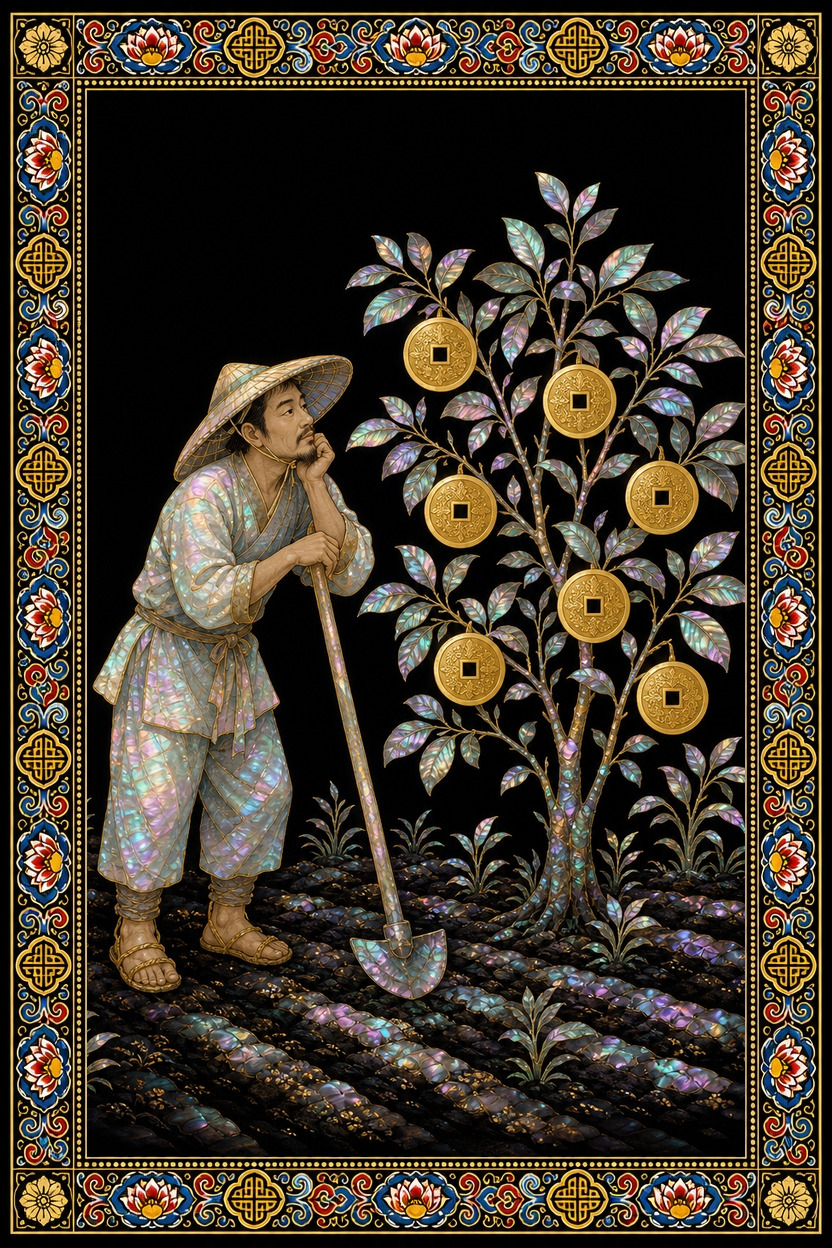
Pentacles · Seven of Pentacles
Seven of Pentacles — The Farmer Leaning on His Hoe
The harvest is still hanging on the tree, so why has the farmer stopped working and looked up? Follow this card's line of sight and consider what waiting and checking mean.
『Seven of Pentacles』 — what this card actually draws
Across the lower part of the picture run rows of furrows, and above them stands a single farmer. He leans his body against the handle of his hoe, both hands resting on the upper part of the shaft. The soil at his feet looks as though it has already been worked once; the lines of the furrows are clean.
Move your eyes upward and five large, round gold coins hang from the branches of a tree. The farmer lifts his head and looks up at them, while his satgat (a conical straw hat) hides his face. The tree stands off to the right side of the picture, and the sky behind it has sunk into darkness.
There is no sickle in the picture, and no pile of gathered grain. The only thing in his hands is a hoe, and the harvest is still hanging on the tree. This card captures not the moment after the work is done but the empty time between the work and the harvest.
Symbols and meaning
Leaning on the hoe means stopping, but it is not idleness. The fact that the furrows are already tidy speaks for the work he has done so far. So this card reads as the season for taking a breath after sowing and before reaping.
The gold coins on the tree are fruit that is not yet ripe. It matters that he looks up at them rather than reaching out to pick them. Even if the growth looks slow, if the direction is right, the waiting itself becomes part of the share.
Placed reversed, the same picture speaks in a different voice. The upward gaze grows anxious and turns away too early, or you are asked to reconsider whether you have been tending a different field all along. The dark sky lends itself to that mood of review.
When this card appears
At work, this is a phase in which results take time to become visible. Go back over the process you have built up so far, as if making a list, and decide only the next step. A mid-course check is worth more than hurrying.
In a relationship, things between you and the other person may be ripening slowly. Rather than measuring the size of the feelings, it is better to count the time you have spent on each other. With money, the harvest is not yet settled, so writing down your spending and your expected returns separately will make you feel less rushed.
If you stand at a fork in the road, you do not have to reach a conclusion right now. Like this farmer who has set his hoe upright, you need a moment to stop and check what you planted. This scene is often summed up in the line: "Don't count what isn't in your hands yet; count what you've already sown."
History and culture: Traditional dress — silhouette, colour and station
The farmer wears a satgat (a conical straw hat) on his head. With its wide brim covering face and shoulders, this hat was a practical item that blocked both sun and rain, and the material and the way it was woven revealed the wearer's circumstances. A satgat woven from cheap grass belonged to the person who went out to the fields.
The clothing on his body is tied at the waist, not wide in the body, and cut so the arms can move easily. This connects with the late Joseon trend in which commoners' dress was trimmed toward practicality, suited to working movements, rather than wide sleeves and long hems. Protecting the body came before decorating the outside.
In this figure's dress there is no colour or ornament that shows off status. Instead, the satgat, the hoe and the furrows together explain his place. In dress history this scene remains an example of how clothing reveals station and, at the same time, how faithfully the clothes of working people served function.
Common misreadings
Some people conclude that when this card appears, "a great harvest is coming soon." But the coins in the picture are still on the tree, and the farmer does not pick them. This card points to a time of checking, not to a guaranteed reward.
Another misreading takes this scene as idleness. Seeing that the furrows are in order, he is someone who has already done the work. The leaning posture is a pause, not a surrender.
Conversely, some decide early on that "waiting is useless no matter how long I wait." The card means to check your direction, not to let go of the work. Confirming what you planted and then lifting the hoe again is the next scene this card holds.
Draw a card yourself
The picture you have just read can be placed against your own question. The same card answers differently when the question changes.
- A deck drawn in-house — 78 cards in the colours of nacre and dancheong
- Readings that read the picture, not a keyword list
- Keep asking — draw one more card for your next question
- A record you can return to and compare
- Let a friend draw for you with a single link
- Seventeen languages, one deck, one reading
More from this suit
