Pentacles · Eight of Pentacles
Eight of Pentacles — The Artisan Bent Over the Bench
While one person carves a single coin, the coins already finished hang on the wall. Why is this a card about keeping at the making rather than about the making itself?
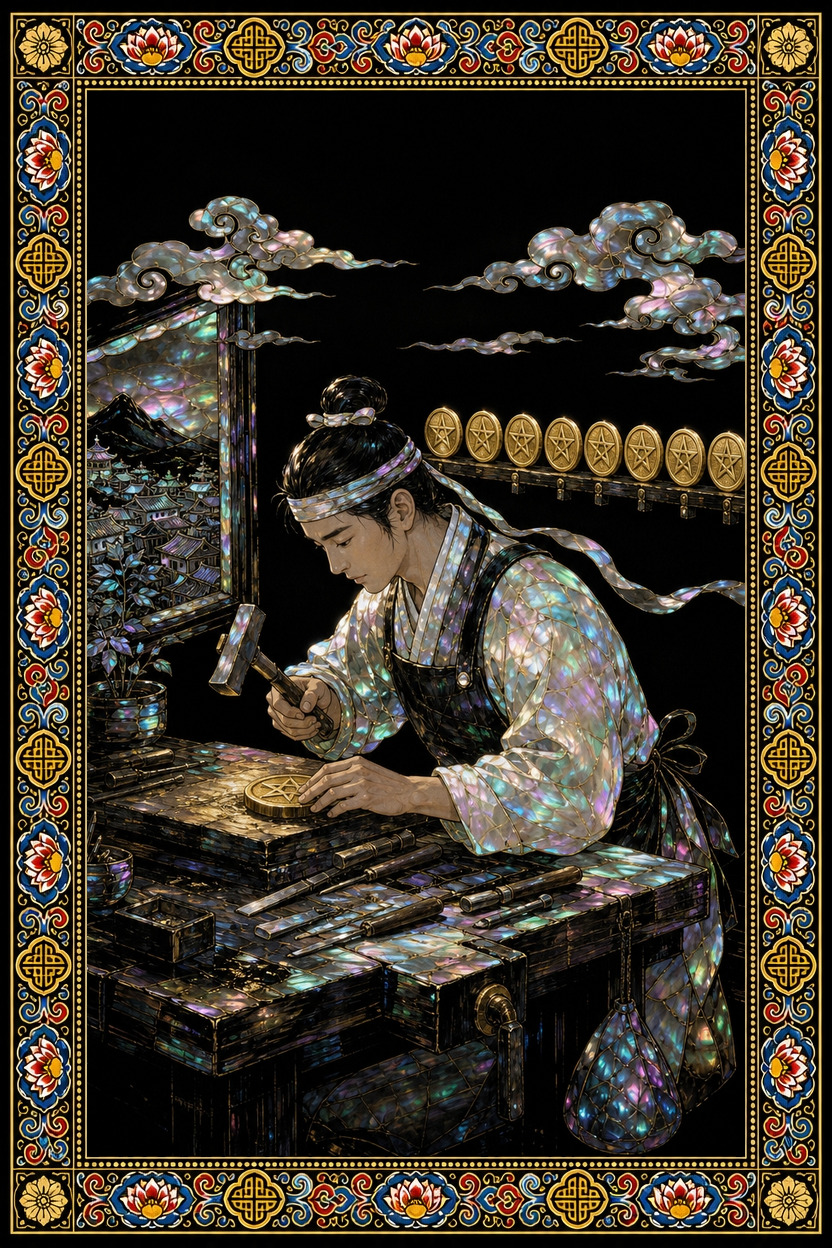
『Eight of Pentacles』 — what this card actually draws
Your eye goes first to the person bent over the workbench. An artisan wearing an apron over long robe (traditional dress) holds a chisel and hammer and is carving a single coin. The stooped posture is the first thing that tells you this is slow work.
Beside the bench, finished coins are stacked. And on the beam behind him hang seven coins. The one in his hand, the stack, and the seven hanging together give you a sense of how much this artisan has made so far.
Only this one artisan appears in the frame. Who ordered the work, and what it is for, are not shown. All the picture gives you is the repetition at his fingertips and what that repetition has left behind.
Symbols and meaning
Upright, the image shows a structure in which repetition accumulates. The movement of the hand carving one coin is small, but it remains as the pile beside him and the seven on the beam. That is why this card reads toward accumulation rather than talent, and toward process rather than result.
Reversed, it looks at the fatigue inside the same picture. When the coins on the beam feel less like a point of pride than a list of chores, repetition stops being mastery and becomes depletion. If you keep looking back at the finished coins and stop your hands, it is easy to slide into cutting corners or into perfectionism.
It is also worth noticing that he holds the chisel and the hammer together. That the delicate carving and the hard striking sit in one person's two hands suggests that building a skill works neither by finesse alone nor by force alone.
When this card appears
At work, it reads as a signal not to let go of what you are doing even if it goes unnoticed. This is a period when results look slow but the repetition itself stays with you as skill. Still, check whether you have been repeating the same motion so long that your sense of it has dulled.
In relationships, the things you have quietly built up for someone else may never become a topic of conversation. When it feels as if that effort never existed, resentment tends to grow, so it is better to give yourself credit for what you have done.
With money and choices, steady management suits this card better than big decisions. Rather than making a large sum all at once, adding a little each month fits this picture. Whatever choice is in front of you, try making "can I keep doing this?" your standard.
Picture the artisan, work finished, hanging the coin on the beam, and a line like this tends to come up: "The one I'm making now will hang on the wall someday."
History and culture: the Egyptian origin myth and its refutation
In the eighteenth and nineteenth centuries, the story went that tarot came from the mysteries of Egypt. Court de Gébelin argued that tarot was rooted in the Book of Thoth, and for a long time this was cited as though it were fact.
But once the gaming origin was documented, this story was refuted in the record. The imagery on this card, too, does not come from ancient Egypt; it comes from the image of the medieval European craftsman carving coins.
What stands out most on this card is the seven coins hung in a row along the beam. This arrangement pairs with the card's number, eight, and shows the card's character as an image laid out in regular order on a printed engraving. The starting point for this card is that it is not a mystical symbol but a picture of the labour of its own time.
Common misreadings
This card is often read as a guarantee that effort will always be rewarded. What the picture shows is not reward but accumulation. The piled coins are evidence of results, not a promise of success.
Conversely, it is sometimes reduced to "the card of tedious repetition." Just as the object being carved changes each time within the same movement of the hand, this picture deals with the minute differences inside repetition.
When it comes up reversed, it is easy to take it to mean the work is over, but the artisan in the picture is still bent over the bench. Try reading it as a question of pace and attitude rather than of stopping.
Draw a card yourself
The picture you have just read can be placed against your own question. The same card answers differently when the question changes.
- A deck drawn in-house — 78 cards in the colours of nacre and dancheong
- Readings that read the picture, not a keyword list
- Keep asking — draw one more card for your next question
- A record you can return to and compare
- Let a friend draw for you with a single link
- Seventeen languages, one deck, one reading
More from this suit
