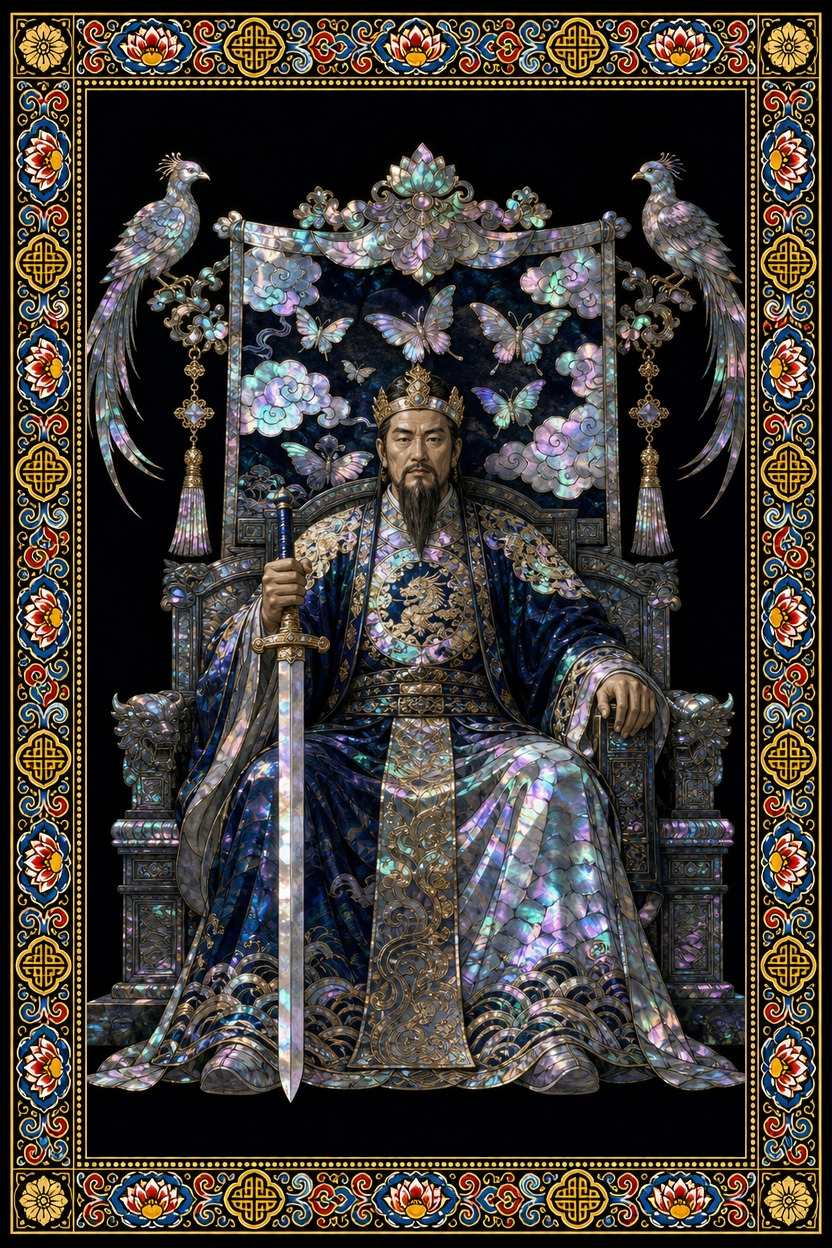
Swords · King of Swords
King of Swords — A King Who Leans on a Throne Where Two Birds Perch
What is this figure judging, leaning back on his throne with his sword raised? This piece begins with the artwork of the King of Swords and reads it as a card that asks about the balance between logic and feeling.
『King of Swords』 — what this card actually draws
At the center of the card sits a bearded king. He leans his body against the back of the throne, and in his right hand he holds a sword upright. The sword rises along the central axis of his body.
Two birds perch on the back of the throne. They sit on either side of the king's head, giving the impression that he is watching both sides at once. The king's robe is deep navy, flowing with a nacre-like sheen.
The composition is simple: the king, the throne, the sword, and the birds. There are no other objects in the background, so the eye lingers on the figure, the sword, and the birds.
Symbols and meaning
The upright sword is a tool of intellect and judgment. The way he sits leaning back with the blade pointed up and his strength relaxed shows an attitude of sorting out a situation and judging it rather than brandishing authority. The two birds stand for two different viewpoints, and this reads as meaning that fair judgment comes from considering both sides together.
Upright, this card represents the power to set strategy on a foundation of logic and ethical clarity. It is the attitude of organizing the facts without being swayed by emotion and making responsible decisions. The deep navy robe suggests that such judgment is not shallow but has depth.
Reversed, it warns that logic can turn cold. A judgment that is right in the head but ignores the voice of the heart can slide into manipulation or rigid logic. At such a time you need to set the sword down for a while and ask yourself whom your judgment is really for.
When this card appears
At work, it points to a situation that demands expertise and fairness. It is a time to present logical grounds in meetings or negotiations, and it is better to approach with facts and principles than with emotional appeals. Just be careful not to disregard your colleagues' feelings.
In relationships, it is a time to sort out each other's positions rationally. Clarifying standards and promises helps more than an emotional conversation. But if you press the other person too hard with logic, the relationship can stiffen.
With money and choices, cool calculation is needed. Compare the alternatives and lay out their pros and cons in a table. This card recommends considered judgment over emotional impulse.
A question like this may surface alongside the card: "Is my judgment fair right now, or am I justifying my own logic?"
History and culture: America, Britain and the modern tarot
The two birds perched on the King of Swords' throne are a striking detail in the iconography of the Waite-Smith deck. It was printed in Britain in the first decade of the 1900s and crossed the Atlantic soon after. The illustrations by Pamela Colman Smith were sometimes simplified in the printing process, but the arrangement of the birds and the sword has been kept relatively consistent.
At the meeting point of the 1970s New Age movement and psychology, tarot was reinterpreted as a tool for self-reflection. It was around this time that the King of Swords began to be read as the 'inner judge.' This card, symbolizing logical thought, became linked to psychological questions about the balance between emotion and reason.
In the modern tarot, the King of Swords is not seen only as a symbol of authority. The multiple perspectives shown by the two birds emphasize the importance of judgment that takes various viewpoints into account. This also connects with the critical thinking demanded in today's decision-making processes.
Common misreadings
Some people dismiss the King of Swords as nothing but a cold-blooded or authoritarian figure. But the king in the artwork sits leaning back with his sword held upright. This is closer to an attitude of contemplating a situation than of showing off power.
It is also easy to misread this card as always guaranteeing the right judgment. Reversed, it shows that logic can slide into self-righteousness. The card is only a tool for judgment; it does not guarantee the outcome.
Finally, some see the King of Swords as a being entirely cut off from emotion. But the two birds stand for different voices, which hints at a harmony between emotion and reason. Balance is the key.
Draw a card yourself
The picture you have just read can be placed against your own question. The same card answers differently when the question changes.
- A deck drawn in-house — 78 cards in the colours of nacre and dancheong
- Readings that read the picture, not a keyword list
- Keep asking — draw one more card for your next question
- A record you can return to and compare
- Let a friend draw for you with a single link
- Seventeen languages, one deck, one reading
More from this suit

