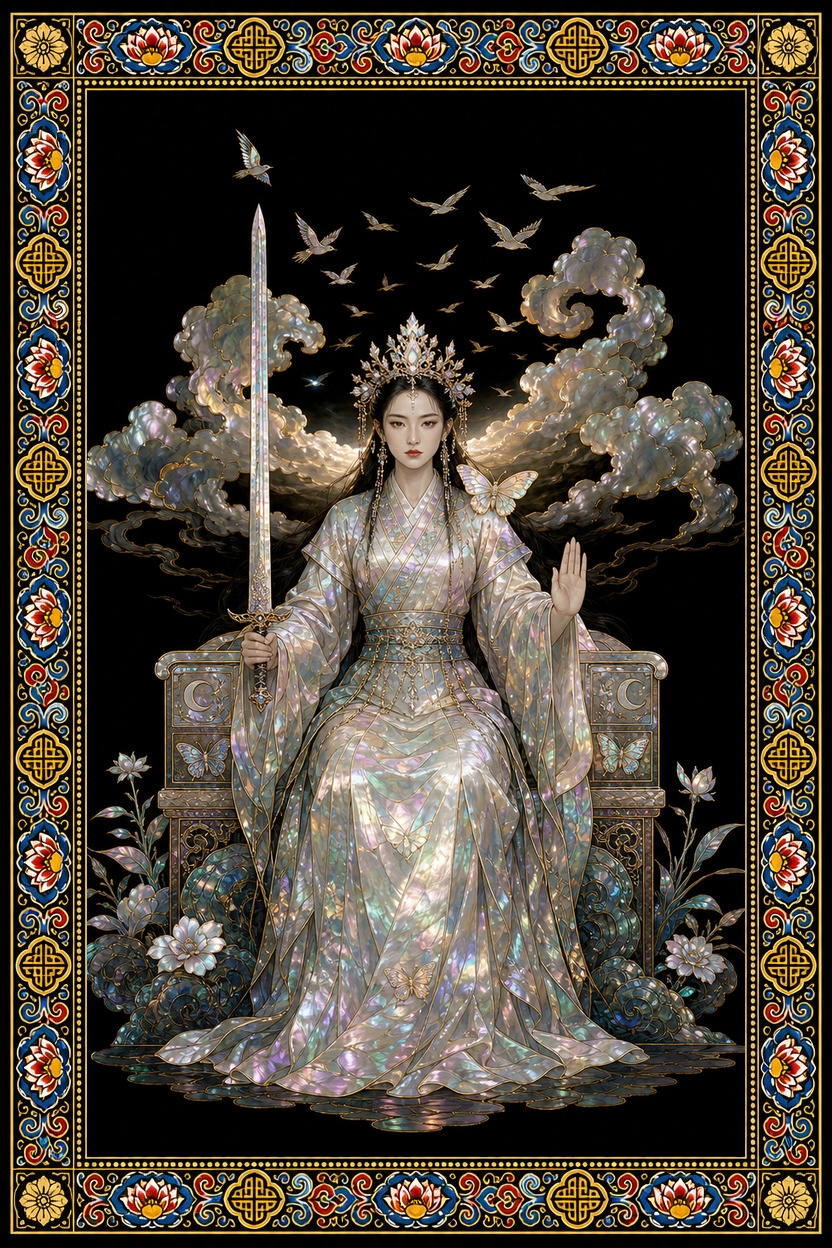
Swords · Queen of Swords
Queen of Swords — The Woman on the Throne, Sword Raised, Palm Open
What is the woman saying, who holds her sword upright and opens her other hand? This essay looks at the Queen of Swords' posture and iconography to see how judgment and tenderness are placed together.
『Queen of Swords』 — what this card actually draws
At the centre of the image a crowned woman sits on a throne of stone. The backrest stands straight, and its angle runs parallel to her posture, forming a single vertical line. Her gaze faces forward and her chin is lifted.
In one hand she holds a sword upright. The tip points up and the blade stands level with the axis of her body, so the sword looks less like a weapon of attack than a pillar that keeps her posture upright. Her other arm is bent at the elbow, the palm open and raised.
Birds fly above her head, and white flowers bloom at her feet. The hard stone of the throne and the soft contours of the flowers are laid over each other in a single frame.
When you read the picture, start at the sword, move to the open hand, then let your eye fall to the flowers at her feet. This downward path shows the card's character exactly as it is.
Symbols and meaning
The upright sword means a standard for judgment. What matters is that it is not being swung but held straight. It reads as the attitude of setting a standard and refusing to waver before it.
The open palm shows that this standard stays open toward people. Had she clenched a fist or drawn her hand back, the boundary would have become a blockade; because the hand is held open, room for honest communication remains.
When the card tilts into reversal, the straightness of the sword turns into sharpness. The same sword and the same crown read as cynicism and harsh criticism at the point when the open hand folds and the gaze no longer turns toward people. What is needed then is not to grow sharper but to allow yourself tenderness.
When this card appears
At work, this is the time to set your standards clearly. Rather than staying quiet in a meeting, it builds trust to state the grounds for your judgment honestly. Just keep the target of the criticism separate from the person.
In relationships, you may need a conversation that draws a boundary. This is not about pushing the other person away but about saying plainly what was uncomfortable. Lower the emotional temperature, but do not blur the content.
In matters of money and choice, check the numbers and conditions coolly. The flowers at her feet are a sign that a warm intention remains behind that coolness.
Looking at a picture that holds a raised sword and an open hand together, people often say something like this: "Say what needs saying, but let me know first that you aren't planning to cut me off."
History and culture: the old grammar of number and figure
The geometric structure that stands out in this card's iconography is the interlocking of vertical and horizontal. The raised sword and the straight backrest make the vertical, while the seated posture and the open arm make the horizontal. The story goes that the Pythagoreans divided odd numbers into the number of activity and limit and even numbers into the number of receptivity and ground; this image can also be read as those two qualities crossing within a single figure.
In medieval European number symbolism, four meant the frame that divides the world, as in the four directions and the four elements. The suit of Swords has been tied to the element of Air and explained as the realm of thought and language, and as the court figure of that suit, the Queen takes on the role of operating that frame from her own place.
In East Asia too, the crossing of odd and even was often explained as the pairing of yin and yang. Still, it is fairer to see this card's numbers and arrangement as not coming directly from any one tradition, but as the result of the seventy-eight-card system starting from card games and hardening as it absorbed number concepts from many regions.
Common misreadings
People often say the Queen of Swords means a cold person. But the woman in the picture has her hand open. Her coolness should be read not as an absence of feeling but as the choice not to be swept away by it.
There is also a reading that assumes a relationship ends whenever this card appears. The raised sword is closer to a pillar that sets a standard than to a blade that cuts. Reading it as a signal to make the conditions clear rather than to close the door of conversation stays truer to the picture.
Seeing the reversal only as a bad card is another misreading. It is merely a mirror reflecting a state in which sharpness has gone too far and the heart has closed, and it remains an invitation to recover tenderness toward yourself in that very place.
Draw a card yourself
The picture you have just read can be placed against your own question. The same card answers differently when the question changes.
- A deck drawn in-house — 78 cards in the colours of nacre and dancheong
- Readings that read the picture, not a keyword list
- Keep asking — draw one more card for your next question
- A record you can return to and compare
- Let a friend draw for you with a single link
- Seventeen languages, one deck, one reading
More from this suit
