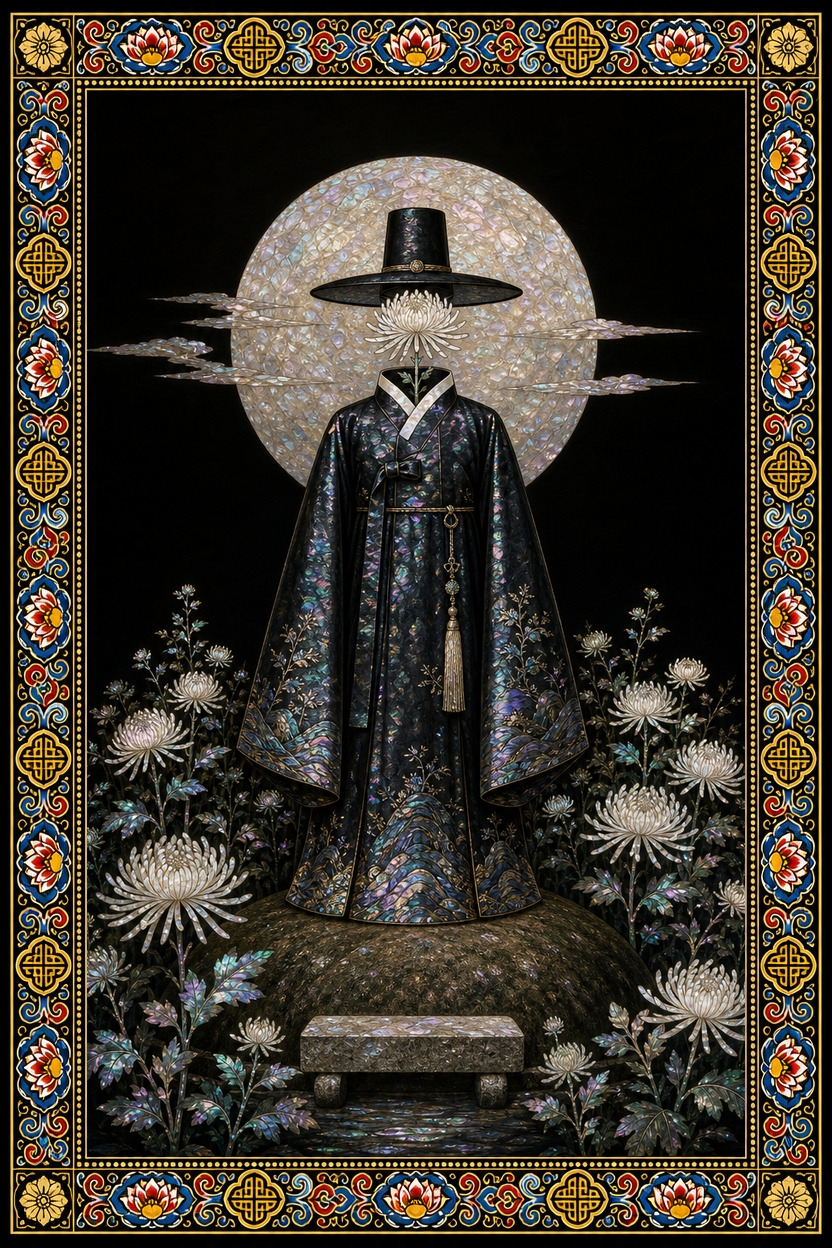
Major Arcana · Death
『Death』 — A White Chrysanthemum Face Beneath the Moon Disc
What comes to mind when you see a figure whose face has blossomed into a flower? This card does not draw disappearance but the place where one phase closes and the next opens.
『Death』 — what this card actually draws
A figure stands at the centre of the frame. It wears a black gat (a wide-brimmed black horsehair hat), and where the face should be a single white chrysanthemum has bloomed. A long coat (a scholar's long coat) embroidered in black hangs over the body, and the figure only stands facing somewhere, holding nothing in its hands.
Raise your eyes a little and a great moon disc floats behind the figure. At its feet lies a field of white chrysanthemums, with a stone bench set beside it. Across the sky clouds drift horizontally, dividing the frame.
What moves in this picture is not the figure but the background. While the clouds flow and the moon hangs there, the figure stays still. So the scene looks less like the instant an event breaks out than like a held moment between something already gone and the next thing not yet arrived.
Symbols and meaning
The white chrysanthemum in place of the face is the strongest marker on this card. A human face turned into a flower can be read not as the extinction of a person but as a swap of form. That is why, upright, the card connects to endings and change, to letting go.
The moon disc behind suggests cyclicity. Just as the moon waxes and wanes, phases rise and fall, and the chrysanthemum field and stone bench at the figure's feet point the same way. The bench is a place where someone sat and then rose; the flower field is a place that blooms again with each season.
Reversed reads as a state that refuses this swap of form. It is as if you were clinging to a face that has not managed to become a flower, so resistance to endings, stagnation and incomplete closure lock naturally into the picture.
When this card appears
At work it points to the moment a phase of what you have been doing closes. A project ends or a role changes, and the more tightly someone is holding on, the more likely the card is to come up reversed.
In relationships it overlaps with the situation of finally admitting, now, a relationship whose form changed long ago. With money it can be read as a signal to check whether there are items still left to settle. Before a choice, the question becomes less which side you pick than what you can set down.
When Death turns up in the spread, it tends to speak in plain, unsparing sentences rather than images. Yours may sound like this: "That thing you could not finish still takes up your place."
History and culture: Marseille tarot and the fifteenth-century card game
The element worth noticing in this card's artwork is the flower in place of the face. The Death card of the Marseille deck is drawn as a skeletal figure holding a scythe, and the imagery you see here translates that tradition into flower and moon.
Death holds the thirteenth place in the Marseille sequence, and it has held it since the earliest surviving printed sheets. In the game of tarocchi the trumps were ranked rather than narrated, so a card could carry a solemn subject without carrying a verdict — the number ordered it against its neighbours and nothing more. The white face in this deck keeps that older restraint: a chrysanthemum in place of a skull, a moon disc in place of a graveyard, and the sequence still doing the counting for it.
Death is one of those twenty-one, and in play too it was a strong card that cut the flow of the round. The imagery of a face turning into a flower can be seen as carrying that strong card's character of severance into a swap of form.
Common misreadings
The most common misreading is the idea that this card foretells an actual death or misfortune. What is in the picture is not a person's extinction but a face turning into a flower, and the context is a place that continues, like the chrysanthemum field and the bench.
Another is the flat assertion that when this card appears something big is about to strike. The scene is closer to the closing of a change already under way, and its pace differs from querent to querent.
It is also a pity to see the reversed card only as a "bad card." Reversed does not mean there is no change but that you are still holding on, so try turning it into the question of what you can let go.
Draw a card yourself
The picture you have just read can be placed against your own question. The same card answers differently when the question changes.
- A deck drawn in-house — 78 cards in the colours of nacre and dancheong
- Readings that read the picture, not a keyword list
- Keep asking — draw one more card for your next question
- A record you can return to and compare
- Let a friend draw for you with a single link
- Seventeen languages, one deck, one reading
More from this suit
