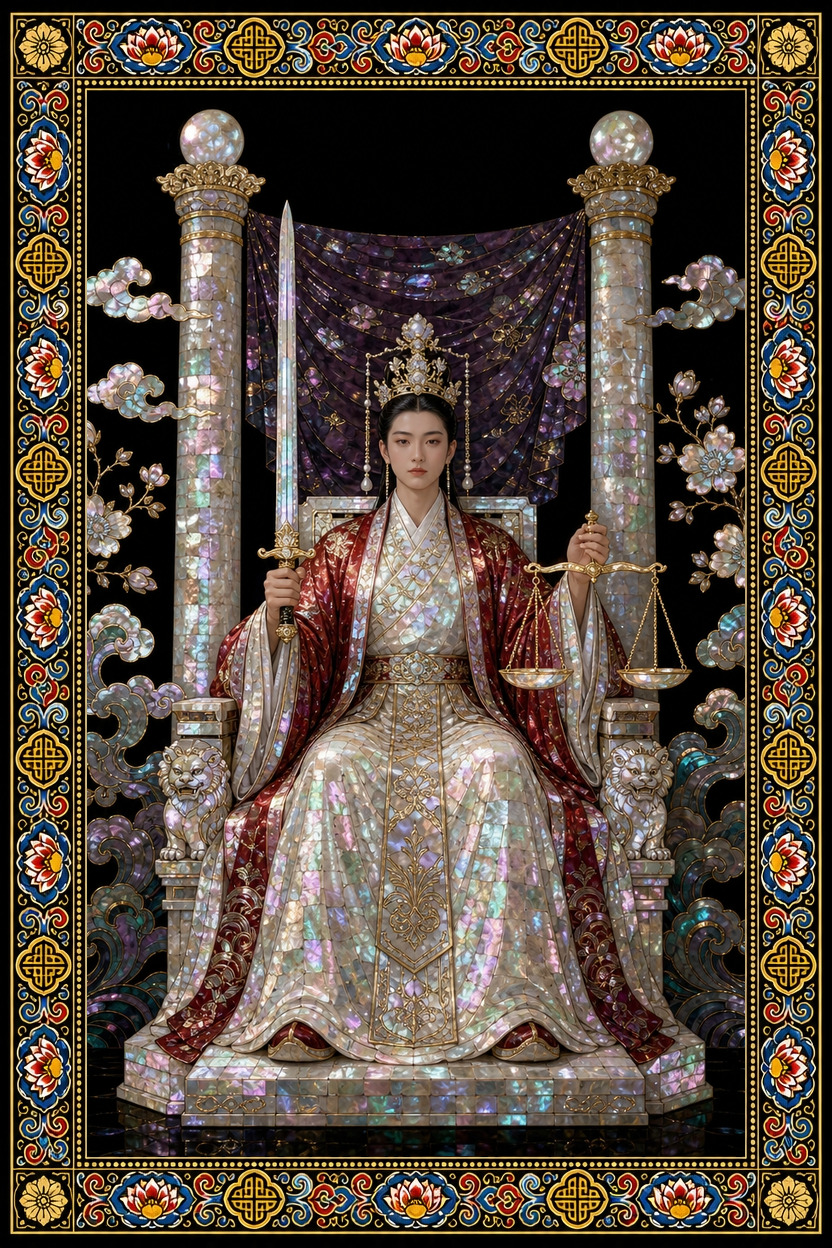
Major Arcana · Justice
Justice: A Woman with Sword and Scales Between Two Pillars
What does an upright sword and a level balance measure? This essay follows the visual elements of the Justice card one by one and offers a way of reading balance and accountability.
『Justice』 — what this card actually draws
At the center of the image sits a woman wearing a red robe and a crown. Behind her, two pearl-topped pillars stand to left and right, and between them hangs a purple veil worked with embroidery. The eye drifts naturally down to her two hands.
In her right hand she holds a sword raised straight upward; in her left, a balance. The sword stands perfectly vertical, without wavering, and the balance stays level as she holds it aloft. Near her feet bloom peonies, placing one soft note among the firm instruments.
Her posture on the throne does not lean. Within the left-right symmetry the two pillars create, she faces forward, shown holding at once both what is to be weighed and what is to be cut.
Symbols and meaning
The balance is an instrument for weighing, and the sword an instrument for cutting. The balance compares weights and builds the grounds for judgment; the sword carries that judgment into effect. The heart of this card is that the two instruments are divided between one person's two hands, showing that judgment and decision are not separate.
Upright, the card is read in terms of fairness, truth, and accountability. Because the balance between the two pillars has not broken, it means the judgment you make now is directed toward restoring the balance of cause and effect. The keyword of clarity comes from here as well: a request to see the situation with a gaze as unclouded as the sword.
Reversed, it illuminates the moment the same instruments waver. When the balance tips to one side, unfairness and bias arise; when the sword loses its role, what remains is the avoidance of accountability. Imagine the symmetry of the picture broken. The reading is that the instruments themselves are not bad; the balance of the hand that holds them is the problem.
When this card appears
At work, it arrives as a scene of evaluation and responsibility. It prompts you to ask whether performance is being assessed fairly, and whether you are avoiding the share that is yours. It is also a moment to check written standards such as contracts or regulations.
In relationships, it asks whether each person's share is in balance. If only one side keeps yielding, or only one side monopolizes judgment, read it as a signal that the balance has tipped. It also appears as a request to check the facts before the feelings.
With money, making ledgers and terms transparent comes first. Put verbal agreements in writing and sort out ambiguous expenses. At a point of choice, it is better to set your criteria than to follow emotional likes and dislikes.
A sentence that often comes up in readings is this: "What you need now is not a conclusion but a decision about what to use as your standard."
History and culture: America, Britain and the modern tarot
The element to note in this card is the balance. In the twentieth century, when tarot spread widely in America and Britain, guidebooks were accustomed to explaining the balance as an instrument of moral judgment. Reading it as a balance that separates good from evil is easy to grasp, but the balance in the picture is held aloft having weighed nothing yet.
From the 1970s onward, as those currents met psychology, the instrument began to be read differently. The balance shifts into a metaphor not for passing sentence on others but for gauging the weight among the many desires within yourself. The sword, too, is reread not as a blade for cutting others but as a tool for cutting away a decision you have put off.
As this practice of reading tarot as a tool for self-reflection took hold, the Justice card came closer to a questionnaire than a verdict. It is worth remembering, though, that this reading is not the only answer, and that the tradition of reading the same image as an image of judgment still remains.
Common misreadings
First, some conclude that when this card appears, a legal dispute or lawsuit must be on its way. It is closer to balance to see the sword in the picture not as a warning of conflict but as a tool that cuts through what is murky and makes it clear.
Second is the misreading that the Justice card always demands cold, emotionless judgment. The peonies at her feet show that this picture is no warmthless diagram. Fairness is closer to seeing the facts without being swayed by emotion than to erasing emotion.
Third, some read a reversed card as a fixed negative outcome. Reversed is only a marker pointing to where the balance has wavered; where to weigh again is still left to you.
Draw a card yourself
The picture you have just read can be placed against your own question. The same card answers differently when the question changes.
- A deck drawn in-house — 78 cards in the colours of nacre and dancheong
- Readings that read the picture, not a keyword list
- Keep asking — draw one more card for your next question
- A record you can return to and compare
- Let a friend draw for you with a single link
- Seventeen languages, one deck, one reading
More from this suit
