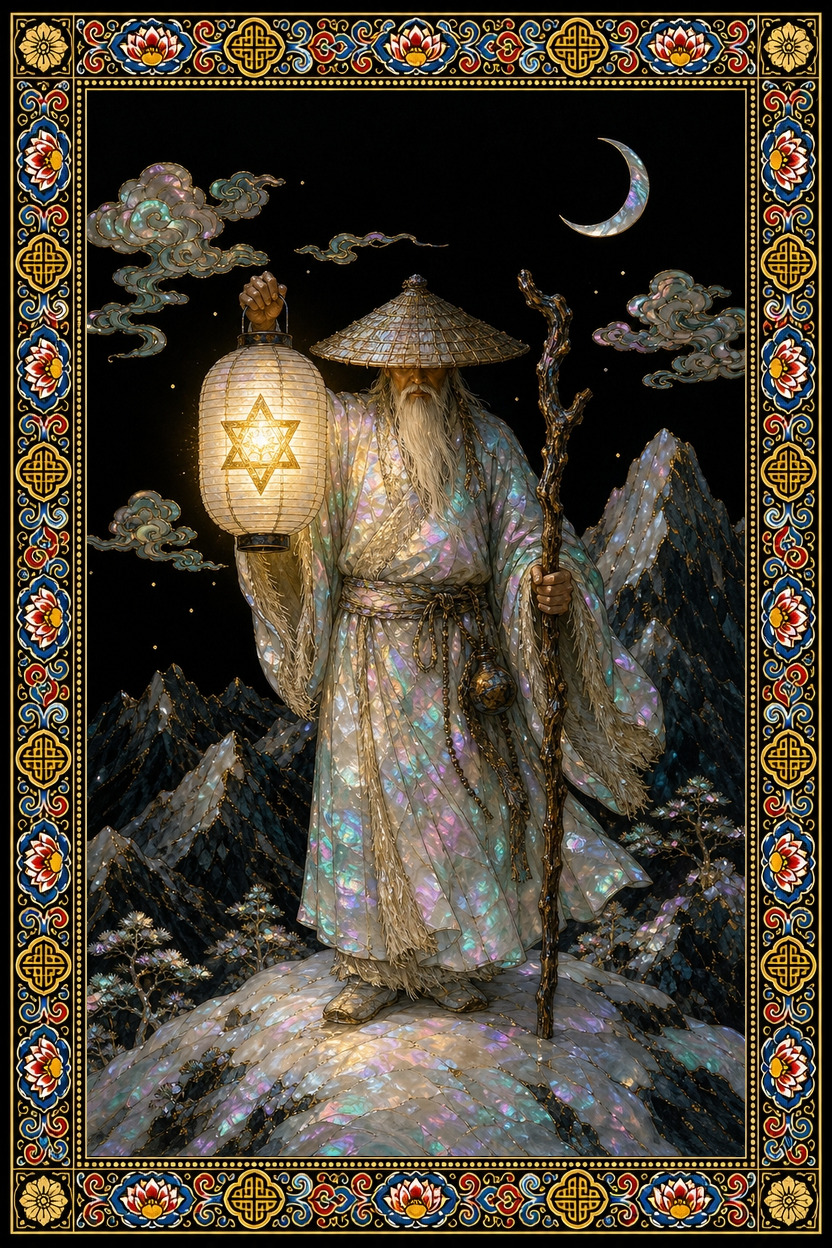
Major Arcana · The Hermit
The Hermit — An Old Man on a Rocky Mountain with a Single Lantern
Why does the old man standing alone on the mountain hold up a lantern that lights not the path ahead but the space around him? This essay follows the Hermit's visual elements one by one and asks how reflection and isolation part ways.
『The Hermit』 — what this card actually draws
The first thing your eye goes to is the crescent moon at the top of the image. Beneath a sky scattered with clouds, a white-haired old man in a satgat (a conical straw hat) stands on a nacre-toned rocky mountain. The mountain is drawn as layers stacked upward from his feet, letting you guess how far up he has come.
In one hand the old man holds a lantern, and inside the lantern a six-pointed star is drawn. In the other hand he grips a staff with a crooked end. The lantern tilts not toward lighting the road ahead but toward his own face and the ground at his feet.
There is no one in the frame but the old man. The picture does not decide what he is looking at or where he is headed. That silence is the card's first impression.
Symbols and meaning
The six-pointed star inside the lantern means a light kindled within oneself. It is not an answer handed over by someone outside but an answer found by questioning yourself. The crooked staff reads as the support that holds up that search.
Upright, this card points to a time of quietly stepping back to think. The altitude on the mountain is distance from others, and that distance is what lets certain sounds be heard. Being alone is not the goal but the process of sorting things out.
Reversed, the same picture wears a different face. When the lantern lights only itself, your field of view narrows, and if you never come down from the mountain, the path disappears. The core of the reversed card is withdrawal hardening into avoidance until direction is lost.
When this card appears
At work it reads as a period for organizing and deliberating rather than displaying results outward. Meetings and reviews may run long, so it helps to set your own deadline for reaching a conclusion.
In relationships the theme is regulating distance rather than how much you say. Stepping back briefly to settle your heart is fine, but if you avoid by cutting off contact, the other person has no way to know why.
With money, checking your current situation suits better than big spending. Before a choice, write down your own criteria first, before gathering other people's answers. Saying something like "I need a little time to sort things out on my own; let's talk again next week" — with a deadline attached — is this card's way.
History and culture: card printing — woodblock, stencil, lithograph
The Hermit's lantern is a good specimen for talking about printing technique. In fifteenth-century woodblock cards, a small lantern like this took its shape from lines carved into the block, with colour added by stencil. Narrow areas such as the star shape and the lantern's rim had to be filled in by hand so the colour would not bleed.
As cards began to be printed in large quantities in eighteenth-century France, the lines grew finer and more regular. Once the practice of re-carving a block to print many sheets at once took hold, details like the lantern stayed identical from card to card.
Nineteenth-century lithography and chromolithography changed the conditions of colouring. By transferring lines drawn directly on stone and layering colours on top, shading such as the texture of the rocky mountain or the glow of the lantern could be expressed more softly than before. The contrast between the dark mountain and the bright lantern that we see in the Hermit today also rests on these printing conditions.
Common misreadings
Some people conclude that when the Hermit appears they should avoid others. But the old man in the picture is not turned away and hiding; he stands holding a lantern, examining something. Withdrawal is observation, not escape.
It is also common to read the reversed card as a confirmed sign of loneliness. Reversed indicates a state; it does not decide the ending. If you are isolated right now, noticing that is itself a starting point.
Be careful, too, of the view that romanticizes time alone as wisdom. A lantern is darkest when it lights only itself, so sometimes the next scene of this card is coming down from the mountain and speaking to someone.
Draw a card yourself
The picture you have just read can be placed against your own question. The same card answers differently when the question changes.
- A deck drawn in-house — 78 cards in the colours of nacre and dancheong
- Readings that read the picture, not a keyword list
- Keep asking — draw one more card for your next question
- A record you can return to and compare
- Let a friend draw for you with a single link
- Seventeen languages, one deck, one reading
More from this suit
