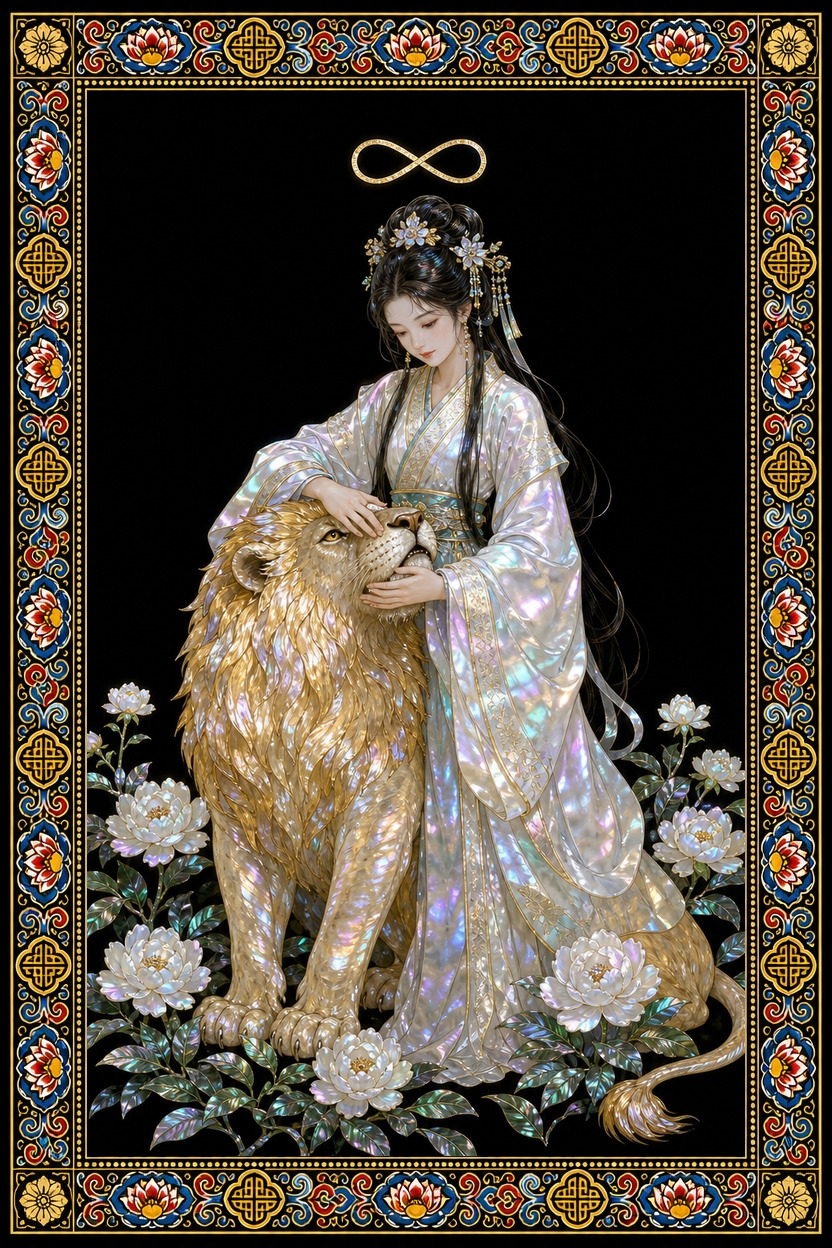
Major Arcana · Strength
Strength: The Woman, the Lion, and the Ring of Light
What does it take to lay a hand on a lion's mouth—the strength of an arm, or the calm of a hand? This piece follows the imagery of 『Strength』 with the eye and tries to answer that question.
『Strength』 — what this card actually draws
The eye goes first to the point where the woman and the lion meet. A woman in a white long robe, without lowering her body, rests her hand on the muzzle of a golden lion. The hand is not pressing down with force; it looks closer to resting on the surface.
Lifting your gaze, you see the flowers in her hair, and above them a slender ring of light floating in the air. The ring sits a little away from her head, so it reads less as a crown she wears than as light that lingers in that place.
Finally, at her feet, white peonies crowd the frame. The figure, the lion, and the flowers each occupy a different height within the same picture, creating a flow of gaze that runs from bottom to top.
Symbols and meaning
In this image, strength is not shown as an act of pressing down. Even with her hand on the lion's muzzle—the most dangerous part—the woman's posture does not waver. So the upright card reads as persistence in a state of released force: patience and courage.
The ring of light above her head looks like a marker for the place where emotion is governed. That the ring floats above her head suggests this governance is not yet something held in the hand but a stage of watching over. The keyword compassion comes from here as well, because this is an attitude that keeps the lion close rather than driving it off as a monster.
Reversed, the same image is lit from the other side. Force enters the hand and tries to hold the muzzle down, or, conversely, the hand cannot let go and grows impatient. Self-doubt and raw emotion are drawn as the state that appears when balance is lost at this point of contact.
When this card appears
At work, this is a phase where holding steady serves you better than pushing. Even if results come slowly, try keeping to your present approach. In relationships, a tone that tries to overpower the other person only creates distance. A gentle tone actually travels further.
With money, a hasty judgment can enlarge your losses. Putting off a big decision and keeping things as they are is also a choice. When you face a decision, write down your most urgent feeling and your calmest feeling side by side.
In a reading, it might come out as a sentence like this: "What you need now isn't to pull harder, but to keep your hand there and wait."
History and culture: French fortune-telling and the occult rearrangement
The woman-and-lion motif on this card is an old piece of iconography, but its meaning was rearranged in eighteenth- and nineteenth-century France when cards were reorganized as a divination tool. In decks of the Etteilla line this image remained a picture of a virtue, and in card use around the time of Mademoiselle Lenormand, symbols were interpreted over existing images rather than newly invented.
The interesting point is the ring of light above the head. In the current that runs through Éliphas Lévi to the Golden Dawn, this kind of marker above the figure was read in connection with the worlds of the Kabbalah and the planets of astrology. Still, this connection is not a layer that was originally in the picture but one added later.
So when you look at this card, I suggest separating the two layers. There is the original layer of the hand and the lion, and the added layer of the ring of light and the planetary correspondences. Laid over each other, the two layers let the picture be read in far more depth.
Common misreadings
A common misreading is the idea that this card is about bending a situation to your will through sheer determination. But the hand in the picture is not a pressing hand; it is a hand that touches. The strength this card speaks of is not overwhelm but endurance.
Another is the reading that reversed means failure. Reversed only shines a light on a moment of being swept up by emotion or growing impatient; it does not fix the outcome. It is enough to use it as a signal to notice where balance is wavering.
Finally, there is the habit of seeing the lion only as a beast to be tamed. In this picture the lion is drawn not as something to eliminate but as a being you keep close and face. Emotions are the same: something to work with, not something to remove.
Draw a card yourself
The picture you have just read can be placed against your own question. The same card answers differently when the question changes.
- A deck drawn in-house — 78 cards in the colours of nacre and dancheong
- Readings that read the picture, not a keyword list
- Keep asking — draw one more card for your next question
- A record you can return to and compare
- Let a friend draw for you with a single link
- Seventeen languages, one deck, one reading
More from this suit
